Your spouse has just died, the house is still in their name, and the children are already asking who gets what. That's the moment when North Carolina intestacy law stops being an abstract topic and becomes a very real family issue. In a state without a will, the answer usually isn't “the spouse gets everything” or “the children split everything,” it's a statutory formula that changes based on who survived the decedent and what kind of property is involved.
That formula is why nc intestate succession spouse and children shares causes so much confusion. North Carolina uses one set of rules for real property and another for personal property, and the spouse's share changes again depending on whether there's one child or two or more children. Add blended families, adopted children, and probate paperwork, and it's easy to see why families feel caught off guard.
When a Spouse Dies Without a Will in North Carolina
A North Carolina widow or widower often starts with one practical question. “Do I get the house, or do the children own part of it too?” The answer depends on the family makeup and the type of property involved, because North Carolina intestacy law applies a set formula instead of a one-size-fits-all result. If there are children, the surviving spouse may receive a share while the children receive the rest, and that can leave everyone sharing title.
That is where the confusion usually starts. People expect the surviving spouse to receive everything, but the statute separates real estate, personal property, and the number of children before it assigns shares. A house, a checking account, a vehicle, and household goods do not all follow the same rule.
A simple example helps. If a home is titled only in the deceased spouse's name and there are children, the surviving spouse may inherit part of that home while the children inherit the remainder. If there is also personal property, such as money in accounts or furniture in the house, the spouse's share is measured under a different rule, so the final result can look uneven even within the same estate.
This is why families often need to slow down and sort the estate by category. The first question is who survived the decedent, a spouse, children, or descendants of deceased children. The next question is whether the asset is real property or personal property. Only after that do the Chapter 29 numbers make sense.
For a worried spouse, the key point is that the statute does not ask what feels fair in the abstract. It asks who is in the family tree and what kind of property is being divided. Once those facts are clear, the shares can be calculated with much more confidence.
How North Carolina's Intestacy Statute Works
Intestate succession means the state decides who inherits because there's no valid will. In North Carolina, that system is set out in Chapter 29 of the General Statutes, and it does not split every asset the same way just because a spouse and children are both in the picture. The statute gives the surviving spouse a protected share, then divides the remaining property among the children or, if a child has already died, that child's descendants.
For real property, the rule turns on how many children are in the family line. If there is one child or descendants of one deceased child, the spouse takes one-half of the property. If there are two or more children or descendants of deceased children, the spouse takes one-third of the property. The children take the rest as co-owners, so a house may end up owned by the spouse and children together instead of passing to one person outright. That can feel counterintuitive, especially if the house is the main asset and everyone assumes one person will keep it.
A concrete example helps. If a home is worth $300,000 and there is one child, the spouse's real-property share is $150,000 in value, and the child's share is the other $150,000. If there are two children, the spouse's share is $100,000 and the children together receive $200,000, usually as shared ownership interests unless the estate is later divided or sold. The statutory fraction matters more than the emotional expectation.
For personal property, the statute uses a dollar threshold. With one child, the spouse gets all personal property if the net personal property is $60,000 or less. If it is above that amount, the spouse gets $60,000 plus one-half of the balance. With two or more children, the spouse still gets all personal property up to $60,000, but above that threshold the spouse gets $60,000 plus one-third of the balance. The children receive the remainder.
Here is the same rule with numbers. If the estate has $90,000 in net personal property and there is one child, the spouse gets $60,000, then one-half of the remaining $30,000, which is $15,000, for a total of $75,000. The child receives the other $15,000. If there are two children, the spouse still gets $60,000, then one-third of the remaining $30,000, which is $10,000, for a total of $70,000. The children split the remaining $20,000.
Practical rule: the spouse is protected first in the first $60,000 of personal property, and then the children's share becomes more significant as the estate grows.
The 2013 elective-share rules add another layer in blended-family cases. That election can change how much a surviving spouse may claim from the estate, especially when the will or intestacy result would leave the spouse with less than the law allows in some circumstances. For families with children from more than one relationship, that can change the final numbers after the intestacy calculation is already done.
Once you sort the estate by category and count the children, the Chapter 29 math becomes much easier to apply.
The Four Common Family Scenarios Under NC Intestate Succession
Surviving spouse with no children
If the decedent leaves a spouse and no children, the spouse usually has the broadest inheritance position under intestacy. In a simple family with no descendants, the statute is designed to keep the estate from being split with children who are not there. That doesn't mean every asset avoids probate, but it does mean the spouse is the primary heir in the spouse-and-no-children setting.
This is the scenario many people assume applies in every case. It does not. The moment children exist, the formula changes, and the spouse may receive only part of the estate.
Surviving spouse with children who are also the spouse's children
When the decedent and surviving spouse share the same children, North Carolina still does not treat the estate as a clean marital half-and-half arrangement. The spouse's personal property share starts with the $60,000 protection, then the remainder is split under the statutory fraction. Real property is divided by the child-count rule, so the spouse can own a portion of the home and the children own the rest.
Families often expect a surviving parent to remain in exclusive control of the house. The statute doesn't automatically work that way. It creates shared ownership, which is why title, sale decisions, and later administration can get complicated.
Surviving spouse with children from a prior relationship
Families feel the tension most sharply here. If some of the children are not the surviving spouse's children, the spouse still receives the statutory share, but the children from the decedent's side take the rest under the intestacy formula. The law does not pause because the family is blended. It applies the same child-count structure and leaves the adults to sort out the result.
Stepchildren are different. If a child was never legally adopted, that child generally does not inherit through intestacy just because the family functioned like a parent-child unit.
No surviving spouse, children survive
If there's no surviving spouse, the children inherit the estate. That result is often straightforward, but it still matters whether a child has died before the decedent, because that child's descendants may step into the share the law gives through representation. The key point is that the spouse is out of the picture, so the children's share is no longer reduced by the spouse's statutory protection.
Worked Examples of NC Spouse and Children Share Calculations
Take a modest estate with $90,000 in net personal property and a house. If there is one child, the spouse gets the first $60,000 of personal property. That leaves $30,000, and the spouse gets one-half of the balance, so $15,000 more. The child gets the remaining $15,000 of personal property. For the property, the spouse takes one-half, and the child takes the other half.
Now change only one fact. If the decedent has two children, the spouse still gets the first $60,000 of personal property. The remaining $30,000 is split at one-third to the spouse and two-thirds to the children. That means the spouse gets $10,000 more and the children split $20,000. The house is also divided differently, because the spouse now takes one-third of the property and the children share the remaining two-thirds.
Here's a blended-family example. Suppose a couple owns a home and the decedent leaves a surviving spouse plus children from a prior relationship. The spouse still gets the statutory share of the property, but the children also own part of the house. If the personal property exceeds $60,000, the spouse's share depends on whether the decedent had one child or two or more children, and the rest goes to the children.
Bottom line: the statute doesn't give the spouse a free pass on the house, and it doesn't give the children everything either. It creates shared ownership and fixed-dollar protection at the same time.
That's why families should calculate each asset class separately. The home is one calculation. The personal property is another.
Exceptions That Catch North Carolina Families Off Guard
North Carolina law is strict about legal family status. Adopted children generally inherit like biological children, but stepchildren who were never legally adopted usually do not inherit under intestacy. That distinction surprises families because daily life and legal inheritance do not always line up.
The same issue comes up with descendants of a deceased child. If a child has already died, that child's descendants can step into the share the statute gives their parent line, which is one reason grandparents sometimes see grandchildren inherit in place of a deceased parent. North Carolina also uses the 120-hour survivorship rule, which helps prevent a close-time-of-death situation from sending property to the wrong person when survivorship is unclear. For blended-family planning, the elective-share discussion in North Carolina Spousal Elective Share NC Estate matters because the marriage-duration formula can change what a surviving spouse can claim outside intestacy.
Unmarried partners are another common trap. Intestacy doesn't treat a long-term partner like a spouse, so the legal relationship matters more than the length of the relationship. That's why a will, trust, or beneficiary designation usually becomes the only reliable way to protect a non-spouse.
What Happens in Probate When There Is No Will
Without a will, the family usually has to open an estate case with the clerk of superior court. Someone has to be appointed to manage the estate, collect assets, pay debts, and distribute property under the statute. In many families, the surviving spouse has priority to serve, then adult children, then other relatives if needed.
That person is the administrator, not an executor, because there is no will naming an executor. The administrator gathers information, files the necessary papers, and works through the estate until the property can be distributed according to law. When the estate includes land, the process can become especially sensitive because the property may have to be held or sold with multiple heirs involved.
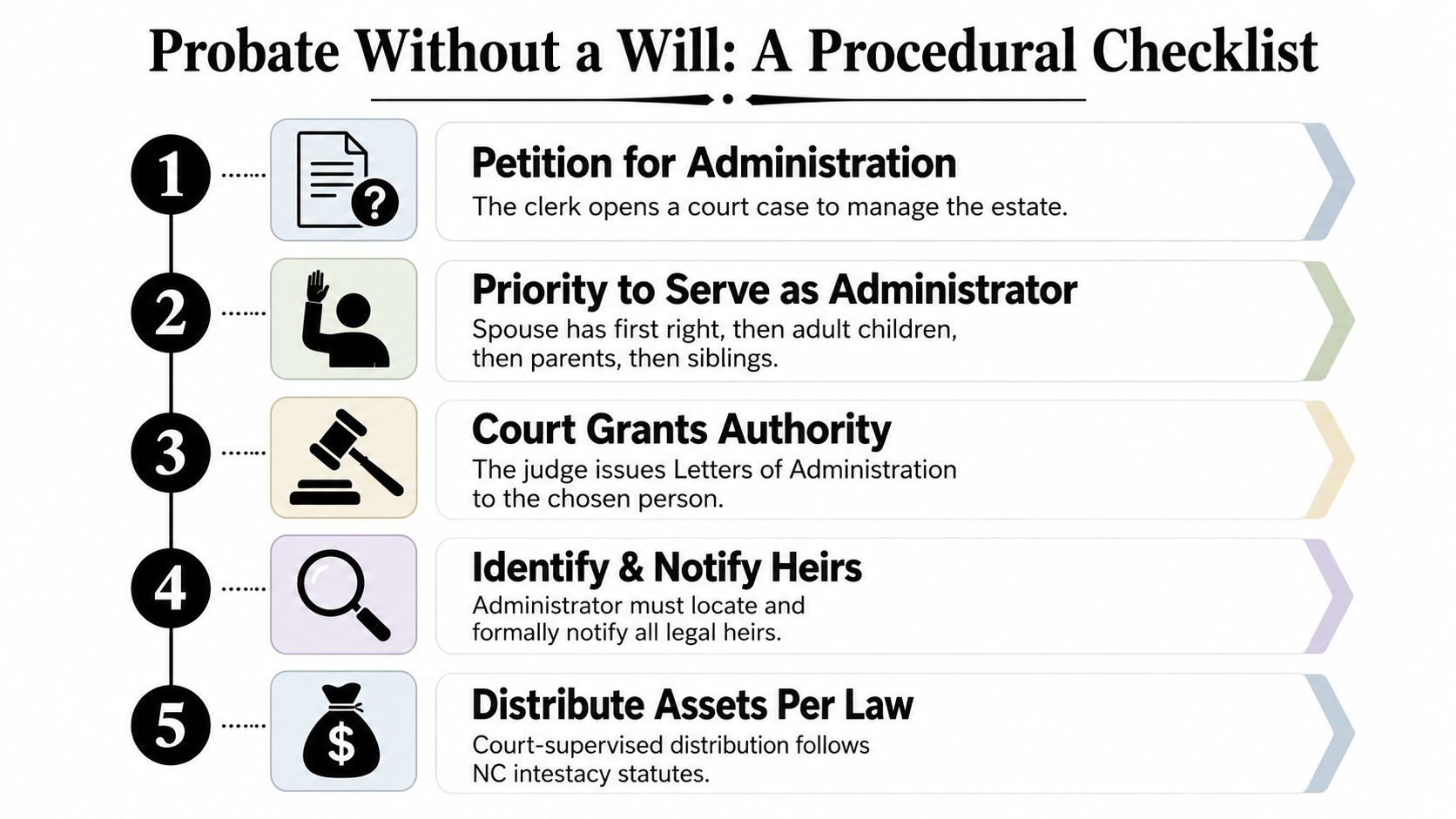
The clerk-controlled process is one reason families often feel probate takes longer and costs more when there's no will. If you want a plain-English overview of that process, see North Carolina Probate Process.
A practical first month usually includes a short list of tasks:
- Secure the home and valuables: Change access where appropriate and make sure nothing disappears.
- Collect account records: Bank statements, deeds, insurance papers, and retirement information matter quickly.
- Identify heirs: The administrator needs a clear family picture before distribution starts.
- Keep payments current: Utilities, mortgage, and insurance can't be ignored while probate is pending.
- Speak with counsel early: Small mistakes in appointment or asset handling can create bigger problems later.
Frequently Asked Questions About NC Intestate Succession
Does a surviving spouse get the whole estate if there are adult children?
Not automatically. If children survive, the spouse gets the statutory share and the children get the rest under North Carolina's formula. The result depends on whether there's one child or two or more children, and whether the property is real or personal.
Can the surviving spouse buy out the children's share of the house?
Often, yes, if the heirs agree and the title issue is handled correctly. The statute creates co-ownership, but families can sometimes reach a buyout or sale arrangement instead of keeping the property jointly.
What happens if my partner dies and we were never married?
Unmarried partners generally do not inherit through intestacy in North Carolina. If there's no will or beneficiary designation, the law usually looks to legal heirs, not long-term partners.
Can intestate shares be redirected into a trust?
Only through a valid estate plan or, in some cases, by agreement after death. Intestacy itself doesn't create a trust for you. It only tells the estate who gets what by default.
Protecting Your Family With a Plan That Reflects Your Wishes
Intestacy is a fallback system, not a personalized plan. It can work for simple family structures, but it's a poor fit for blended families, second marriages, and estates with meaningful real property or personal property. If you want your spouse, children, stepchildren, or someone else to inherit in a specific way, a will or trust gives you that control, and How to Avoid Probate in North Carolina explains why many families try to keep those assets out of court.
Law Office of Bryan Fagan helps North Carolina residents sort through estate planning and probate questions with clear, practical guidance. If you're trying to understand how the statute treats your spouse and children, schedule a consultation and get advice suited to your family, your property, and your goals.
If you're facing a North Carolina probate issue or want to make a will that avoids these default shares, the Law Office of Bryan Fagan can help you think through the right next step. Visit Law Office of Bryan Fagan to schedule a consultation and talk through your family's situation with a North Carolina-focused attorney.