You're looking at a mortgage, several credit-card statements, and perhaps a student loan that exists in only one spouse's name. Separation may have stopped the household, but it didn't stop the bills. The difficult question in North Carolina isn't, “Who owes what?” It's whether each liability is marital, separate, or divisible debt, what amount belongs in the marital estate, and how a fair distribution should address it.
North Carolina doesn't use community-property rules that automatically divide every marital obligation equally. The court must examine the debt's timing, purpose, balance, and relationship to the marriage. A careful marital debt classification NC equitable distribution analysis can affect both the final judgment and your financial exposure after the divorce.
Navigating Debt Division in a North Carolina Divorce
A couple separates with a mortgage on the family home, credit-card balances for groceries and repairs, a personal loan in one spouse's name, and student loans incurred during the marriage. The account holder does not settle the classification question. A card held by one spouse may have paid household expenses, while a jointly signed loan may have financed a personal venture.
North Carolina requires the court to identify and classify property and debt before distributing the marital estate. The statutory scheme appears in Chapter 50 of the North Carolina General Statutes. Equitable distribution then involves classification, valuation, and distribution of the marital and divisible estate. A North Carolina equitable distribution overview can provide context, but debt classification still depends on evidence for each account.
Practical rule: “Equitable” does not mean every bill is divided equally. It means the court applies North Carolina law to the evidence and assigns responsibility fairly.
The separation date sets an important boundary. Debt incurred during the marriage and before separation may qualify as marital debt, but the spouse seeking that result must prove its timing, purpose, and joint benefit. Debt incurred after separation usually requires a separate analysis. A post-separation increase, payment, or reduction connected to an existing marital obligation may fall within the often-missed category of divisible debt, rather than disappearing from the distribution calculation.
That distinction can change the result. A spouse who focuses only on account names may miss divisible debt or claim that a personal liability benefited the household without records to support it. Statements, loan applications, payment histories, and proof of how borrowed funds were used can determine whether the court shares the obligation.
The financial stress is real. One spouse may fear responsibility for debt created by the other, while the other may worry that paying bills alone will receive no credit. Both concerns require a fact-specific review, not an automatic promise of a 50/50 split.
The Three-Step Equitable Distribution Process
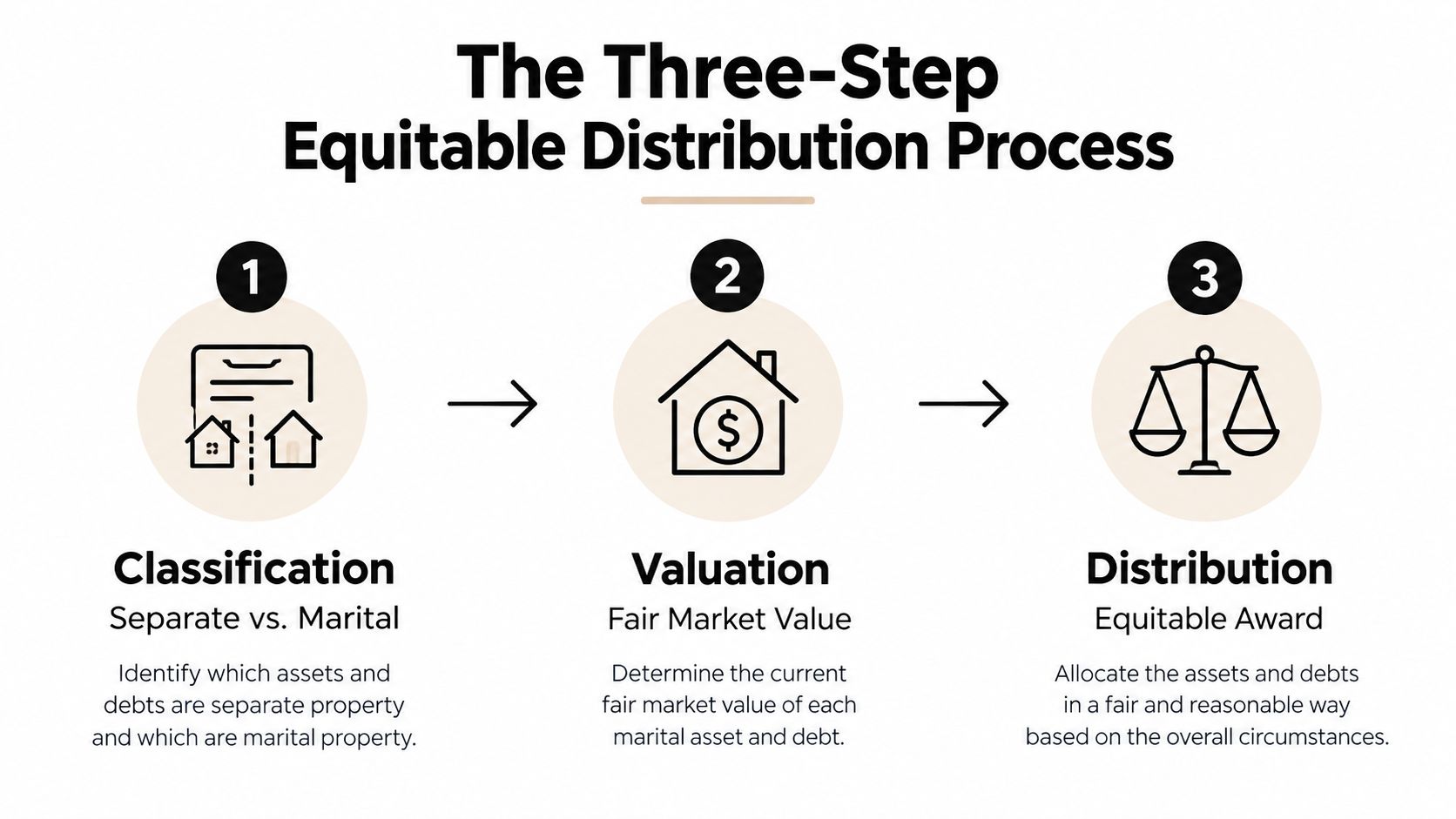
A credit-card balance can look simple on a spreadsheet and still produce a difficult dispute. Before assigning responsibility for a mortgage, loan, or card account, a North Carolina court follows three steps: classification, valuation, and distribution. The order matters. A judge must first identify the debt's legal category, then determine the amount subject to division, and only afterward decide how to allocate it.
Step one: classification
The first question is whether the liability is marital, separate, or divisible. Marital debt generally arose during the marriage and before separation for the spouses' joint benefit. Separate debt belongs to one spouse because it predates the marriage, arose after separation, or has no provable marital purpose. Divisible debt covers qualifying post-separation changes connected to a marital obligation.
Classification is often the point at which an unrepresented spouse loses money. An account opened during the marriage does not automatically become marital debt, and an account opened in one spouse's name is not automatically separate. The spouse asking the court to include or share the liability must support the requested classification with records showing when the debt arose, how the funds were used, and who benefited.
Step two: valuation
The court next identifies the amount to be included. Marital debt is generally measured as of the date of separation, so that balance remains important even if the account stays open or payments continue afterward.
Divisible debt follows a different valuation rule. Under G.S. 50-21, divisible property and divisible debt are valued as of the date of distribution. Qualifying passive increases or decreases may include interest, financing charges, or other changes tied to marital debt. Active post-separation borrowing or new purchases require separate analysis.
Step three: distribution
After classification and valuation, the court distributes the estate equitably. The analysis may consider the related asset, each spouse's financial circumstances, post-separation payments, and other statutory factors. Equal division is not automatic, and responsibility for a debt owed to a creditor can remain different from the allocation ordered between spouses.
For additional background on the property side of this process, Equitable Distribution of Property in North Carolina explains how North Carolina applies equitable distribution rather than community-property rules.
Build the evidence around a timeline: account opening, each major charge or advance, use of the funds, balance at separation, and every later increase or payment. That record is often what separates a divisible-debt claim from an unsupported assertion.
Marital vs Separate vs Divisible Debt Explained
North Carolina's three debt categories answer different legal questions. Marital debt asks whether the obligation arose during the marriage and before separation for the parties' joint benefit. Separate debt asks whether the obligation belongs to one spouse alone. Divisible debt addresses certain changes occurring after separation, rather than treating every later balance change as a new marital obligation.
The 1997 amendment to North Carolina's equitable distribution statute created divisible property and divisible debt, changing how qualifying post-separation changes are handled. The classification date and valuation date can therefore differ. A principal balance may be tied to separation, while later passive interest or financing charges may be considered through divisible-debt rules.
| Debt Category | When Incurred | Valuation Date | Common Examples |
|---|---|---|---|
| Marital debt | During marriage and before separation, for joint benefit | Generally the date of separation | Household credit-card charges, a family mortgage, or a loan used for marital purposes |
| Separate debt | Before marriage, after separation, or during marriage without a provable joint benefit | Determined under its separate legal treatment | A pre-marriage car loan or personal borrowing unrelated to the marriage |
| Divisible debt | Qualifying passive increases or decreases connected to marital debt after separation | Date of distribution | Interest or financing charges associated with an existing marital liability |
A pre-marriage vehicle loan normally remains the borrowing spouse's separate obligation. A credit-card account opened in one spouse's name during the marriage isn't automatically separate, because account ownership doesn't answer how the funds were used. Conversely, a debt incurred during the marriage isn't automatically marital merely because it falls within the correct time period.
The divisible category is where many people lose sight of the timeline. If a marital credit-card balance continues to generate interest after separation, the later increase may require separate treatment rather than being folded into the original marital balance. The same issue can arise with mortgages and personal lines of credit.
North Carolina courts have also recognized that a debt incurred after separation to pay off an existing marital debt can, in specific circumstances, still be classified as marital debt. That result depends on the facts and the connection between the later obligation and the original marital liability. A focused discussion of this post-separation category appears in North Carolina divisible property and equitable distribution analysis.
Proving Joint Benefit and Valuing Liabilities
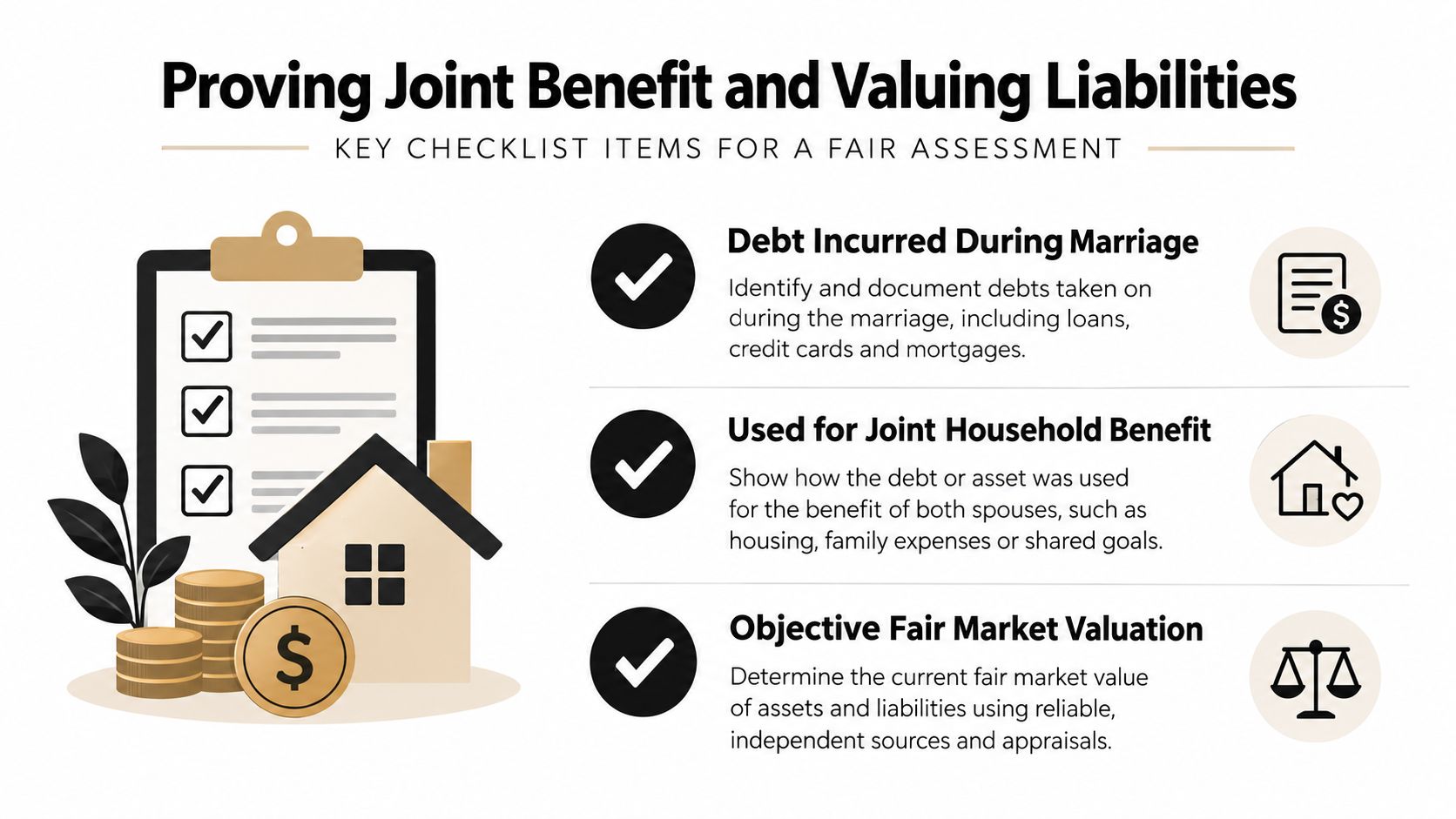
The most important practical point is simple: marital debt isn't presumed automatically. The spouse seeking classification must prove that the debt was incurred during the marriage and before separation, establish the amount owed at separation, and show that the liability was incurred for the joint benefit of the parties. UNC School of Government materials explain this burden directly in their treatment of the marital-property presumption and marital debt.
“Joint benefit” doesn't require both spouses to have personally used every dollar. A charge for household repairs, family housing, or shared living expenses may support marital classification even if one spouse made the purchase. North Carolina case law has also recognized that a tangible benefit isn't necessarily required in every situation. The evidence must still connect the obligation to the marriage and support the legal finding of joint benefit.
Evidence that makes the difference
A court needs more than a spreadsheet with account names and current balances. Useful records may include:
- Account statements: Trace charges and payments around the relevant period.
- Bank records: Show whether borrowed funds entered a joint account or paid household expenses.
- Tax documents: Joint returns and supporting records may help explain the purpose of a liability.
- Invoices and receipts: Home improvements, medical care, tuition, and family expenses can establish use.
- Loan applications: The stated purpose and funding records may clarify whether borrowing served a marital or personal objective.
- Communications: Messages discussing a purchase, repayment, or household need may help establish context.
The separation-date balance must be proven with precision. A current statement may include post-separation interest, fees, payments, and new charges. Using that statement without reconstructing the earlier balance can mix marital and divisible amounts.
Build the financial record early
Start by downloading statements rather than relying on online access that may later disappear. Create a separate entry for each liability showing the creditor, account holder, opening date, purpose, balance near separation, payments afterward, and current status. For a formal discovery process and financial documentation, North Carolina divorce discovery and financial affidavits can provide context about the records commonly requested in family-law litigation.
A divorce filing and its residency and procedural requirements are separate from debt classification. How to File for Absolute Divorce in North Carolina addresses those filing issues, while equitable distribution requires its own evidence and legal analysis.
Real-World Scenarios and Common Misconceptions
A student loan taken during the marriage illustrates why timing alone doesn't decide classification. If one spouse borrowed for education, the other spouse may argue that the loan supported the marriage through shared finances or household planning. The borrower may respond that the debt served only a personal objective. North Carolina's analysis focuses on proof of joint benefit, and the law doesn't require the parties to show that both spouses received the same direct advantage.
Business debt creates a similar problem. A loan in one spouse's name may have paid expenses for a business that supported the household, or it may have funded a venture kept separate from the marriage. The relevant records may include business statements, deposits, invoices, tax filings, and evidence showing where the borrowed money went. The account title is only one fact among many.
Post-separation credit-card interest requires a timeline rather than a conclusion. The original qualifying balance may be marital debt valued at separation, while passive interest and financing charges afterward may fall within divisible debt. New purchases made after separation generally require their own classification analysis, particularly where the other spouse disputes any connection to the marriage.
A balance is not a single legal number. It may contain a separation-date principal amount, later passive charges, payments, and new transactions that must be separated.
Several common assumptions create avoidable disputes:
- “The account is only in my spouse's name, so it's automatically separate.” North Carolina looks at purpose and joint benefit, not only the name printed on the statement.
- “Every debt from the marriage is automatically shared.” The spouse claiming marital classification must prove the required elements.
- “I paid the bill after separation, so I automatically receive a dollar-for-dollar credit.” Post-separation payments may matter, but the resulting distribution depends on the debt's classification, the associated asset, and the complete equitable-distribution analysis.
- “A student loan can never be marital.” That conclusion is too broad. The facts and evidence determine whether the joint-benefit requirement is met.
- “A debt that appears after separation is irrelevant.” A later obligation may still require analysis if it paid or refinanced an existing marital debt, while passive changes may be addressed as divisible debt.
The strongest position usually comes from tracing funds, preserving statements, and identifying the precise argument before negotiations begin.
Negotiation Strategies and Creditor Implications
A divorce judgment can allocate responsibility between spouses, but it doesn't rewrite a contract with a bank, mortgage company, or credit-card issuer. If both spouses signed the original agreement, the creditor may still pursue either signer when payments are missed. The spouse ordered to pay may owe reimbursement to the other spouse, but that internal remedy doesn't necessarily protect the other signer's credit or release them from the creditor's contract.

That risk should shape settlement discussions from the beginning. Assigning a joint credit card to one spouse without a realistic payment plan may produce a clean-looking order but leave the other spouse exposed. A negotiated solution should address both the allocation between spouses and the practical relationship with the creditor.
Structures that reduce future exposure
Refinancing or assumption may be appropriate for a joint mortgage or vehicle loan if the responsible spouse can qualify. The goal is to remove the other spouse from the account, not merely promise that payments will be made.
Closing or freezing joint credit lines can prevent new charges from complicating the separation-date analysis. Account changes should be coordinated carefully so they don't create missed payments or violate an existing agreement.
Indemnification language can require the spouse assigned a debt to reimburse the other for payments, collection costs, or losses caused by default. This doesn't bind the creditor, but it can create an enforceable remedy between the spouses if drafted properly.
A settlement may also require proof of payment, deadlines for refinancing, sale of an associated asset, or a procedure for resolving disputed charges. The more specific the order or agreement, the easier it is to identify a breach and pursue enforcement.
Do not measure a debt settlement only by who is assigned the balance. Ask whether your name will actually come off the account and what happens if your former spouse stops paying.
Keep checking accounts and credit reports during the transition. If a jointly held debt remains open, missed payments can affect both parties even when one person has moved out and stopped using the account.
Frequently Asked Questions and Next Steps
How are tax liabilities classified in a North Carolina divorce?
Tax debt requires careful review of the underlying return, assessment, payment history, and any agreement with the taxing authority. A state-court allocation between spouses may not change the taxing authority's rights under the original filing or liability. Gather returns, notices, payment records, and correspondence before proposing an allocation.
What happens if I discover secret debt after separation?
The key questions are when the debt was incurred, how the funds were used, and whether the marriage received a joint benefit. Discovery tools may help identify undisclosed accounts and trace proceeds. A debt that lacks a provable marital purpose may be argued as separate, but the correct treatment depends on the evidence and procedural posture of the case.
Can bankruptcy change equitable distribution?
Bankruptcy and equitable distribution interact in complicated ways. Bankruptcy may affect collection, dischargeability, or the enforcement of obligations, but it doesn't eliminate the need to classify and value the debt under North Carolina law. Consult family-law and bankruptcy counsel before transferring property, agreeing to an allocation, or filing bankruptcy during a pending divorce.
Should I wait until the divorce is final to address debt?
Waiting can make records harder to obtain and allow interest, fees, or new charges to complicate the analysis. Preserve statements, separate new spending from existing balances, and obtain legal advice before signing a property-settlement agreement.
North Carolina residents facing marital debt classification should bring a complete debt inventory to a consultation. The Law Office of Bryan Fagan offers North Carolina-focused representation for divorce, equitable distribution, and related family-law disputes, including strategic review of financial records and creditor risks. Schedule a consultation through Law Office of Bryan Fagan to evaluate your liabilities and develop a plan grounded in the facts of your case.