You've just learned that your spouse had an affair, and now you're facing a frightening question: Will the affair eliminate spousal support, or can the unfaithful spouse still ask for money? In North Carolina, the answer depends on more than the fact that someone cheated. The type of support, each spouse's financial role, the date of the conduct, the evidence, and whether the conduct was forgiven can all matter.
North Carolina draws a sharp line between postseparation support and alimony. Many online explanations treat them as the same thing, but they aren't. This guide explains the statutory rule, the meaning of illicit sexual behavior, the timing traps, proof issues, condonation, practical scenarios, and steps to discuss with a lawyer. It won't predict your result, replace legal advice, or address equitable distribution and child custody.
When Infidelity Meets Spousal Support in North Carolina
Consider a common situation. One spouse discovers messages suggesting a relationship that began while the couple was still married. The financially dependent spouse worries that the affair will destroy a claim for support. The other spouse, who earns more, wonders whether the misconduct means support is automatic. Both may also be dealing with temporary bills before a final alimony decision.
That uncertainty exists because North Carolina uses different rules for different forms of support. Illicit sexual behavior can create a mandatory consequence in an alimony case, but the same conduct doesn't automatically eliminate postseparation support. The court must first identify the support being requested and then apply the correct statutory framework.
The key questions usually include:
- Who committed the conduct? The dependent spouse and supporting spouse face different statutory consequences.
- When did it happen? The conduct must fall within the marriage and occur on or before the date of separation for the alimony rule to apply.
- What can be proved? Suspicion, emotional closeness, or a vague admission may not establish the statutory conduct.
- Was it condoned? Forgiveness with knowledge of the conduct can affect whether the court considers it.
- Did both spouses engage in misconduct? If so, the judge may have discretion rather than facing an automatic bar or award.
Practical rule: Don't assume that “cheating ends alimony” answers every support question. In North Carolina, the remedy and timeline come first.
A spouse who's trying to understand the financial roles in the case may also benefit from reviewing Alimony in North Carolina: Dependent and Supporting Spouses, which addresses how those classifications affect an alimony analysis. A consultation is still important because small timeline details can change which rule applies.
How North Carolina Law Defines Illicit Sexual Behavior
North Carolina's alimony statute uses the term illicit sexual behavior, not the word adultery alone. Under N.C. Gen. Stat. § 50-16.1A, the definition includes voluntary sexual or deviate sexual intercourse, deviate sexual acts, and related sexual acts by one spouse with someone other than the other spouse.
In plain language, the statute focuses on voluntary sexual conduct between a married person and a third party. Flirtatious messages or an emotional attachment may be relevant to other issues, but they don't automatically satisfy this specific statutory definition.
The three statutory paths
North Carolina's rule in G.S. 50-16.3A works differently depending on the spouses' roles.
The dependent spouse committed the conduct. A dependent spouse is the person who seeks support because their income and resources aren't sufficient to meet their needs. If that spouse engaged in illicit sexual behavior during the marriage and on or before separation, the court shall not award alimony.
The supporting spouse committed the conduct. A supporting spouse is the person with the ability to provide support. If that spouse engaged in illicit sexual behavior during the marriage and on or before separation, the court shall order alimony to be paid, assuming the dependent spouse otherwise qualifies.
Both spouses committed the conduct. When both engaged in illicit sexual behavior, the statute gives the court discretion to deny or award alimony. The outcome is no longer controlled by the automatic rule applicable to only one spouse's misconduct.
The statute's language makes the result unusually direct. The conduct isn't merely one consideration among many when the required facts are established. It can determine whether an alimony award is legally available.
Role and remedy are separate questions
A person's income alone doesn't settle whether they're dependent or supporting. The court evaluates financial need and ability to pay, among other circumstances. The mandatory bar applies to alimony, not automatically to every form of temporary support.
For additional discussion of how misconduct can affect a support claim, see marital misconduct and alimony in North Carolina. The distinction between alimony and postseparation support deserves separate attention because it often changes the immediate strategy.
Alimony Versus Postseparation Support After an Affair
Postseparation support and alimony serve different purposes. Postseparation support generally addresses immediate financial needs after separation while the case is pending. Alimony is the longer-term support claim decided under the applicable statutory requirements.
North Carolina materials distinguish the strict alimony consequence from the more flexible postseparation support analysis. Illicit sexual behavior by a dependent spouse can bar alimony, while the same conduct doesn't automatically bar postseparation support. The court may consider misconduct in the temporary-support analysis, but it remains part of a broader discretionary evaluation.
| Factor | Postseparation Support (§ 50-16.1A) | Alimony (§ 50-16.3A / § 50-16.5) |
|---|---|---|
| Purpose | Addresses immediate financial need after separation | Provides support under the final alimony analysis |
| Duration | Temporary and connected to the pending separation or divorce process | Can continue according to the terms of the award and applicable law |
| Standard | Need, ability to pay, and relevant circumstances | Eligibility, dependency, ability to pay, statutory factors, and misconduct rules |
| Role of misconduct | May be considered as one factor in the court's discretion | Can create a mandatory bar, mandatory award, or discretionary result |
| Burden of proof | The requesting party must establish the facts supporting temporary relief | The party relying on illicit sexual behavior must prove the statutory facts |
| Practical impact | A dependent spouse may still receive temporary support despite misconduct | A qualifying dependent spouse's misconduct can eliminate alimony |
This means a spouse barred from alimony may still seek postseparation support. Conversely, receiving temporary support doesn't guarantee that the spouse will receive alimony later.
The temporary-support issue can require a different financial presentation, especially when household expenses and immediate income shortages are involved. North Carolina residents can review postseparation support eligibility in North Carolina while gathering the records needed for a case-specific assessment.
A careful lawyer will avoid treating temporary support as a preview of the final result. The two claims may involve overlapping facts, but they answer different legal questions.
Timing, Evidence, and the Condonation Defense
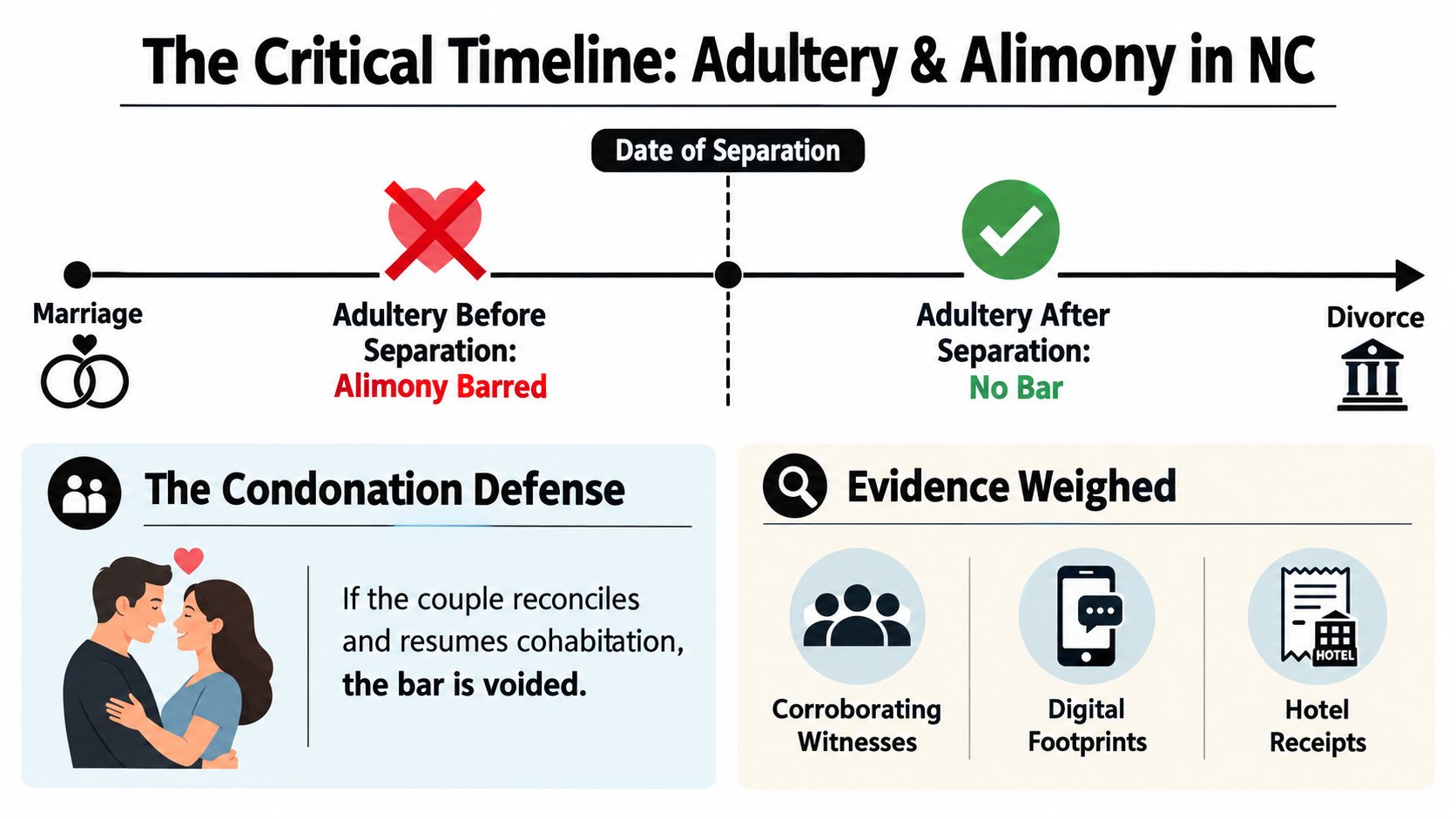
The timing rule is central. For the statutory alimony consequence, the illicit sexual behavior must have occurred during the marriage and on or before the date of separation. Conduct that begins after separation doesn't trigger this particular bar, although it may raise other legal or practical issues.
The date of separation itself can become disputed. A spouse may believe the marriage ended when the couple stopped communicating, began sleeping in separate rooms, or announced the breakup. North Carolina analysis focuses on the legally significant separation facts, including living arrangements and intent. Don't choose or characterize that date casually.
What can prove the conduct
Courts may evaluate direct and circumstantial evidence. Common examples include:
- Corroborating witnesses: A friend, coworker, neighbor, or investigator may provide testimony about relevant events.
- Digital communications: Text messages, emails, social media messages, and account records may help establish inclination or opportunity.
- Travel and transaction records: Hotel receipts, photographs, and financial records can place people together.
- Admissions: Statements by a spouse may matter, but an unsupported confession can present a problem.
- Circumstantial proof: North Carolina cases may use evidence of both romantic or sexual inclination and an opportunity for sexual conduct.
N.C.G.S. § 50-10 contains corroboration requirements that can affect how testimony and admissions are evaluated. A confession without supporting evidence often won't carry the case by itself. The evidence must be preserved lawfully and connected to the required timeline.
The North Carolina State Bar's alimony materials also help explain why postseparation support and alimony shouldn't be collapsed into one question.
Condonation and related defenses
Condonation means forgiveness with knowledge of the misconduct. It may arise when a spouse learns of the affair and then resumes marital relations, continues holding the parties out as a couple, or otherwise acts in a way that supports forgiveness. Shared finances alone may not answer the question, particularly when a spouse remains financially dependent, but the overall conduct can become important.
North Carolina's statute says condoned illicit sexual behavior isn't considered for the statutory consequence. If both spouses engaged in misconduct, recrimination can also become relevant because each side may argue that the other's conduct affects the support claim.
A separate timing trap involves filing. An alimony claim generally must be raised before the absolute divorce is finalized, and the statutory framework includes a one-year deadline to file an alimony claim after divorce. A lawyer should review the pleadings and dates before a party assumes the issue is preserved.
After separation, dating raises its own questions. Read about dating during separation in North Carolina before making public statements or taking steps that could complicate the timeline.
For readers dealing with children as well as support, The North Carolina Custody Process and Mediation addresses how a custody case proceeds, including mandatory custody mediation. Custody and alimony are separate matters, but the same family events can create evidence and communication issues in both.
Real World Scenarios Under the NC Rule
The same word, “affair,” can describe cases with very different legal results. These examples are hypothetical, but they show how role, timing, and forgiveness can change the analysis.
Scenario A, misconduct by the dependent spouse
A financially dependent spouse had a single encounter during the marriage, but the conduct ended long before the couple separated. The supporting spouse knew about it and the couple continued their marital relationship afterward. The dependent spouse later seeks alimony.
The conduct raises the statutory issues of timing and condonation. If the supporting spouse knew and forgave the conduct, the dependent spouse may argue that it was condoned. The court must examine the surrounding facts rather than treating the old affair as an automatic result.
Even without condonation, the legal analysis still requires proof that the conduct fits the statutory definition and occurred before or on separation. The court can't decide the issue based on a label alone.
Scenario B, misconduct by the supporting spouse
A higher-earning spouse maintained a relationship that ended only shortly before the parties separated. The other spouse is financially dependent and seeks support.
If the evidence establishes illicit sexual behavior during the marriage and before separation, the supporting spouse's conduct can trigger the statutory requirement that alimony be paid. The dependent spouse may still need to establish the other elements of an alimony claim, but the misconduct rule operates in the dependent spouse's favor.
The temporary-support question remains distinct. Even if long-term alimony is disputed, the dependent spouse may seek postseparation support while the case proceeds.
Scenario C, misconduct by both spouses
Both spouses had relationships during the marriage. One spouse discovered the other's conduct, continued the marriage for a period, and later relied on the affair in an alimony dispute. The other spouse responds that the conduct was forgiven and points to the first spouse's own misconduct.
Now condonation, timing, proof, and recrimination may collide. The judge may have discretion because both spouses engaged in qualifying conduct, but the court still needs to determine what happened, when it happened, and what each spouse knew.
A timeline can be more important than the emotional intensity of the affair. Write down when the relationship began, when it ended, when it was discovered, and what happened afterward.
Practical Steps If You Are Facing This Issue
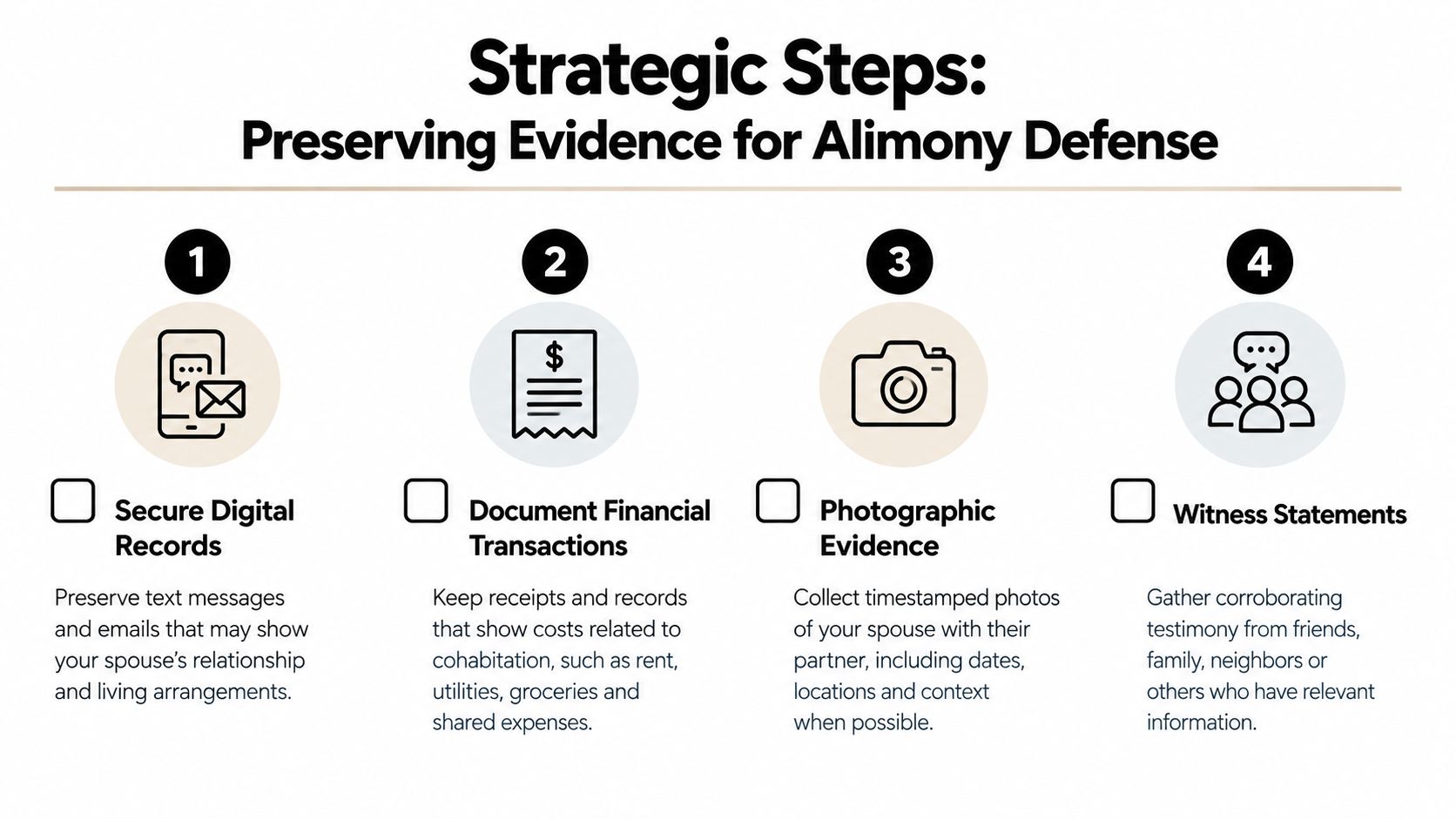
Evidence can help, but only if it's preserved legally and in a form a court can understand. Start by saving text messages, emails, photographs, receipts, and relevant account records. Keep original files when possible, preserve timestamps and surrounding context, and make a record of how you obtained each item.
Don't hack an account, steal a device, or secretly record a conversation without legal advice. North Carolina's wiretap law can create separate problems, and aggressive evidence-gathering can damage credibility or expose you to claims by the other party.
Build a reliable timeline
Write a private chronology that separates what you personally observed from what someone else told you. Include:
- Possible beginning and end dates: Identify when the relationship may have started and stopped.
- Discovery: Record when you learned about it and what information you had then.
- Post-discovery conduct: Note whether you resumed marital relations, lived together, reconciled, or continued presenting yourselves as a couple.
- Separation facts: Document residences, communications, intent, and financial arrangements.
- Support needs: Gather income records, recurring expenses, account statements, insurance costs, and evidence of the other spouse's ability to pay.
A private investigator may be useful when the evidence is incomplete and the conduct occurred before separation. It may be unnecessary when lawful records already show the relevant facts. An attorney can help compare the likely value of additional investigation with its cost and legal risks.
Avoid moves that create new problems
Don't confront your spouse in a way that could lead to threats, property damage, or allegations of harassment. Don't post accusations on social media, and don't send angry messages that may later be shown to a judge. Moving out can also affect how the parties argue about separation, so get advice before treating a housing decision as final.
A consultation should address both sides of the support issue. If you're seeking support, prepare to show need and the other spouse's ability to pay. If you're defending against alimony, bring the evidence, dates, and facts that may support the bar, condonation, or recrimination.
Common Questions About the NC Misconduct Rule
Does dating after separation trigger the alimony bar?
Not by itself. The statutory bar concerns illicit sexual behavior during the marriage and on or before the date of separation. Conduct after separation doesn't trigger that specific bar, although it can create other legal or practical issues depending on the facts.
Is one act enough?
North Carolina practice materials emphasize that a single act of illicit sexual behavior can invoke the rule. The party still must prove that the conduct fits the statutory definition, occurred within the required timeframe, and wasn't condoned.
Can text messages prove illicit sexual behavior?
Text messages may support a claim, especially when combined with evidence showing opportunity and physical conduct. Messages alone don't automatically prove every required element, and uncorroborated statements can be insufficient.
Does this rule affect child support or property division?
The illicit sexual behavior bar is an alimony rule. It doesn't automatically decide child support or equitable distribution. Those issues use different legal standards, although the same communications or financial records may become relevant in a broader case.
Schedule a Consultation With a North Carolina Family Lawyer
If you're worried that an affair will change support, bring the facts in an organized form. Start with the likely separation date, then gather financial records, messages, photographs, receipts, witness names, and anything showing what happened after the conduct was discovered.
A North Carolina family lawyer can help map those facts onto three separate questions: whether the alimony bar applies, whether postseparation support remains available, and whether condonation or recrimination changes the analysis. That review can also identify whether an alimony claim was preserved in the divorce pleadings and whether the evidence was obtained lawfully.
The Law Office of Bryan Fagan provides North Carolina-focused family law representation involving divorce, equitable distribution, child custody, child support, and spousal support disputes. Its resources on alimony in North Carolina and how marital misconduct affects alimony can provide additional background, but online information can't resolve a disputed timeline or determine whether conduct was condoned.
A consultation isn't a promise of a particular result. It's an opportunity to test your assumptions before negotiation, mediation, or trial, and to understand which facts deserve attention first.
The Law Office of Bryan Fagan helps North Carolina clients evaluate alimony, postseparation support, illicit sexual behavior, timing, evidence, and condonation issues. Visit Law Office of Bryan Fagan to schedule a consultation and discuss your support options with a North Carolina family law attorney.