You've just qualified as the personal representative of a North Carolina estate. The will may name you as executor, but your work now includes much more than locating a few bank statements. You're receiving calls from family members, identifying property, dealing with financial institutions, and trying to understand what the clerk expects while grieving a loved one.
The phrase “90-day inventory” can create the wrong impression. North Carolina generally requires the inventory within three months after qualification, not automatically 90 calendar days after the decedent's death, unless the clerk of superior court grants an extension. The filing is also more than a deadline exercise. It's a sworn record of property, ownership, and date-of-death values that can affect later creditor review, tax analysis, accounting, and distribution.
The First Weeks After You Qualify as Personal Representative
Consider a representative who qualifies on a Monday morning. By the end of the week, she has received letters testamentary, opened an estate account, contacted the decedent's bank, and started sorting through papers at the family home. A sibling asks whether a jointly held account belongs on the inventory. A creditor sends a bill. The bank says it needs additional documents before it can release historical account information.
That representative may feel as though the legal clock began when the decedent died. It didn't. For the inventory obligation, the controlling event is qualification, meaning the formal appointment that gives the personal representative authority to act for the estate. The date of death remains critical for valuation, but it generally isn't the date from which the three-month inventory period is measured.
Practical rule: Write the qualification date at the top of your estate administration file and use it to calculate the ordinary inventory deadline.
The early work should be organized around evidence, not guesses. Preserve bank statements, deeds, vehicle titles, brokerage records, business documents, insurance information, account beneficiary records, and correspondence with institutions. Keep a written log of requests, responses, missing documents, and follow-up efforts. That record can help explain why an item remains unresolved or why an extension becomes necessary.
What the first weeks should accomplish
You don't need every administration question resolved immediately, but you do need a reliable investigation process. Start by:
- Confirming authority: Keep the letters issued by the clerk and identify whether you're serving as executor, administrator, or collector.
- Creating an asset register: Record each possible asset, its apparent owner, the institution holding it, the records requested, and the current status.
- Separating information from conclusions: A bank employee's statement that an account is “joint” isn't the same as obtaining the signature card or deposit contract.
- Protecting estate funds: Use an estate account for estate transactions and preserve receipts for expenses and payments.
- Tracking questions: Note unresolved ownership, valuation, beneficiary, and title issues instead of leaving them unaddressed.
The inventory is an early checkpoint in administration. It doesn't replace creditor procedures, debt payment, accountings, or distribution. Careful preparation during these first weeks gives you a defensible foundation for each later stage.
Understanding the Deadline Under North Carolina Law
North Carolina's controlling rule appears in N.C. Gen. Stat. § 28A-20-1. The personal representative must file an inventory with the clerk of superior court within three months after qualification, unless the clerk grants an extension. The inventory must be made under oath, signed by the representative, and recorded by the clerk. It must provide a “just, true and perfect” account of real and personal property that has come into the representative's possession, or into the possession of someone acting for the representative. The statutory language is available through the North Carolina General Statutes governing estate inventories.
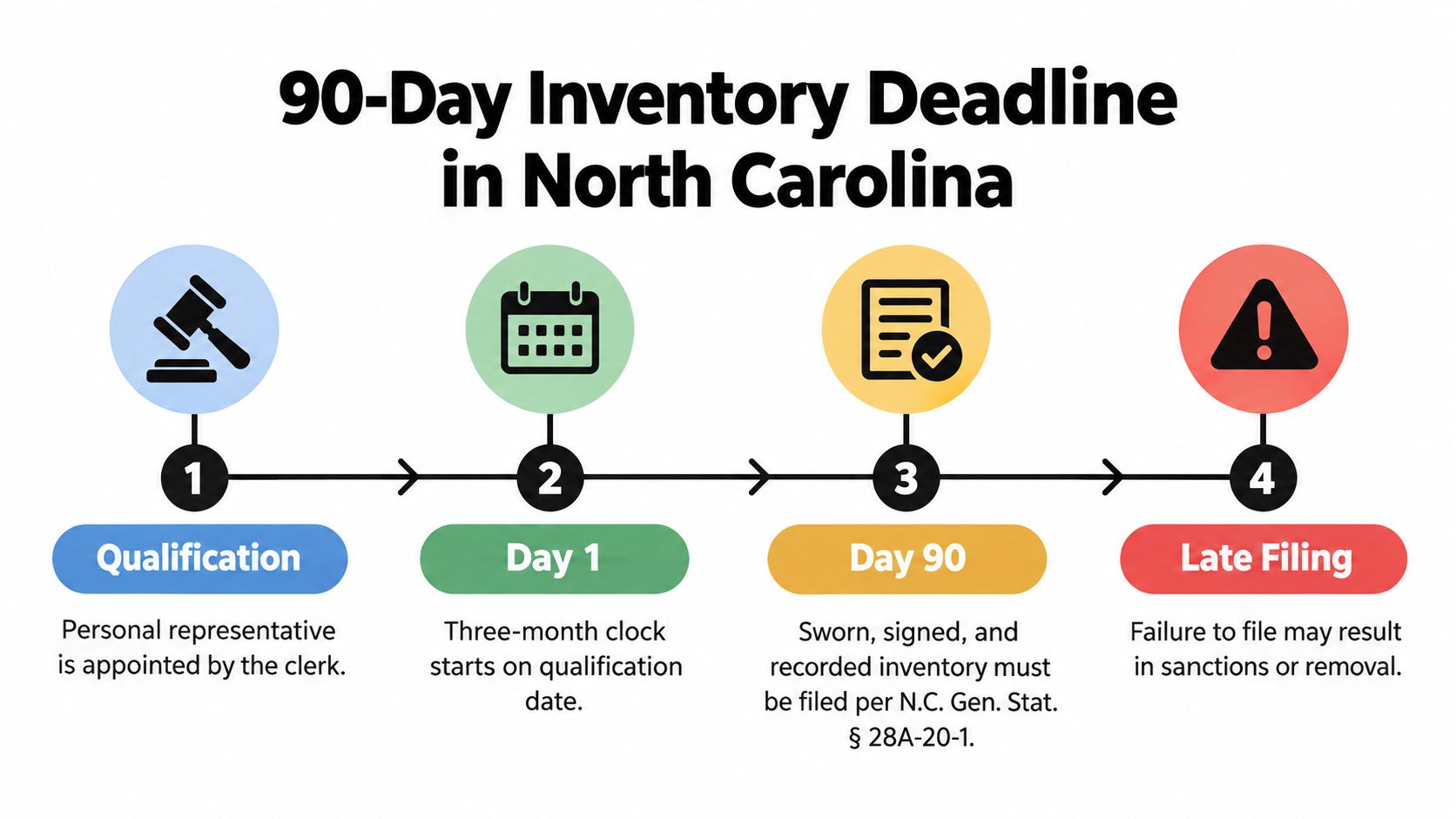
The practical calculation is straightforward. If an administrator qualifies on April 10, the ordinary deadline falls three months later, subject to the clerk's rules and any approved extension. That isn't necessarily the same as counting 90 calendar days from the date of death. The official AOC-E-505 inventory form reinforces that the filing is due within three months after qualification.
Who carries the responsibility
The person responsible depends on the appointment:
- An executor is the person named in a will who has been formally appointed and qualified by the clerk.
- An administrator is appointed when the estate requires administration without an effective executor serving under a will.
- A collector may handle estate property in limited circumstances and can have inventory responsibilities within the scope of that appointment.
Being named in a will alone doesn't give someone authority to act as executor. Qualification matters because it establishes the legal role and begins the administration responsibilities connected to that role.
“Under oath” means you affirm that the information is truthful to the best of your knowledge. “Signed” means the representative executes the filing. “Recorded” means the clerk receives and records it as part of the estate file. These words describe a formal fiduciary filing, not an informal list kept at home.
The inventory deadline also exists alongside other estate deadlines. For example, creditor notice work has its own requirements, so review the North Carolina notice to creditors publication deadline separately rather than assuming the inventory resolves creditor issues. The unrelated six-month residency rule for filing divorce in North Carolina is addressed in North Carolina Divorce Residency Requirements.
What Belongs on the Inventory and How to Value It
The inventory should identify real and personal property that has come into your hands, or into the hands of someone acting for you. That includes property held in the decedent's sole name, such as a solely owned bank account, titled vehicle, brokerage account, real estate interest, business interest, or personal property.
The key valuation principle is the date of death. Values are generally reported as of the decedent's date of death, creating an early baseline for administration, tax analysis, creditor review, and later accountings. The North Carolina Judicial Branch estate procedures guidance also explains that property found after the original filing should be reported through a supplemental inventory.

A practical asset review
Start with the records most likely to establish ownership and value:
- Bank and investment accounts: Request statements showing ownership and the balance or value as of the date of death.
- Real estate: Review deeds, tax records, loan information, and any appraisal or valuation material appropriate to the property.
- Vehicles and titled property: Obtain titles, registration records, and a defensible date-of-death value.
- Business interests: Locate operating agreements, stock records, partnership documents, financial statements, and ownership evidence.
- Personal effects: Document valuable items with photographs, appraisals, purchase records, or other reliable support.
- Digital property: Identify electronically held accounts, online financial assets, and records that may establish ownership or value.
An asset doesn't become a probate asset because a family member believes the decedent owned it. Conversely, an asset shouldn't be ignored because someone says it passes outside probate. Ownership documents and beneficiary records should support the treatment you choose.
Probate and non-probate property
Sole-name property commonly requires administration through the estate. Joint property with survivorship rights, payable-on-death accounts, transfer-on-death arrangements, life insurance, and retirement accounts with named beneficiaries may pass outside the ordinary probate distribution process. The exact ownership language still matters, and the estate file should preserve evidence supporting inclusion, exclusion, or characterization.
For example, a retirement account may have a named beneficiary, but you should still obtain the account statement and beneficiary designation information. A jointly held account may pass to a surviving owner, but the signature card or deposit contract may be necessary to establish whether survivorship rights apply.
The inventory is not a casual estimate of what the decedent ever possessed. It is a formal account tied to property within the statutory scope and supported by records. If the value is uncertain, document the method used and consider whether an appraisal or legal advice is appropriate.
Joint Accounts, Beneficiary Designations, and Ownership Disputes
Ownership questions become difficult when family assumptions conflict with account documents. A surviving child may say a joint account was created only for convenience. Another beneficiary may insist that the surviving joint owner was entitled to everything. The personal representative shouldn't resolve that dispute by relying on conversations alone.
North Carolina court guidance recommends obtaining signature cards and deposit contracts for joint accounts and notes that clerks may request documentation supporting the information reported on the inventory. The North Carolina Judicial Branch estate-procedure publication supports that documentation-focused approach.
How to Treat Common Asset Categories on the Inventory
| Asset Category | Records to Obtain | Inventory Treatment | Valuation Note |
|---|---|---|---|
| Sole-name bank account | Account statements, ownership records, date-of-death balance | Generally identify as estate property within the representative's possession | Use the date-of-death balance |
| Joint account | Signature card, deposit contract, statements, ownership terms | Characterize based on the governing agreement and available evidence | Preserve records showing the relevant balance |
| Real estate held as tenants in common | Deed, title records, tax information, valuation support | Identify the decedent's ownership interest | Value the decedent's interest as of death |
| Retirement account with named beneficiary | Account statement and beneficiary designation | Review whether the account passes under the designation and document the treatment | Obtain the value tied to the date of death |
| Life insurance | Policy, beneficiary designation, carrier correspondence | Document whether proceeds pass to the estate or a designated beneficiary | Preserve the carrier's value or proceeds information |
| POD or TOD account | Account agreement and beneficiary record | Review the transfer designation and retain support for the treatment | Use institution-provided date-of-death information when applicable |
The table is a working framework, not a substitute for reading the actual documents. A deed can use language that changes the analysis. An account can have a beneficiary designation that differs from family expectations. A business interest can require review of governing documents before anyone can value or transfer it.
A clean inventory doesn't mean every asset was included. It means every reasonable lead was investigated and the treatment of each material asset can be supported.
If the estate includes disputed ownership, blended-family relationships, or a closely held business, avoid presenting an uncertain conclusion as settled fact. Describe the issue in your working records, gather the underlying documents, and obtain advice before filing if the characterization could affect beneficiaries or later accounting. Guidance on avoiding probate structures can be found in how to avoid probate in North Carolina, but an existing estate still requires careful analysis of the documents signed by the decedent.
Filing the Inventory With the Clerk of Superior Court
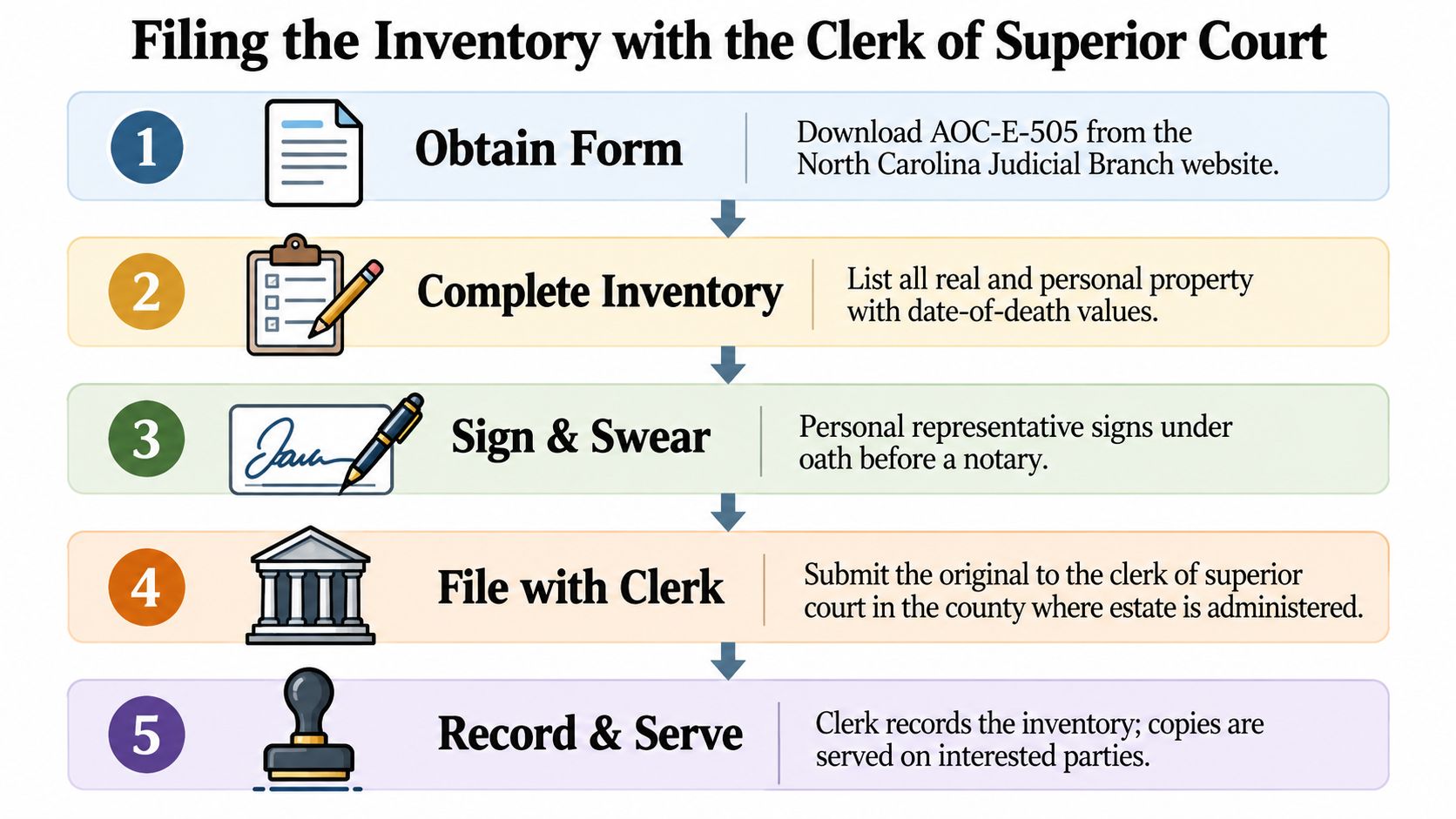
A personal representative who qualifies on one date but begins gathering records weeks later can easily miscalculate the filing period. The North Carolina Judicial Branch provides the official AOC-E-505 inventory form. It uses the three-month period after qualification, so confirm the date shown in the clerk's estate records rather than relying on the decedent's death date, funeral date, or the date you first contacted a bank. Use the current form and follow the filing practices of the county handling the estate.
A documentation-first workflow helps:
- Confirm the qualification date. Check the clerk's records and calculate the filing period from that date.
- Build the asset register. Record known and possible property, ownership questions, requested records, and unresolved values.
- Request historical documentation. Ask banks, brokerages, insurers, and other institutions for statements and values tied to the decedent's date of death.
- Reconcile titles and accounts. Compare deeds, account names, beneficiary records, vehicle titles, and business documents.
- Address valuation gaps. Obtain an appraisal or other reliable support when ordinary records do not establish value responsibly.
- Review non-probate transfers. Keep beneficiary designations, joint-account documents, and agreements supporting the treatment selected.
- Sign under oath and file. Execute the inventory properly and submit it to the clerk for recording.
- Keep a complete file. Retain the recorded copy, supporting documents, correspondence, and proof of filing.
What the clerk may need from you
The clerk's office records the filing, while the personal representative remains responsible for the submission's truth and completeness. A clerk may request documentation supporting an account classification, ownership position, or reported value. A clerk request for documentation is a normal part of administering the estate record, not a sign that the filing was improper.
Before filing, check the form for internal consistency. Account totals should match the underlying statements, and real estate descriptions should correspond with title records. Property omitted because it passes outside probate should have records supporting that conclusion.
County procedures can differ in practical details, including document delivery, applicable fees, and copy requirements. Contact the relevant clerk of superior court probate jurisdiction in North Carolina before submission. After filing, retain a recorded copy and proof of delivery. Mailing an unsigned draft does not satisfy the filing obligation.
Extensions, Supplemental Inventories, and Consequences of Missing the Deadline
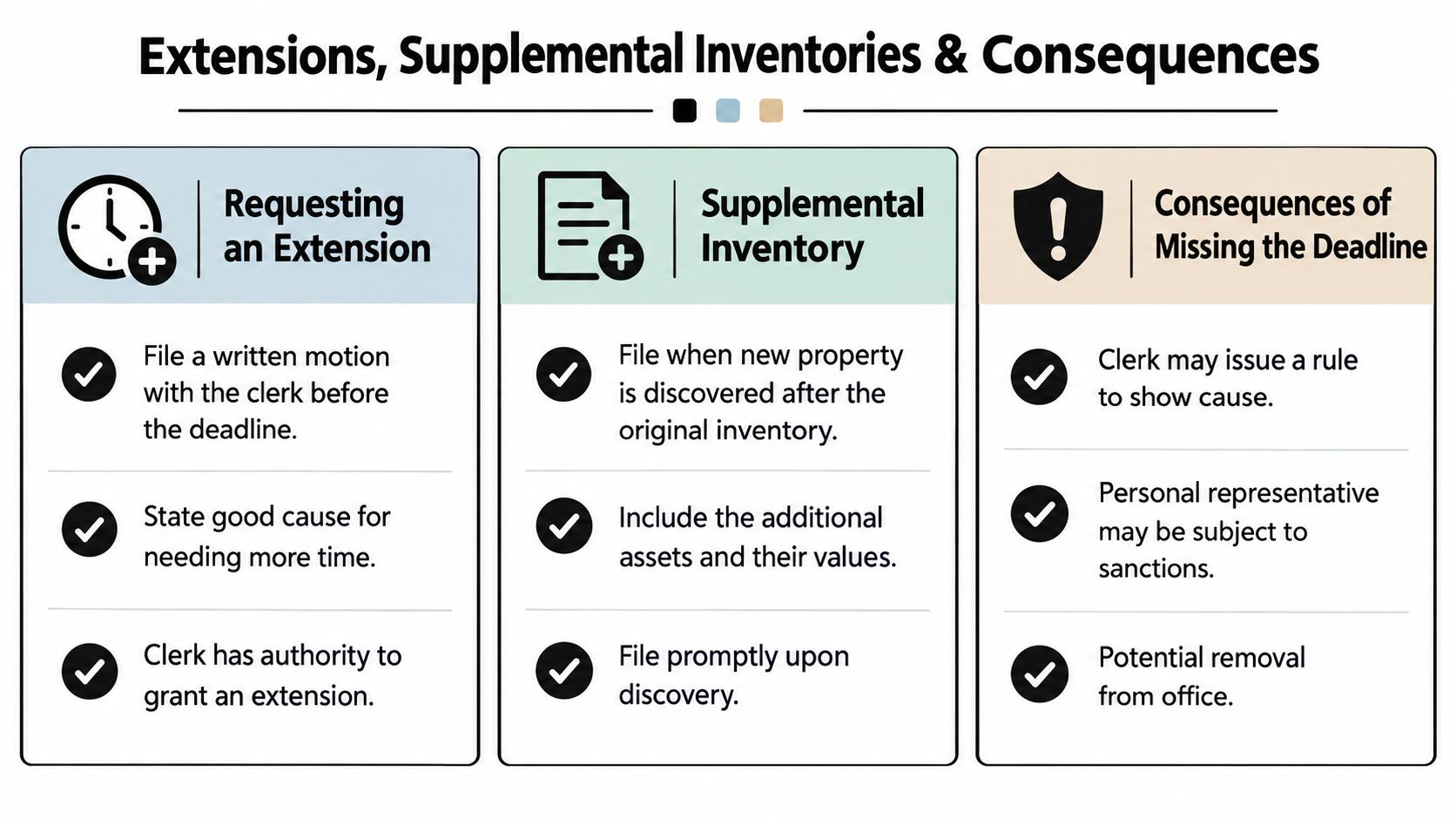
The most dangerous response to an approaching deadline is sometimes a rushed filing that you know is materially unreliable. If a bank hasn't produced ownership records, a business interest remains unvalued, or title documents are unavailable, the better course may be to document the investigation and ask the clerk for an extension before the deadline.
An extension isn't automatic. The clerk of superior court has authority to grant it, so the request should explain the practical reason more time is needed and show the work already performed. Keep copies of requests to institutions, follow-up correspondence, appraisal arrangements, title searches, and other evidence of diligent investigation.
When a supplemental inventory is appropriate
A supplemental inventory is used when property is discovered after the original filing. It should identify the newly discovered property and its value, with supporting records where available. File promptly after discovery rather than waiting until the end of administration or assuming the original filing can remain unchanged.
Examples include an overlooked account, a newly located deed, a business interest identified in company records, or property held by someone acting for the representative. The fact that an asset was discovered later doesn't automatically mean the original filing was dishonest. The way you respond after discovery matters. Preserve the evidence, determine the correct treatment, and make the appropriate supplemental filing.
What happens when the representative fails to file
A failure to file can trigger direct action by the clerk. The clerk must order filing within at least 20 days and require the representative to show cause why removal should not occur. That consequence is described in the North Carolina statutory provisions governing estate administration.
Removal is a serious fiduciary risk because it can interrupt administration, increase conflict, and expose the representative to further scrutiny. If the deadline is close, act before it passes. Seek an extension when appropriate, file a supported inventory when it is accurate, and obtain legal advice when unresolved ownership or valuation issues could materially affect the estate.
What Comes Next and Answers to Common North Carolina Questions
The inventory is an early administration record, not the end of the estate process. You still may need to address creditor notice, debts, tax matters, accountings, beneficiary communications, and distribution. The date-of-death values and ownership records collected now can make those later tasks more orderly.
Is the deadline counted from death?
Generally, no. The ordinary period runs from the personal representative's qualification date, subject to a clerk-approved extension. The date of death usually controls valuation, which is why both dates should be recorded separately in your estate file.
Do joint accounts belong on the inventory?
That depends on the account agreement and ownership evidence. Obtain the signature card, deposit contract, statements, and related records. Don't rely solely on a family member's understanding of why the account was created.
What triggers a supplemental inventory?
Property discovered after the original inventory should be reported through a supplemental inventory. Preserve the discovery record, determine the appropriate date-of-death value, and file promptly.
Is the inventory a public record?
The inventory is filed and recorded with the clerk as part of the estate administration record. Ask the relevant clerk's office about access procedures and protect sensitive information when sharing copies outside the court process.
Serving as a North Carolina personal representative can feel personal and procedural at the same time. You're carrying out a loved one's affairs while making decisions that can affect beneficiaries, creditors, and your own fiduciary exposure. Careful documentation is the most reliable way to reduce preventable disputes, but a consultation is especially useful when the qualification date, joint ownership, valuation, or extension question is unclear.
Law Office of Bryan Fagan provides North Carolina estate planning and probate guidance, including help organizing inventory documentation and addressing administration concerns. Schedule a consultation through Law Office of Bryan Fagan to discuss your estate's qualification date, assets, records, and filing options.