You've just been appointed executor of a North Carolina estate. The family is asking when assets can be distributed, a hospital bill has arrived, and someone tells you that a newspaper notice will take care of every creditor. That assumption can create serious problems.
North Carolina uses two separate notice tracks. The general notice protects the estate against many unknown claims, while direct notice protects known or reasonably ascertainable creditors. The most important timing distinction is easy to miss: publication runs once each week for four consecutive weeks, but the claims deadline must be at least three months from the first publication or posting date, not merely the end of the fourth insertion. North Carolina's probate process requires careful attention to both calendars.
Understanding the North Carolina Creditor Notice Process
Consider a common situation. An executor qualifies before the Clerk of Superior Court, contacts a local newspaper, and arranges a creditor notice. The executor then assumes the estate can be distributed after the fourth newspaper insertion. That approach confuses the publication schedule with the claims period and overlooks creditors who require individual notice.
The published notice serves a broad purpose. It tells potential creditors to present claims by a stated date and creates a process for addressing debts that the executor may not know about. A properly completed notice can help the estate move toward final distribution with a defined cutoff for many claims.
Publication, however, isn't a substitute for investigating the decedent's records. If the executor knows about a hospital account, credit-card balance, personal loan, or other obligation, the creditor may be a known or reasonably ascertainable creditor. That creditor must generally receive direct information about how, when, and where to file a claim.
Practical rule: Treat newspaper publication and direct creditor notice as separate assignments. Completing one doesn't complete the other.
North Carolina's system balances two interests. Creditors need a fair opportunity to present legitimate claims, while beneficiaries and the personal representative need a reliable process for resolving estate obligations. The executor's job is not merely to publish an advertisement. It is to document a reasonable search for creditors, provide required notices, evaluate claims, and preserve proof of compliance.
The distinction matters especially when a family is eager to distribute personal property or sell real estate. Paying beneficiaries before creditor obligations are properly addressed can leave the estate short of funds and expose the personal representative to disputes. A disciplined notice process protects the estate, the beneficiaries, and the executor.
Calculating the Publication and Claims Deadlines
North Carolina General Statutes § 28A-14-1 establishes the basic publication mechanics. When a qualified newspaper is available in the county where the estate is administered, the personal representative must publish the notice once each week for four consecutive weeks. The notice must state a claims deadline that is at least three months after the first publication or posting date. See the official text of G.S. 28A-14-1.
The calculation should begin with the first insertion, not the final one. For example, if the first notice appears on April 10, the deadline printed in the notice can't be earlier than July 10. The newspaper may publish the notice during the following weeks, but those later insertions don't restart the claims period or reduce the minimum time available to creditors.
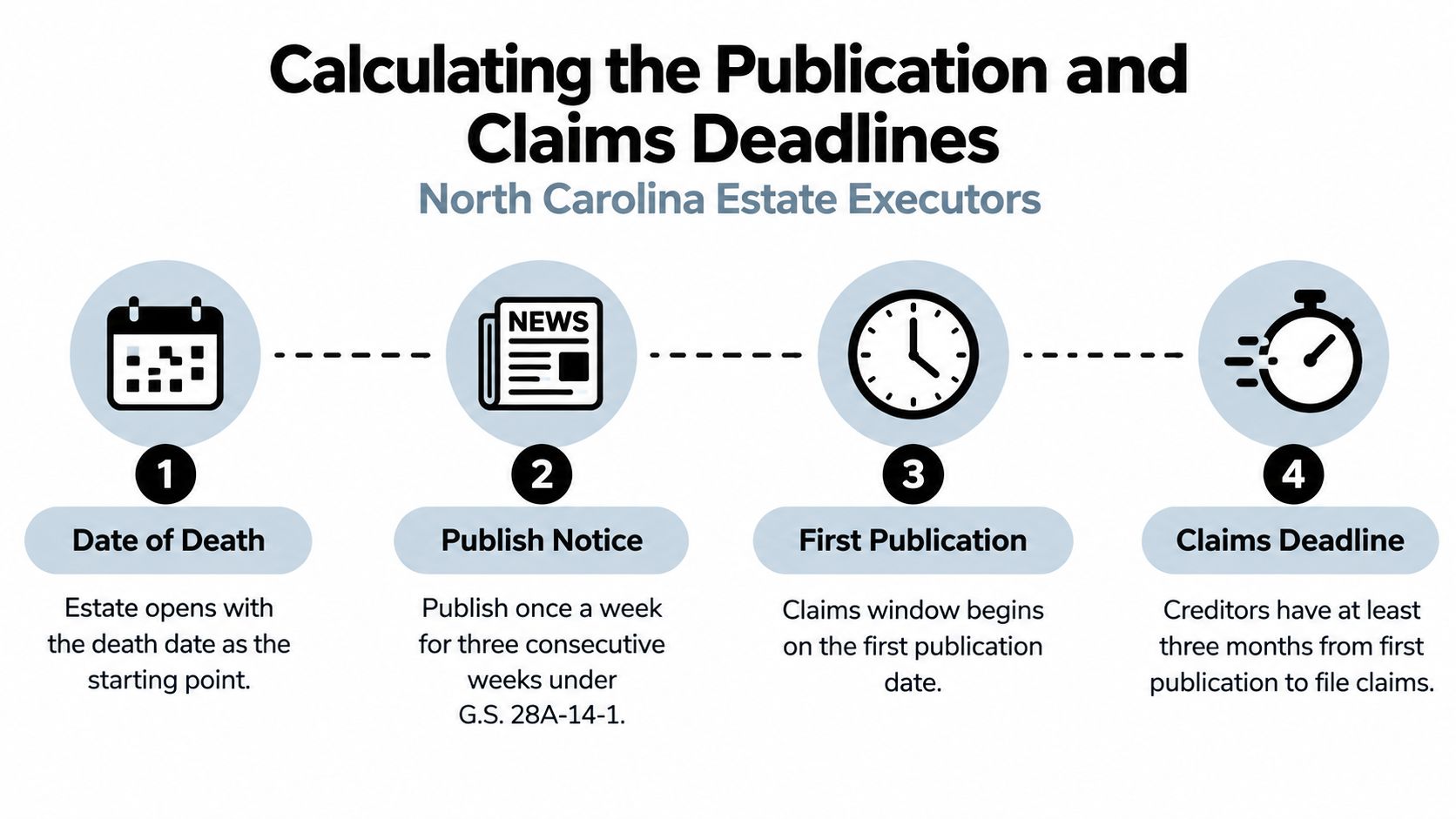
The four dates an executor should track
- Letters granted: The publication obligation begins after the clerk grants letters. It doesn't begin automatically on the date of death.
- First publication or posting: This date starts the minimum claims-period calculation.
- Four weekly insertions: The notice ordinarily runs once a week for four consecutive weeks.
- Stated claims deadline: This date must provide at least three months from the first publication or posting.
A county without a newspaper qualified to publish legal advertisements has alternatives under the statute. Depending on what publication resources exist locally, the executor may use a newspaper of general circulation together with courthouse posting, or post at the courthouse and in four other public places in the county. The method must match the statutory circumstances, so the executor shouldn't choose a substitute casually.
A frequent mistake is setting the deadline four weeks after the last publication. That date may fall short of the required period measured from the first publication. Before arranging the notice, confirm the county, the newspaper's legal-advertisement qualification, the first available insertion date, and the exact claims deadline. The Clerk of Superior Court's probate jurisdiction is central to the estate's filing and proof process.
The publication schedule and claims deadline are related, but they aren't interchangeable. The four insertions show that the general notice ran as required. The date printed in the notice determines when claims generally must be presented.
The 75-Day Rule for Known and Ascertainable Creditors
Newspaper publication reaches potential creditors generally. It doesn't replace direct notice to a creditor the executor already knows about or could identify through a reasonable review of the decedent's affairs.
Within 75 days after letters are granted, the personal representative must personally deliver or send by first-class mail information explaining how, when, and where a creditor must file a claim. This requirement applies to known or reasonably discoverable creditors and specifically includes the North Carolina Department of Health and Human Services, Division of Medical Assistance, when the decedent was receiving Medicaid. The North Carolina courts' creditor notice form and guidance identify this direct-notice obligation.
What a reasonable creditor search looks like
An executor doesn't need to discover an unknown debt through extraordinary investigation. The executor should, however, review the information reasonably available in the estate.
- Review incoming mail: Look for statements, collection letters, medical bills, renewal notices, and tax correspondence.
- Check financial records: Bank statements, check registers, loan documents, and recurring electronic payments can reveal obligations.
- Ask informed family members: Relatives may know about care providers, lenders, landlords, or service contracts.
- Examine property records: Mortgages, liens, homeowner obligations, and other recorded interests may require attention.
- Confirm Medicaid status: If the decedent received medical assistance, address the required notice to the appropriate state division.
A creditor is “reasonably ascertainable” when the executor could identify the creditor through a sensible review of the information available. The executor shouldn't wait for a creditor to discover the newspaper notice if the estate's records already identify that creditor.
For example, if the decedent's final mail includes a hospital statement, mailing a general newspaper notice alone is risky. The executor should send the required information by first-class mail, preserve the address used, and retain evidence showing when the mailing occurred. The same reasoning applies to a credit-card company named on a recent statement or a medical provider listed in the decedent's records.
The North Carolina Divorce Residency Requirements page concerns the six-month residency rule for filing divorce in North Carolina, a separate issue from estate administration. It doesn't change the executor's creditor-notice duties.
Consequences of Missing Statutory Notice Deadlines
A defective notice can undermine the protection the executor expected to obtain. Problems may arise when the notice is published in the wrong venue, runs on the wrong schedule, states an insufficient claims period, or lacks reliable proof. The estate might then have difficulty showing that it properly invoked the statutory process for barring untimely claims.
That risk becomes concrete when assets have already been distributed. If a valid obligation later surfaces and the estate has no funds left, beneficiaries may be asked to return property or the personal representative may face a demand for reimbursement. The precise outcome depends on the claim, the estate's assets, the notices sent, and the executor's conduct, but early distribution increases exposure.
A notice deadline is a fiduciary safeguard, not an administrative suggestion.
North Carolina law also imposes an outside limit. Claims that are otherwise subject to being barred are barred in any event if the first publication or posting of the general notice doesn't occur within three years after the decedent's death. The North Carolina statutes governing limitations on estate claims should be reviewed alongside the notice provisions.
That outside rule shouldn't encourage delay. Waiting can complicate the estate, make records harder to locate, and create uncertainty about whether the notice process was completed correctly. It also doesn't eliminate the need to address known creditors through direct notice.
A personal representative should resist the temptation to treat a late or missing publication as a harmless paperwork issue. If a deadline was miscalculated or proof is incomplete, obtain legal advice before distributing assets or declaring the estate ready to close.
Step-by-Step Workflow for Estate Executors
The safest workflow begins immediately after the clerk grants letters. Put every date in one calendar, keep a creditor file, and don't rely on memory or an informal conversation with the newspaper.
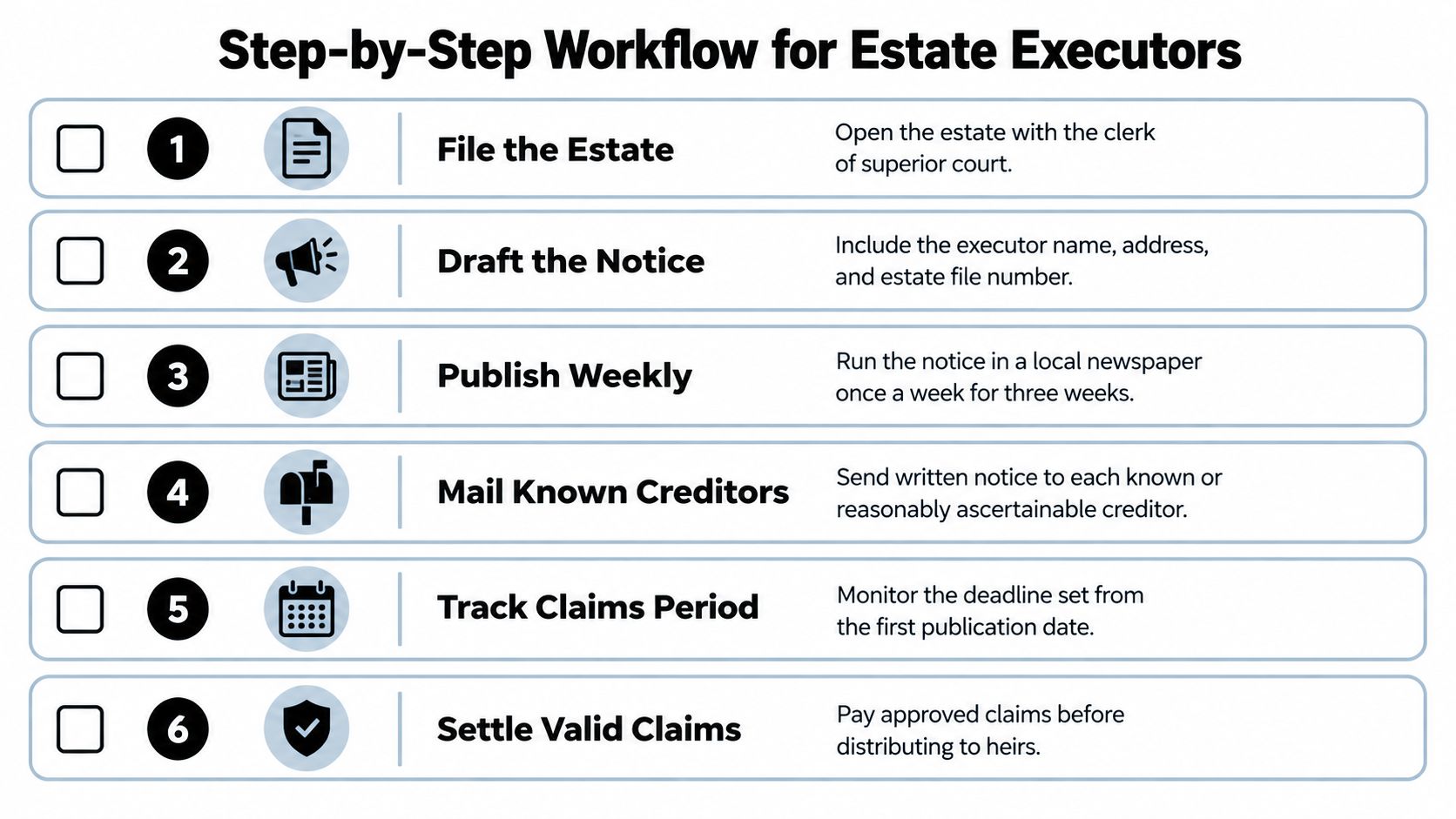
Start with the legal calendar
First, confirm the date letters were granted and identify the county where the estate is administered. Ask the newspaper whether it is qualified to publish legal advertisements and obtain its publication schedule in writing. If no qualifying newspaper exists, confirm the statutory alternative with the clerk or counsel before posting or publishing.
Next, prepare the notice with a claims deadline calculated from the first publication or posting. Schedule the notice once each week for four consecutive weeks. Don't use the fourth insertion as the starting point for the claims calculation.
Run the direct-notice process at the same time
Create a creditor list while gathering the estate inventory. Record each creditor's name, mailing address, account description, and the date and method of notice. Send the required information by first-class mail or deliver it personally within the applicable 75-day period after letters are granted.
Keep copies of every letter, the address used, returned mail, receipts, and any follow-up correspondence. Returned mail isn't something to discard. It may show that additional investigation or a different address was necessary.
Close the documentation loop
After publication, obtain the newspaper's affidavit of publication. File the notice and affidavit with the Clerk of Superior Court. When applicable, file affidavits documenting personal delivery or mailing as proof that direct-notice duties were completed. The North Carolina executor commission and fees information addresses a separate aspect of administration, but executor compensation should also be considered only within a properly documented estate process.
Before distributing assets, compare the filed proof against the calendar:
- Publication proof: Confirm all four weekly insertions and the affidavit.
- Deadline verification: Confirm the stated date was measured from the first publication or posting.
- Direct notices: Confirm known and reasonably ascertainable creditors were contacted.
- Claim review: Evaluate each claim before payment or rejection.
- Distribution decision: Preserve sufficient funds until creditor obligations are resolved.
This workflow won't eliminate every estate dispute, but it creates a clear record showing what the executor did and why.
Common Questions and When to Seek Legal Counsel
What happens if a creditor misses the stated deadline?
Claims generally must be presented by the date stated in the notice or they are barred, but that rule has statutory exceptions. Certain real-estate warranty claims, federal claims, North Carolina tax claims, and insured claims may receive different treatment under North Carolina law. An executor shouldn't reject a late claim automatically without determining whether an exception applies.
Does publication notify every creditor?
No. Publication provides general notice, but it doesn't replace direct notice to known or reasonably ascertainable creditors. If the executor knows about a hospital, lender, card issuer, or Medicaid-related obligation, the estate should address that creditor individually and preserve proof.
Can the executor distribute assets after the fourth publication?
Not automatically. The four-week publication schedule is not the same as the minimum claims period. The executor should verify the date stated in the notice, confirm that the applicable claims period has expired, review direct-notice compliance, resolve valid claims, and ensure the clerk has the necessary proof before seeking final distribution.
What if the estate can't pay every valid debt?
Don't distribute assets while treating the shortage as a family problem. The executor may need to apply statutory priority rules, sell or preserve assets, address disputed claims, and obtain advice before paying one creditor over another. Beneficiaries should understand that an estate with insufficient assets may require a different administration strategy than a solvent estate.
When should an executor consult an attorney?
Legal guidance is particularly important when publication was delayed, the wrong newspaper was used, a creditor was discovered late, Medicaid may be involved, a claim is disputed, records are incomplete, or the estate owns property in more than one state. A probate attorney can help evaluate the notice record before the executor makes an irreversible distribution.
North Carolina estate administration places real responsibility on the personal representative, but you don't have to manage that responsibility without help. If you're handling an estate and need to confirm the notice to creditors publication deadline, direct notices, or filing proof with the clerk, schedule a consultation before a preventable mistake becomes a larger dispute.
The Law Office of Bryan Fagan offers North Carolina families guidance with estate planning and probate matters, including creditor-notice procedures and executor responsibilities. Contact the firm to discuss the estate's deadlines, documentation, and distribution plan with counsel familiar with North Carolina law.