Your brother wants to sell the North Carolina home you both inherited. You want to preserve it for the family. Another relative says the property should be divided, even though the house sits on a single residential lot. Everyone has an opinion, but no agreement is possible.
That situation is common in inherited property disputes. A petition to partition can provide a legal path forward, but it isn't just a form that automatically forces a sale. North Carolina courts may consider physical division, a sale, a combination of both, or a negotiated solution outside court. The right path depends on title, ownership interests, property characteristics, estate issues, liens, and the evidence each person can present.
What a Petition to Partition Really Means in North Carolina
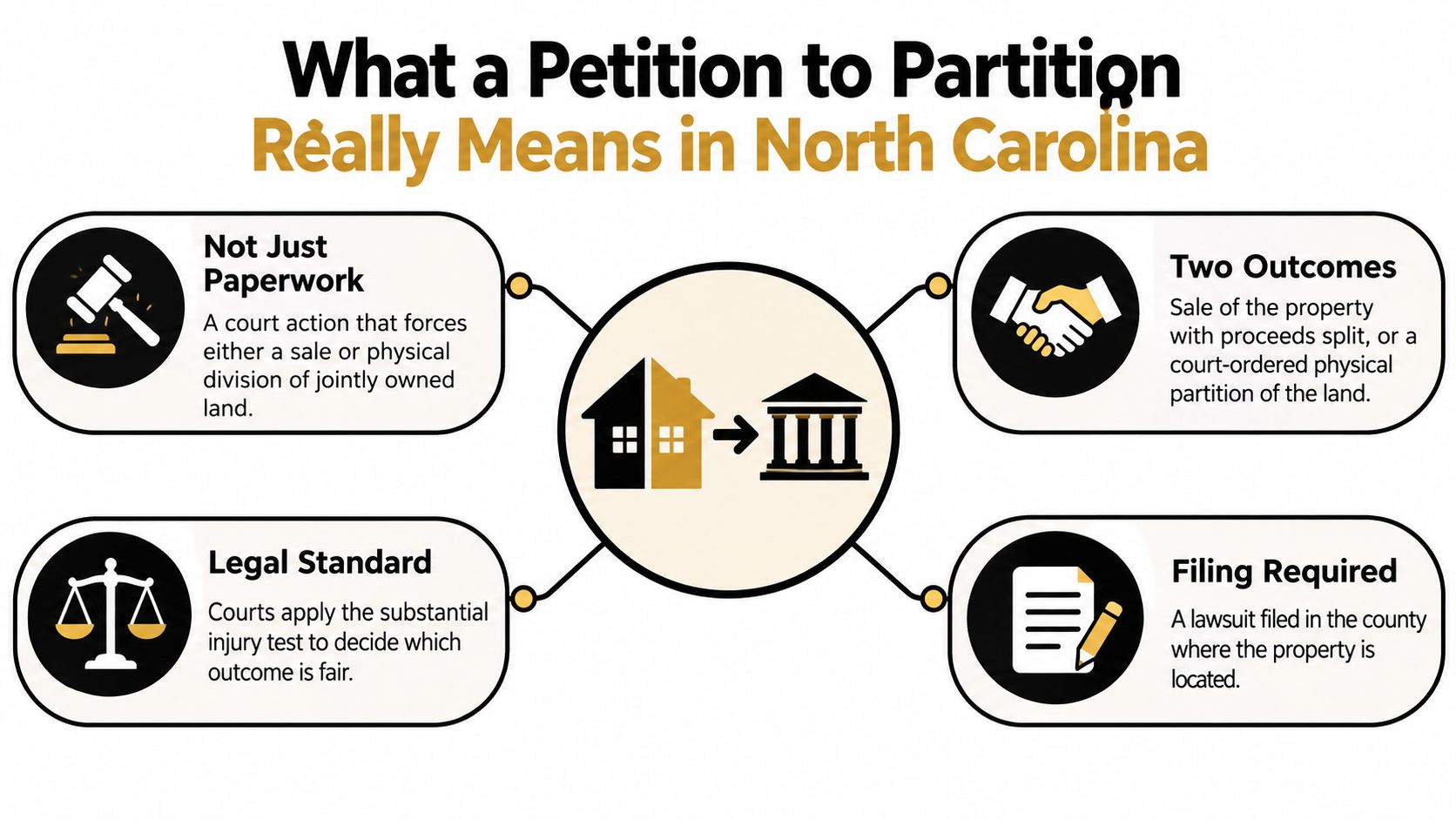
Two heirs can own the same house and still want very different things. One wants to keep it because it has been in the family for years. The other wants cash now. A petition to partition is the court process North Carolina uses to break that deadlock and turn a shared ownership problem into a legal decision.
Under North Carolina Chapter 46A, a partition case asks the superior court to decide what can fairly be done with real property owned by more than one person. The court is not there just to approve a sale because one owner is frustrated. It first has to identify who owns what, what kind of co-ownership exists, and which remedies the law allows. In plain terms, partition is the decision tree for co-owners who have reached the point where private agreement is no longer working. The governing statute is the North Carolina Chapter 46A partition statutes.
A person who holds property as a tenant in common or joint tenant may file. A personal representative may also file for a deceased cotenant's estate. That matters in family property disputes, because the critical question is often bigger than "sell or keep." Sometimes the dispute is about whether the property can be preserved through a buyout, whether title was transferred correctly, whether estate administration is still affecting ownership, or whether liens and other claims will reduce what anyone receives.
Chapter 46A applies to partition proceedings commenced on or after October 1, 2020. It separates an actual partition, which means dividing the land itself, from a partition sale, which means selling because physical division does not fit the property or would unfairly hurt the owners' interests. Sale price is only part of the story. Net recovery can change sharply once costs, liens, repairs, carrying expenses, and the feasibility of a family buyout are put on the table.
Why venue and procedure matter
The case usually must be filed in the county where the property sits. If the land stretches across county lines, filing may be made in any county containing part of the property, with notice filed in the others.
That rule exists because the court is acting on the land and on title, not refereeing a family argument. If inherited property is involved, it also helps to separate partition from estate planning and administration issues, including avoiding probate in North Carolina.
Practical rule: Before anyone pushes for a sale, confirm title, ownership shares, estate status, and creditor issues. Those details often determine whether the best outcome is preservation, division, buyout, or liquidation.
Partition in Kind Versus Partition by Sale
A North Carolina partition case usually turns on one practical question: can the land be split fairly, or does the property work better as a whole?
How physical division works
In an actual partition, the superior court appoints three disinterested commissioners. They inspect the property, study its layout, and divide it according to the cotenants' ownership interests. The commissioners generally must file their report within 90 days after the last commissioner receives notice of appointment, as the statute requires.
Equal shares do not always mean equal pieces of land. One side may have road frontage, a better building site, utility access, or stronger development potential. A smaller tract with those advantages can be worth more than a larger tract without them. When a straight split would leave one owner with more value than another, the commissioners may recommend an owelty payment, which is money paid to balance the difference.
This approach often fits a larger tract with separate buildable areas. It becomes harder when the property is a single house, a narrow lot, or land limited by zoning, access, or topography. In those settings, division can create parcels that look fair on paper but do not work well in real life.
How a sale becomes available
A court may order a sale only when the requesting party proves, by a preponderance of the evidence, that actual partition would cause substantial injury. The court compares what each cotenant would likely receive from separate parcels with what the property could bring if sold as one unit. It also looks at whether a partition would impair a cotenant's rights and whether an owelty payment would solve the problem instead.
| Factor | Partition in Kind | Partition by Sale |
|---|---|---|
| Property type | Large tract with separable areas | Single home, constrained lot, or property difficult to divide |
| Main result | Owners receive separate parcels | Property is sold and owners receive determined shares |
| Key evidence | Survey, access, zoning, parcel value | Appraisal, market evidence, development feasibility, sale proceeds |
| Family objective | Preserve some or all land among owners | Convert ownership into money |
| Main risk | Unequal or unusable parcels | Loss of the property and sale-related expenses |
Disagreement by itself does not prove substantial injury. If one sibling wants to keep the home and another wants cash, the court still needs evidence showing that division would reduce value in a material way or interfere with a legal right.
The practical choice often comes down to preservation versus liquidation. A family may prefer to keep inherited land in the family, but that goal only works if the parcels can stand on their own or if a buyout makes the numbers work. If the property cannot be divided without leaving one side stranded with a weak or unusable parcel, a sale may produce the cleaner result, even though the emotional cost is higher.
Partition disputes sometimes arise alongside marital property issues. For a separate overview of the steps, residency rule, and filing requirements for an NC divorce, see How to File for Absolute Divorce in North Carolina. The legal questions are different, but both situations require careful identification of ownership and the relief a court can order.
Who Can File and Where the Case Must Be Filed
A person doesn't need every cotenant's permission to begin a North Carolina partition case. A person claiming an interest in real property as a tenant in common or joint tenant may petition the superior court. In an inherited-property dispute, that person may be an heir, devisee, or another owner whose interest appears in the title and estate records.
A personal representative may also file on behalf of a deceased cotenant's estate. That can matter when an owner dies before the family resolves the property dispute, or when the estate needs to protect or administer the deceased person's interest.
Choosing the proper county
The general venue is the county where the property is located. For land extending across multiple counties, the petition may be filed in any county containing part of the property, with notice filed in the other counties.
The petition typically identifies:
- The property: A legal description, address, deed information, and relevant survey material.
- The owners: Every cotenant, heir, devisee, estate representative, and other person whose interest may be affected.
- The ownership interests: The alleged percentage or fractional interests and the documents supporting them.
- The requested relief: Actual partition, a sale, or another form of relief authorized by the circumstances.
- The supporting record: Deeds, probate documents, death certificates, tax information, surveys, appraisals, and lien records when relevant.
Naming the right parties matters. A missing heir, unresolved estate, or person with a recorded interest can complicate service, title, sale, and distribution.
A partition case can't produce a reliable result if the court doesn't have the right owners and title interests before it.
The clerk of superior court's role in probate matters can overlap with the practical issues surrounding inherited property. Families should understand that a partition petition doesn't automatically replace estate administration, as discussed in this guide to the clerk of superior court's probate jurisdiction in North Carolina.
A Worked Example of the Substantial Injury Test
Consider two siblings who inherit their parent's small house on a single residential lot. One sibling lives elsewhere and wants the property sold. The other wants to remain in the house and believes the family property should stay intact.
The sibling requesting a sale can't win by showing that the owners disagree. The question is whether dividing the property would cause substantial injury when compared with selling the property as a whole.
Cutting a small residential lot into separate pieces could make one parcel too small to use, eliminate necessary access, violate zoning requirements, or damage the value of the house. If one sibling would receive a parcel containing the structure while the other would receive an unusable strip of land, a physical division may not be a fair legal or economic solution.

Evidence that can change the result
The court may examine the property's physical layout, road access, zoning, utility arrangements, development potential, and likely value after division. The requesting party must compare what each owner could receive from separate parcels with what each could receive from a whole-property sale.
For qualifying heirs property, the court may appoint a disinterested North Carolina-licensed appraiser to determine fair market value, assuming sole ownership of the fee-simple estate. An open-market sale is generally required unless another method is more economically advantageous and in the cotenants' collective best interests. The statutory framework is available through the North Carolina partition legislation.
That evidence can support different outcomes. A large tract with independent access and several workable building areas may support partition in kind. A house on one constrained lot may support a sale. A mixed property may support a combination, such as dividing a usable portion while selling the remainder.
Timeline, Costs, and What Reaches Your Pocket
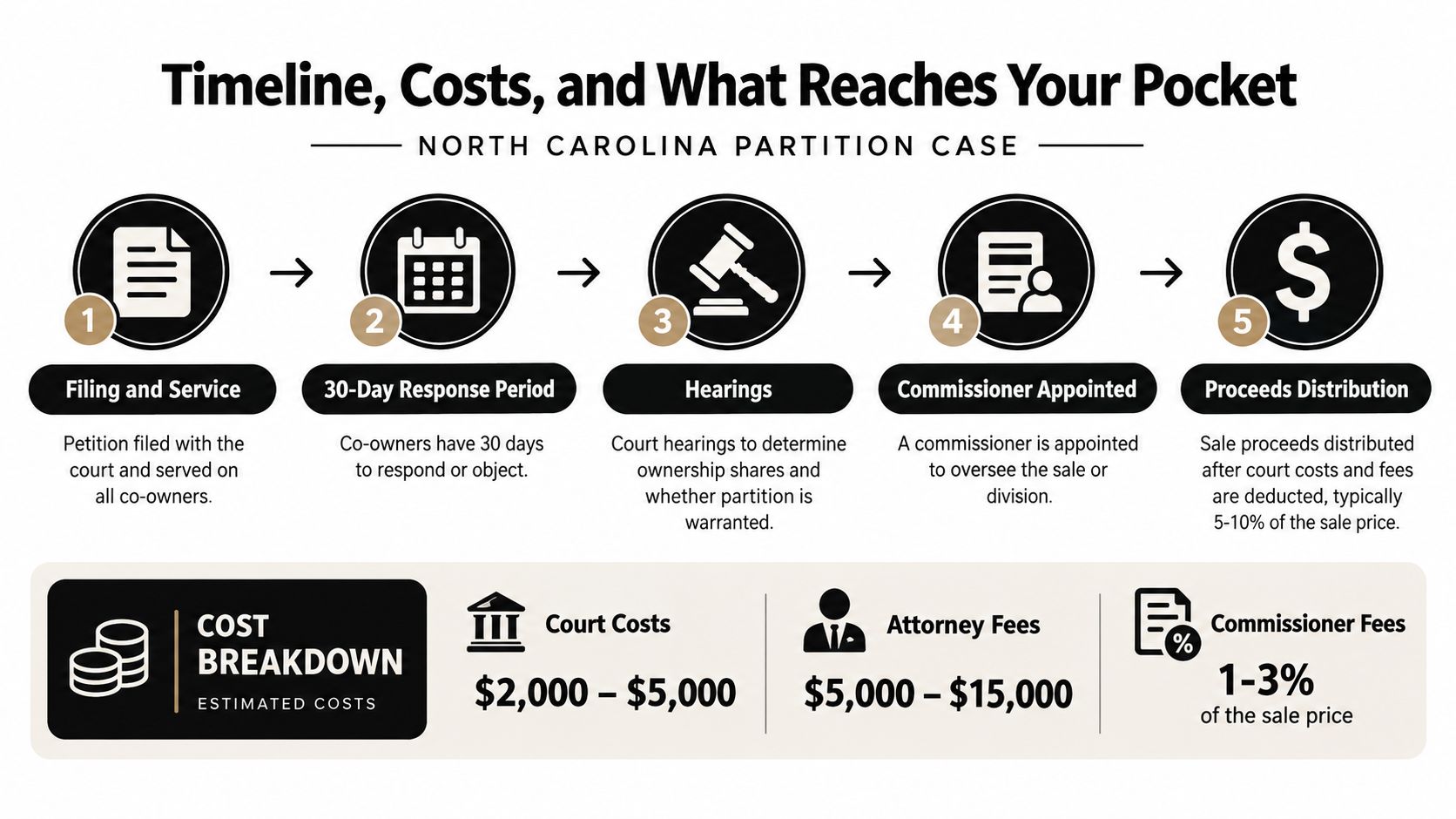
A partition case usually moves in stages, and each stage can change both timing and cost. Filing comes first, then service and a response period, followed by hearings, appraisal, commissioner review, sale or division, confirmation, and distribution. One North Carolina discussion places the overall process at roughly 6 to 12 months, but the actual pace depends on service problems, title issues, court scheduling, the property's condition, and whether the co-owners settle early. See the North Carolina partition process and cost discussion.
The stages create different expenses
Early in the case, filing and service create court and service expenses. If the matter is contested, attorney preparation, title review, and evidence about ownership usually add more cost. Appraisal work and commissioner fees can follow, and if the property is marketed or sold, repairs, insurance, taxes, utilities, and mortgage payments may reduce what is left to divide.
That is why a sale price and a payout are not the same number. A house that sells for a strong price can still leave less cash in each owner's pocket after the debts and case expenses are paid.
A practical net-proceeds review should account for:
- Secured debt: Mortgage payoff and other liens attached to the property.
- Property expenses: Taxes, insurance, repairs, maintenance, and needed work before marketing.
- Court-related expenses: Filing, service, appraisal, commissioner, and sale expenses.
- Ownership disputes: Reimbursement claims, improvement claims, and disagreements over prior payments.
- Creditor issues: A judgment or creditor claim affecting one cotenant's interest.
- Estate problems: Probate defects, creditor notice, or uncertainty about who has authority to convey.
N.C. Gen. Stat. § 46A-85 requires the court to secure each co-owner's ratable share in severalty after sale proceeds are received. In plain English, the court must separate and protect each person's share instead of treating the money as one undivided pool. If the amount due to each owner has not been determined, the court must set a hearing on its own initiative or after a motion by a party or commissioner. The distribution procedure is set out in N.C. Gen. Stat. § 46A-85.
A creditor may also reach only one cotenant's interest to satisfy a debt, without disturbing the others' interests. In practice, that means one owner's lien or judgment may reduce only that owner's distribution. The person who appears to own a larger share on paper may still take home less once creditor claims and case expenses are resolved.
Notice, Sale Method, and Appeals You Should Not Miss
A public partition sale has specific notice requirements. Under N.C. Gen. Stat. § 46A-76, the commissioner must certify that at least 20 days before the sale, a copy of the notice of sale was sent by first-class mail to the last known address of every party previously served under the applicable service rule. The commissioner's affidavit stating that the notices were mailed is treated as prima facie evidence that mailing occurred. The statute is available at N.C. Gen. Stat. § 46A-76.
A co-owner shouldn't assume that informal knowledge is enough. If a sibling learns about the sale from another family member but doesn't receive the required mailed notice, the court file, mailing records, returned envelopes, and affidavit may become important. Notice challenges are fact-specific and should be raised promptly.
Heirs property and the method of sale
For petitions filed on or after January 1, 2026, a qualifying heirs-property case may involve actual partition, a sale, or a combination of both. If the court orders a sale, an open-market sale is generally required unless the court finds that sealed bids or an auction would be more economically advantageous and in the cotenants' collective best interests. The relevant legislative framework appears in North Carolina House Bill 976.
Confirmation creates another important deadline. An order confirming a real-property sale becomes final 15 days after entry of the confirmation order, or when the clerk denies a petition for revocation, whichever occurs later. A party may appeal an order confirming the sale within 10 days after the order becomes final. These deadlines can affect disputes about ownership shares, sale expenses, liens, improvements, and notice.
Negotiation, Buyouts, and the Limits of Partition
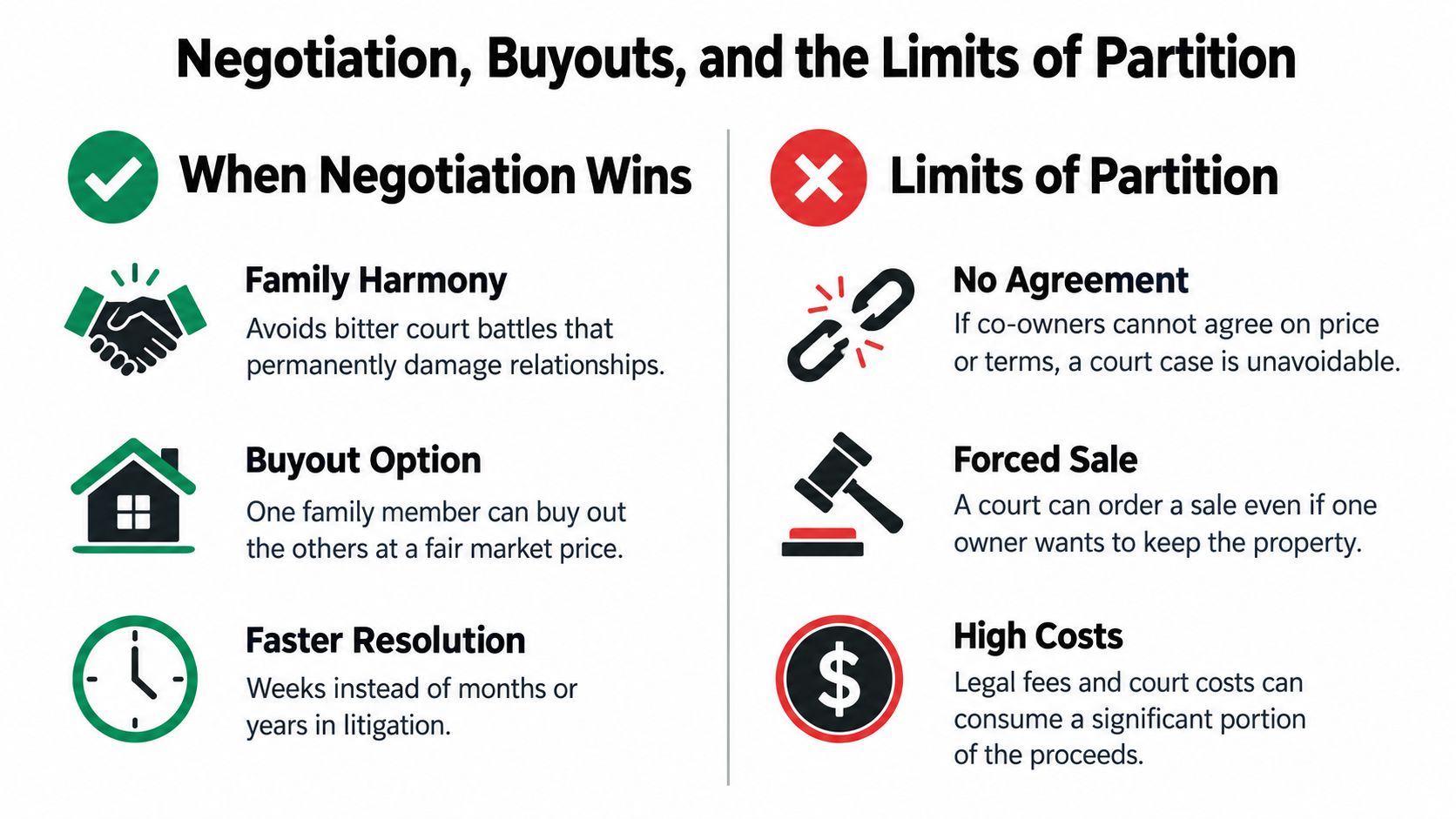
Court is not always the most practical first move. One family member may be able to refinance and buy out the others at a supported value, or the owners may agree to divide a large tract and sell the remainder. A written agreement can also address repairs, possession, taxes, valuation, closing expenses, and releases.
The newer heirs-property framework may create more room for preservation, but a statutory preference doesn't guarantee that a family will keep the land. Owners may still need appraisals, title work, legal representation, and coordination among heirs who live in different places or disagree about value.
What partition can't fix
Partition doesn't automatically cure defective title, missing probate steps, undisclosed creditor claims, or an invalid deed. A sale by heirs before required creditor-notice milestones may be void as to creditors and the personal representative unless statutory conditions are satisfied.
A transfer-on-death arrangement is also different from a partition proceeding. Families considering ownership and transfer options can review this information about a North Carolina transfer-on-death deed, while recognizing that existing title and estate facts control.
The best decision may be a buyout, a negotiated sale, a partial division, or litigation. The answer depends on the property's value, condition, title, debt, family objectives, and the evidence supporting each option.
Frequently Asked Questions for North Carolina Owners
Can one co-owner force a sale?
One eligible co-owner may file a partition action, but the court does not order a sale automatically. Under Chapter 46A, the requesting party usually must show that dividing the property in kind would cause substantial injury.
How long does partition take?
The timeline often depends on ownership disputes, service, appraisal work, title issues, and how the property is sold. As noted in the timeline section above, those steps can stretch the case well beyond an early estimate.
Does inherited property receive different treatment?
Yes. Qualifying heirs property can be handled through actual partition, sale, or a mix of both. For petitions filed on or after January 1, 2026, an open-market sale is generally preferred.
Will everyone receive the same amount?
No. The court looks at each owner's ratable share, and recovery can change because of liens, creditor claims, expenses, reimbursement disputes, and estate issues.
North Carolina partition disputes benefit from early, fact-specific advice because Chapter 46A, the substantial injury standard, heirs-property sale rules, notice requirements, and confirmation deadlines all affect the available choices. A consultation does not commit you to litigation. It can help you compare a buyout, negotiated sale, partial division, or petition to partition and see which path may produce the best net result for each owner.