In North Carolina, you're legally separated once you live in separate homes and at least one spouse intends the separation to be permanent, without a court order; a legal separation lawyer helps protect custody, support, and property during the one-year-and-one-day wait before divorce. The question isn't just whether you're separated, but whether you've protected what matters while you're still married.
Maybe your spouse has moved out, the mortgage is still coming from a joint account, and your children keep asking where they'll sleep next weekend. You don't need to settle every disagreement immediately. You do need a workable plan that doesn't depend entirely on your spouse keeping verbal promises.
When North Carolina Spouses Separate Without a Plan
A spouse leaves the family home in Raleigh or Charlotte with clothes, a laptop, and an agreement to discuss everything else later. By the next morning, the remaining spouse is sorting through school transportation, automatic payments, and questions about access to shared savings. Physical separation can happen quickly; practical arrangements usually take more work.
North Carolina doesn't require spouses to prove marital misconduct or obtain a signed document before separation begins. The North Carolina Judicial Branch's separation guidance explains that spouses must live in different homes and that at least one must intend the separation to be permanent. You may already be legally separated even though neither spouse has filed anything.
The move itself can be emotionally overwhelming, but it's only the beginning of the practical decisions.

Separate the move from the plan
Start by identifying what the move leaves unanswered. Don't assume your spouse understands your expectations because you discussed them before someone packed a bag.
- Household expenses: Identify who will pay the mortgage, utilities, insurance, and other recurring bills.
- Children's routines: Write down proposed school transportation, overnight arrangements, and communication expectations.
- Financial access: Preserve account statements and identify shared debts before negotiations become contentious.
- Separation documentation: Record when separate residences began and what each spouse understood about the arrangement.
These are planning recommendations, not a substitute for individualized legal advice. A lawyer can help decide which issues belong in a negotiated agreement and which need court attention.
The absence of mandatory separation paperwork is convenient, but it isn't protection. A friendly understanding may work while both spouses cooperate; it becomes much less useful when payments stop or someone changes the children's schedule without discussion.
Practical rule: Treat an amicable separation as an opportunity to document fair arrangements, not a reason to leave them unwritten.
What Legal Separation Actually Means in North Carolina
Separation and eligibility for absolute divorce are different questions. Living apart establishes the starting point, but the passage of time and residency requirements determine when a spouse can seek the legal end of the marriage.
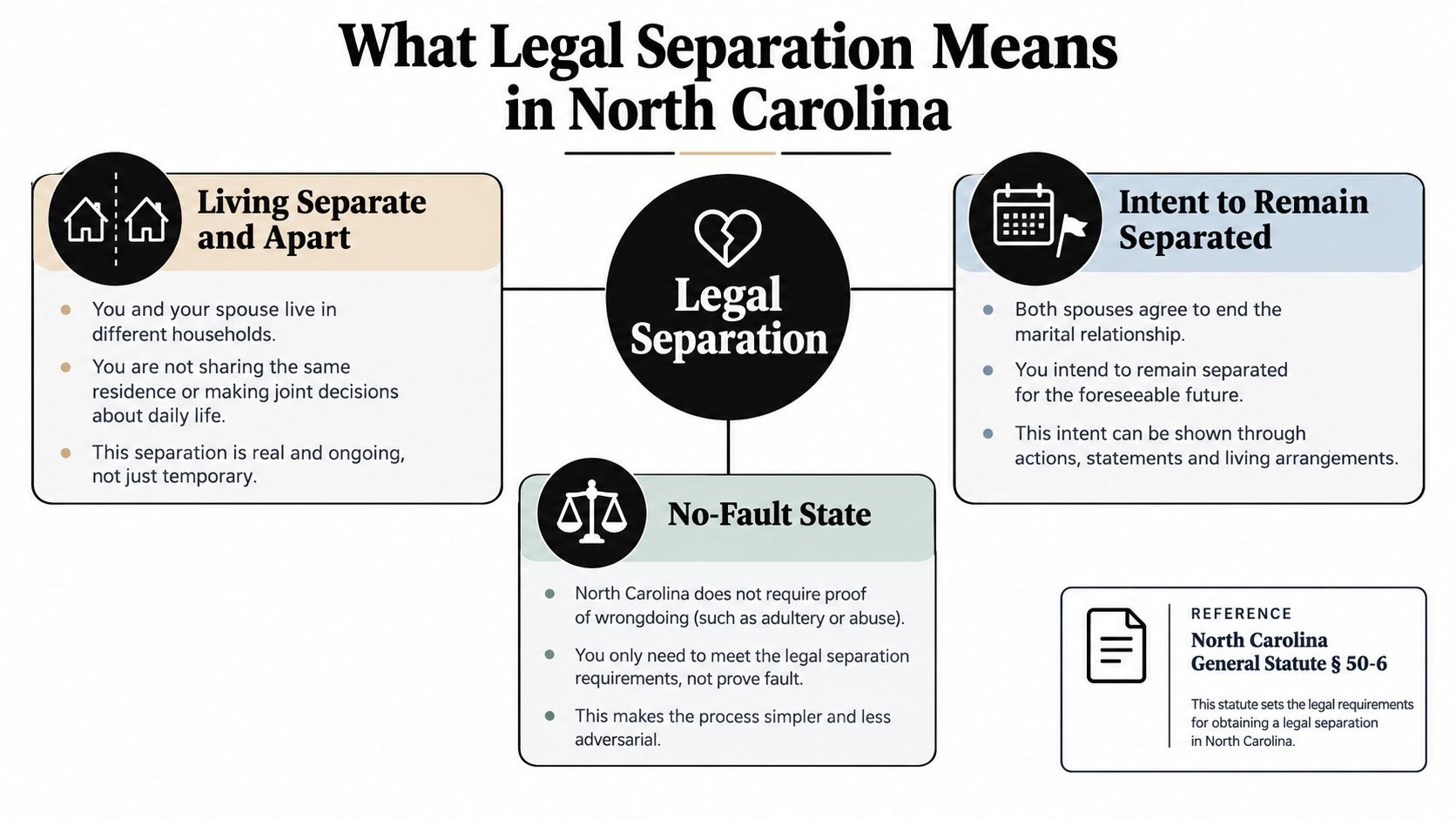
Under North Carolina General Statute § 50-6, spouses must live separate and apart continuously for the required year, and either the plaintiff or defendant must have resided in North Carolina for at least six months. North Carolina's court guidance expresses the filing threshold as one year and one day, so don't schedule a filing based on a rough anniversary calculation.
The basic separation concepts are summarized below.
No-fault doesn't mean every dispute is irrelevant
The no-fault framework means spouses don't need to prove wrongdoing to satisfy the separation-based divorce requirement. Don't stretch that rule into an assumption that marital conduct can never matter to a separate financial claim. Divorce eligibility, support, and property negotiations require distinct legal analysis.
Think of the divorce clock as a timing requirement, not a settlement. Reaching eligibility doesn't establish a parenting schedule, decide who should receive retirement assets, or produce money for household expenses.
| Timing question | What to document |
|---|---|
| When did separate residences begin? | Move-related records and communications |
| Was the separation intended to be permanent? | Contemporaneous statements and surrounding circumstances |
| Did the spouses reconcile? | Actual living arrangements and conduct, not just labels |
| Is North Carolina residency established? | Records supporting the relevant residence history |
Reconciliation requires more than a calendar calculation
Section 50-6 expressly says isolated incidents of sexual intercourse do not toll the separation period. It also refers to G.S. 52-10.2 for determining whether spouses resumed marital relations.
That distinction matters. An isolated encounter isn't the same as moving back together and acting as a married household. Genuine reconciliation can interrupt the required continuous separation and require the period to begin again.
Keep an honest record. Don't describe a temporary visit as a permanent move, and don't conceal a genuine reconciliation because it complicates your preferred filing date.
Legal Separation and Divorce in North Carolina Compared
The practical choice usually isn't between a formal separation judgment and divorce. North Carolina's basic separation framework begins without a court order, while spouses can use agreements and appropriate court proceedings to address particular disputes.
Absolute divorce changes marital status. A separation arrangement addresses how you'll live while the marriage continues. Neither should be mistaken for a complete solution to every financial or parenting issue.
The following visual highlights the distinction.
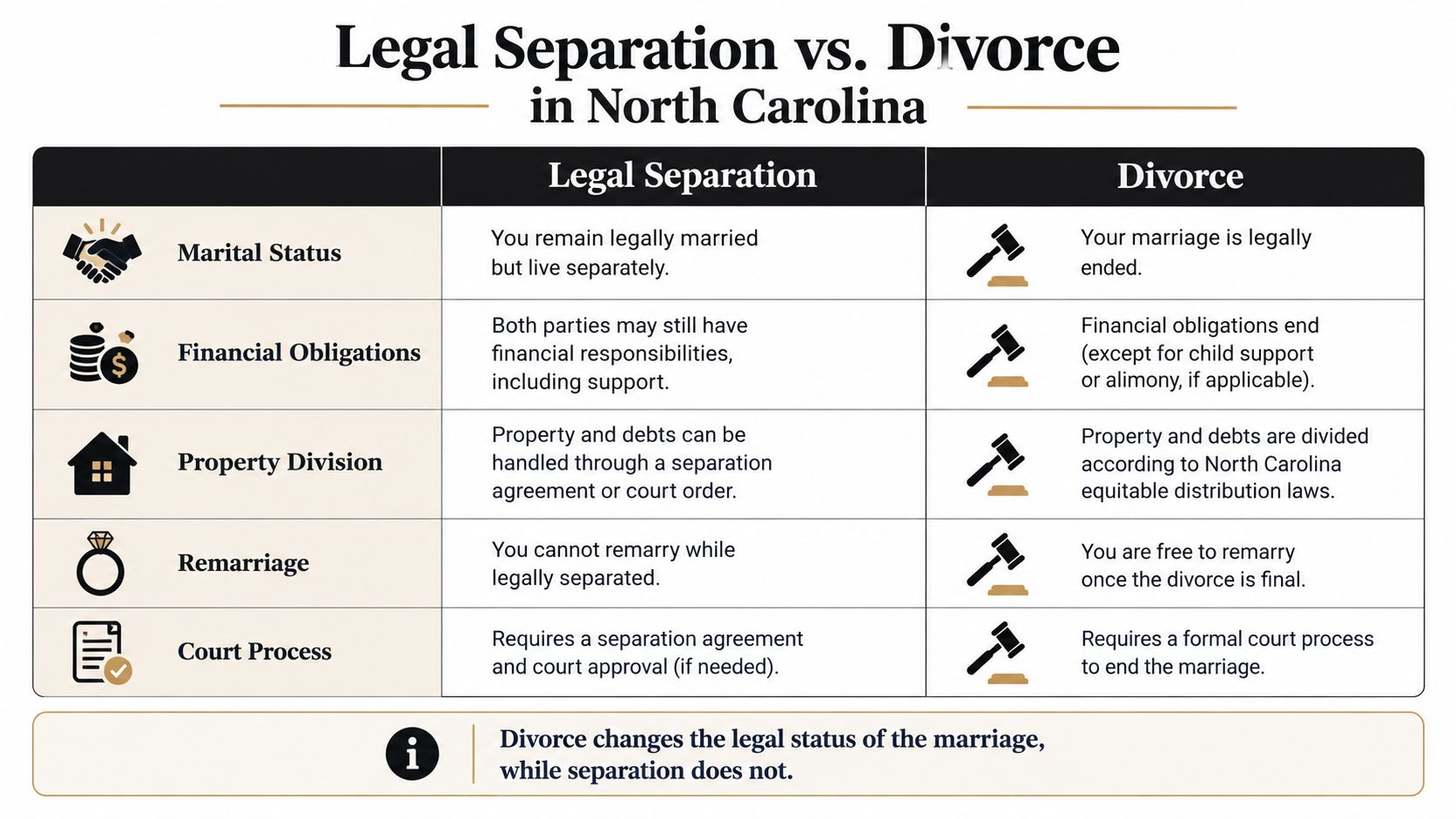
Legal Separation Compared with Divorce in North Carolina
| Issue | Legal Separation | Absolute Divorce |
|---|---|---|
| Marital status | Spouses remain married | Ends the marriage |
| Court process | No filing required merely to become separated | Requires a divorce proceeding |
| Remarriage | Separation doesn't end the existing marriage | Ending the marriage makes remarriage possible |
| Property division | Can be addressed through negotiation or a separate claim | Don't assume divorce itself settles property |
| Financial obligations | Need clear terms or appropriate relief | Existing support issues require separate attention |
| Custody | Can be addressed during separation | Divorce isn't the required starting point |
| Timing | Begins when the separation conditions are met | Depends on the statutory separation and residency requirements |
Finality depends on what you actually resolve
Suppose spouses agree that one will remain in the home while they negotiate its future. That arrangement answers an immediate housing question, not necessarily who ultimately receives the home or how its value will be addressed.
Likewise, ending the marriage doesn't tell you whether an earlier support obligation continues, changes, or has been settled. Your lawyer should identify the agreement, order, or claim controlling each issue rather than treating the divorce judgment as an all-purpose finish line.
For timing questions, review the North Carolina separation rule for divorce alongside advice about your unresolved claims.
The video below offers another way to consider separation and divorce.
My recommendation is straightforward: don't pursue finality without checking what remains unresolved. Waiting passively leaves practical problems unanswered, but rushing toward divorce without reviewing financial claims is no better. Plan for both daily stability and the eventual legal end of the marriage.
What a Separation Lawyer Does During the One-Year Wait
A useful legal separation lawyer turns an unsettled household into a defined set of decisions. The work includes gathering records, negotiating terms, addressing urgent disputes, and checking that proposed documents match your intentions.
A separation agreement can be temporary, partial, or full. Under Chapter 50's provisions concerning separation agreements and support, express terms in a valid agreement can bar alimony, postseparation support, and attorney-fee claims when the agreement is performed. Signing something described casually as a temporary arrangement deserves careful review.
These are the core work areas to discuss with counsel.

Match the document to the problem
A mortgage-payment provision shouldn't be mistaken for a complete property settlement. A household-expense contribution shouldn't be confused with a carefully negotiated waiver of future support.
Ask your lawyer to explain the scope of a North Carolina separation agreement before you sign. The resource Separation Agreements in North Carolina addresses how an agreement can resolve property, support, and custody.
- Clarify immediate expenses: Identify responsibility for payments and how the spouses will document them.
- Prepare the property picture: Gather mortgage records, retirement statements, business records, and debt information for equitable distribution discussions.
- Address children's needs: Determine whether cooperation is sufficient or whether custody and support proceedings are necessary.
- Review execution and performance: Confirm that the agreement is properly completed and that each spouse understands what compliance requires.
Use milestones instead of passive waiting
Set priorities based on urgency. A child's disrupted routine or an unpaid essential bill needs attention before a debate over household furniture.
Then work toward a complete financial inventory and a deliberate settlement strategy. Equitable distribution is the legal process for addressing the division of marital property; your lawyer needs records, not guesses, to prepare that discussion.
Don't sign away a long-term claim simply to end a difficult conversation today.
A lawyer can explain trade-offs, negotiate, and pursue appropriate relief. No agreement or litigation strategy can guarantee that every dispute will disappear.
Real Scenarios North Carolina Families Face During Separation
The following are hypothetical illustrations, not reports of actual clients or successful outcomes. They show why the right legal response depends on what has changed, what was documented, and what needs immediate protection.
North Carolina parents can seek custody regardless of marital status, and a custody order isn't required before requesting child support. The North Carolina Judicial Branch's custody and child-support resources also explain that these are separate issues and that support may remain payable under joint custody.
A Wake County relocation disrupts an informal arrangement
Consider a Wake County couple with two children. One parent moves two hours away, changes the children's schools, and stops making previously agreed support payments. Those details illustrate a scenario, not a rule about permissible relocation or an actual case result.
A lawyer's first questions should concern the children's present location, existing orders, communications about the move, and immediate needs. The next discussion would address a custody complaint, child-support relief, and whether any urgent protection is warranted.
Without an existing written arrangement, counsel must reconstruct what the parents understood. Preserve messages, payment records, and school communications rather than trying to resolve the dispute through increasingly hostile exchanges.
- Custody work: Identify the parenting arrangement being requested and the facts supporting it.
- Support work: Document the financial shortfall and assess the appropriate support process.
- Urgency assessment: Ask whether the circumstances justify emergency relief rather than assuming every relocation qualifies.
Before changing residences yourself, discuss moving out during separation in North Carolina with counsel.
A Durham agreement answers only part of the problem
Now consider Durham spouses with a jointly titled home, a small business, and a written Voluntary Support Agreement. Their support arrangement gives counsel something concrete to examine, but it doesn't necessarily settle ownership of the home or business.
The lawyer would review whether the support agreement received court approval, what it requires, and whether payments comply with it. Separately, counsel would gather property and business records and prepare equitable distribution negotiations.
If either spouse reports asset transfers or threats, counsel should assess whether protective measures or orders are appropriate. The existence of an agreement helps define obligations; it doesn't eliminate the need to respond when circumstances change.
When It Is Time to Hire a Legal Separation Lawyer
Schedule a consultation when the consequences of being wrong exceed what you can comfortably manage alone. You don't need to wait for a hostile letter, a missed payment, or a court filing.
An early consultation can be limited and practical. You may need advice on a proposed move, review of a draft agreement, or help deciding whether a negotiated arrangement is sufficient. Full litigation isn't the only way to obtain legal guidance.
Signals that deserve prompt attention
- Your children's arrangements are changing: A parent restricts contact, proposes relocation, or makes school decisions without meaningful discussion.
- Essential expenses aren't being paid: Bring the actual bills and payment history, not just an estimate of what your spouse owes.
- Joint finances are becoming unpredictable: New debt, unexplained withdrawals, or missing statements justify a focused records review.
- Your property is complicated: A business, retirement assets, jointly owned real estate, or concerns involving a professional license call for individualized advice.
- You're being pressured to sign: Ask what rights the document settles or waives before accepting a deadline imposed by your spouse.
- You're considering reconciliation: Discuss the proposed living arrangement before relying on your existing divorce timeline.
Bring documents that let counsel act
Prepare a short chronology of the move, important discussions, payments, and parenting changes. Bring any existing agreement or order, recent financial records, and communications directly related to the dispute.
A lawyer can help document the separation date in writing, assess a court-approved Voluntary Support Agreement, or evaluate a custody filing. When children may be at risk, ask specifically whether emergency custody relief is available on your facts.
Don't spend the consultation proving that your spouse is difficult. Use it to identify what needs protection and what evidence supports the next step.
Before signing: Ask your lawyer to distinguish immediate relief, negotiable issues, and rights you could permanently give up.
You should leave with priorities, not just reassurance. Ask what needs action now, what can be negotiated, and what you should avoid doing while the dispute remains unresolved.
Misconceptions North Carolina Spouses Bring to the Table
The most dangerous assumptions often sound reasonable because they combine a true idea with an unsupported conclusion. Parents may share custody, for example, but that doesn't answer the separate financial question.
Custody, support, separation timing, and property rights aren't interchangeable. Treating them as a single package leads spouses to make concessions without understanding what they're receiving in return.
Parenting time isn't a substitute for support
| Common assumption | Better way to approach it |
|---|---|
| Joint custody means no child support | Review the children's needs, parental incomes, and custodial arrangement |
| Moving out creates an automatic equal schedule | Obtain advice about an actual parenting agreement or custody claim |
| Missed support payments justify withholding visitation | Address support enforcement separately from parenting access |
| Denied visitation excuses nonpayment | Pursue the contact dispute without assuming support obligations disappear |
| A friendly parenting plan is enough protection | Ask what is enforceable and what requires court action |
The Judicial Branch's custody and support guidance distinguishes payment obligations from access to children. Do not use either to influence the other. Keep records and pursue the appropriate legal remedy.
A promise and an enforceable arrangement aren't the same
An oral promise may explain why you accepted an arrangement, but relying on memory creates avoidable disputes. Ask counsel whether you need a notarized separation agreement, a court-approved support agreement, or a custody order.
These documents serve different purposes. Have your lawyer explain how each can be enforced, changed, and used if a parent crosses state lines.
Reconciliation isn't determined by what you call it
Saying you're only testing the relationship doesn't settle whether your conduct amounts to resumed marital relations. Likewise, one encounter shouldn't automatically be treated as a full reconciliation.
The statutory distinction discussed earlier requires an honest examination of what happened. Tell counsel about shared residences, household routines, and attempts to reunite rather than offering only your preferred label.
The better habit is to ask a narrow question before making a consequential decision. Will this document waive support? Does this parenting arrangement need a court order? Could this move affect the separation timeline? Specific questions produce more useful advice than assumptions drawn from someone else's divorce.
Frequently Asked Questions About Legal Separation in North Carolina
Can I request child support or postseparation support before divorce?
Yes, divorce filing isn't the required starting point for every support claim. Child support and postseparation support, which addresses spousal support during separation, involve different requirements.
Ask counsel to assess both separately. A request for support isn't a guarantee of an award, and the wording of an existing agreement may affect available spousal-support claims.
Does moving out settle who gets the marital home?
No. A decision about who lives in the home during separation shouldn't be treated as a completed property settlement.
Before moving, review the mortgage, title records, payment arrangements, and any proposed agreement with a lawyer. Ask how to preserve records and address possession without unintentionally agreeing to broader financial terms.
Do I need a court order declaring me legally separated?
Not for North Carolina's basic separation status. The living-arrangement and intent requirements described earlier govern that question.
Court proceedings may still be appropriate for custody, support, or other disputes. Don't confuse the absence of a required separation order with the absence of legal remedies.
What if we date, vacation together, or briefly share an address?
Those labels don't provide a dependable answer by themselves. Counsel needs to understand where you lived, why you shared space, and whether you resumed marital relations.
Distinguish a visit from reestablishing a married household, and disclose intimate contact. The statutory treatment of isolated intercourse doesn't give blanket protection to every attempted reconciliation.
Before planning a filing date, have counsel evaluate the actual conduct and continuity of separation. A careful review is more useful than assuming either that every visit restarts the clock or that no attempted reunion can affect it.
For North Carolina residents navigating separation, Law Office of Bryan Fagan offers representation in divorce, equitable distribution, custody, child support, and spousal support matters. Schedule a consultation and bring your separation timeline, financial records, and any proposed agreement so you can discuss immediate protections and a practical plan before divorce eligibility arrives.