A final order can leave a North Carolina family with a problem that still needs attention. A parent may learn that a support obligation no longer reflects a major change in income. A former spouse may fall behind on support. Or a party may read the signed judgment and find that a key fact, calculation, or requested ruling appears to be missing.
Those situations can feel similar, but they don't necessarily call for the same legal response. A motion to correct or challenge the original judgment follows a different path from a request to modify an ongoing obligation because circumstances have changed. Choosing the wrong procedure, or missing its deadline, can limit what the court can consider.
When the Final Order Is Not the End
Suppose a North Carolina parent receives a custody and support order, then discovers that the written order doesn't match what the judge said at the hearing. That parent may need to ask the court to correct or clarify the judgment, not seek a new arrangement based on changed circumstances. A former spouse whose income has changed substantially may face a different question: whether an ongoing support order can be modified under the applicable family-law statute.
A third person may be dealing with missed payments. That problem may call for enforcement rather than an effort to change the original judgment. In family law, contempt of court may be one avenue to address alleged noncompliance, but it doesn't replace the rules for challenging or modifying an order.
North Carolina provides procedures to ask a court to revisit a judgment, correct an error, or modify certain continuing obligations. The route depends on what went wrong. An error in the judgment itself, newly discovered evidence, and a later change in financial circumstances are distinct problems, even when each leaves someone feeling that the current order is unfair.
Timing matters because some post-judgment remedies have short filing windows, while others turn on a different statutory standard. The court also needs specific facts and evidence, not only a general statement that the result is difficult or unjust. If you're dealing with a recent judgment, a missed payment, or a changed family situation, first identify whether you're challenging the original order, seeking a change to an ongoing obligation, or asking the court to enforce what it already ordered.
What a Post Judgment Motion Really Is
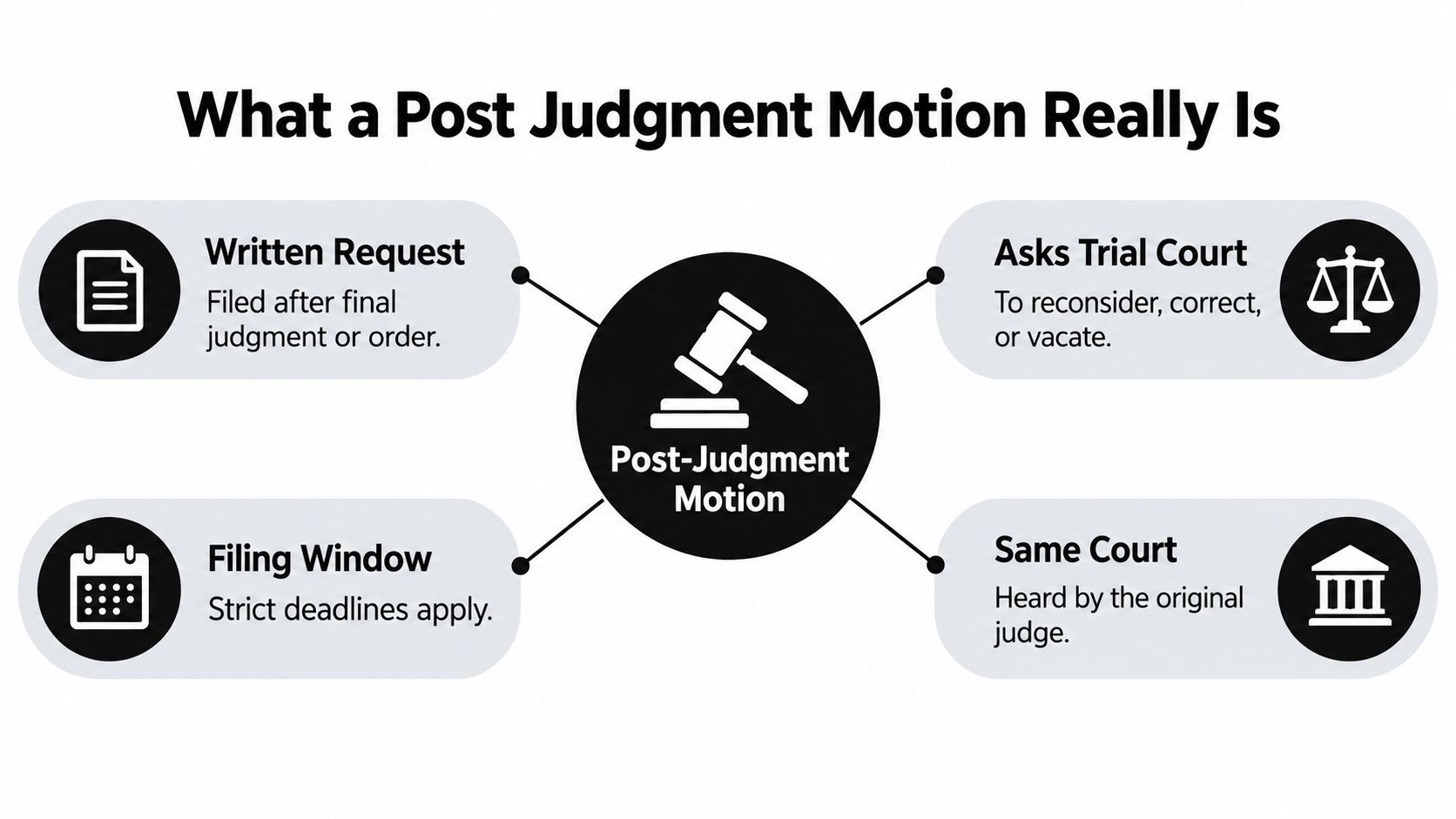
A post-judgment motion is a written request asking the trial court to take action after entering a judgment or order. Depending on the rule and the problem, the request may seek a correction, additional factual findings, a new trial, a change to the judgment, or relief from the judgment.
The term describes a category of filings, not one form that fits every situation. A motion asking the judge to amend findings is different from one seeking relief because of fraud. A request to change ongoing support based on changed circumstances is different again.
A motion is not an appeal
A post-judgment motion is generally brought in the trial court that entered the judgment. An appeal asks a higher court to review claimed legal error under the appellate rules. The motion may give the trial court an opportunity to correct or clarify its own ruling, but it doesn't automatically substitute for an appeal or preserve every appellate right.
A useful starting point is to name the precise problem. Did the written order contain a clerical mistake? Are factual findings missing or inconsistent with the record? Did something happen that could justify relief from the judgment? Or has an ongoing support obligation become inappropriate because circumstances changed? Each answer points toward a different legal analysis.
North Carolina's Rules of Civil Procedure govern many motions challenging a civil judgment. Family-law statutes separately address some continuing obligations, including alimony and postseparation support. That distinction matters: a party trying to undo the original result may need to meet a rule-based standard, while a party seeking to update an ongoing obligation may need evidence tied to a statutory basis for modification.
The Main Post Judgment Motions Under NC Rules
A motion's usefulness depends on the problem it addresses and the deadline that applies. North Carolina procedure separates requests to correct or set aside a judgment from requests to change an ongoing family obligation. Choosing the wrong route can leave a valid concern without an available remedy.
Rules 50(b), 52(b), and 59
Rule 50(b) concerns a request for judgment after a jury verdict in circumstances covered by the rule. It is not a general method for reopening a family-law order or asking a judge to reconsider an unfavorable outcome. Whether it applies depends on the case type and its procedural history.
Rule 52(b) allows a party to request amended or additional findings of fact and a corresponding amendment to the judgment. In North Carolina civil and family-law matters, the motion must be made no later than 10 days after entry of judgment. It may be combined with a Rule 59 motion. The request should identify a defect in the findings or in how those findings support the legal result, rather than offer evidence that could have been presented before judgment. The text of North Carolina Rule 52 sets out this procedure.
Rule 59 permits a party to seek a new trial or ask the court to alter or amend a judgment. The motion must be served no later than 10 days after entry of judgment. Grounds listed in the rule include irregularity in the proceedings, misconduct, newly discovered evidence, excessive or inadequate damages, and an error in law. Supporting affidavits must be served with the motion. See North Carolina Rule 59 for the grounds and timing.
Rule 60 and continuing family obligations
Rule 60 allows relief from a final judgment for specified reasons, including mistake, excusable neglect, newly discovered evidence, fraud, a void judgment, or another ground that justifies relief. A motion based on mistake, excusable neglect, newly discovered evidence, or fraud must be made within a reasonable time and no more than one year after entry. Other Rule 60 grounds must also be raised within a reasonable time, even if the rule sets no matching one-year limit. The text of North Carolina Rule 60 describes these limits.
A continuing obligation follows a different path when the request concerns changed circumstances rather than a defect in the original judgment. North Carolina law permits a court to modify or vacate alimony or postseparation support on a motion in the cause and a showing of changed circumstances. Missed payments raise a separate enforcement issue, and contempt of court in family law has its own requirements. Residency rules govern the underlying divorce filing, not post-judgment relief, so confirm jurisdiction separately.
Choosing the Right Pathway for Your Situation
The central question is whether the problem lies in the judgment as entered or in circumstances that changed afterward. A request to fix an error in the original order follows a different legal route from a request to revise an ongoing support obligation.
For example, if an entered order contains a clerical error, Rule 60(a) may allow the court to correct it. If the order accurately records the judge's decision but the party believes that decision was affected by fraud or excusable neglect, the analysis may involve Rule 60(b). If the issue is that a continuing support order no longer fits the parties' circumstances, the relevant family-law statute may provide the route instead.
A parent seeking a custody change should be prepared to connect the requested relief to the facts that matter under the custody law, not point to dissatisfaction with the existing arrangement. The procedural question of modifying an order is separate from the question of custody modification in North Carolina.
| Pathway | Typical problem | Key deadline | Standard the court applies |
|---|---|---|---|
| Rule 60(a) | Clerical or mechanical error in the order | May be corrected at any time under the rule | Correction of a clerical mistake, not a substantive change |
| Rule 52(b) | Missing or defective factual findings | No later than 10 days after entry | Whether amended or additional findings are warranted based on the record |
| Rule 59 | Grounds for a new trial or amendment of the judgment | Serve no later than 10 days after entry | Whether a listed Rule 59 ground supports relief |
| Rule 60(b) | Mistake, excusable neglect, newly discovered evidence, fraud, or another specified ground | Within a reasonable time; some grounds have a one-year limit | Whether the facts meet a recognized Rule 60 ground |
| Modification of ongoing alimony or postseparation support | Changed circumstances affecting a continuing support order | The statute allows a motion in the cause; timing depends on the issue | Whether changed circumstances justify modification or vacation |
Before contacting counsel, ask: What went wrong? When did I learn of it? Is the requested change clerical or substantive? Is an appeal deadline approaching? Those answers help identify the right evidence and prevent a motion from being treated as a substitute for a different remedy.
Evidence and Elements You Need Before You File
A post-judgment motion is strongest when it connects a specific problem in the order to a rule, a requested remedy, and evidence supporting that request. Begin with the signed, entered order and identify what needs correction. The evidence for attacking a judgment differs from what supports a request to change an ongoing obligation.
For a Rule 52(b) motion, point to the specific finding that is missing or inaccurate and identify the part of the hearing or trial record supporting the requested change. If the issue is a claimed change in income affecting continuing support, gather financial records tied to that obligation, such as pay records or tax documents. Relevant evidence should prove the issue raised, rather than recount the entire history of the dispute.
Assemble a focused filing packet
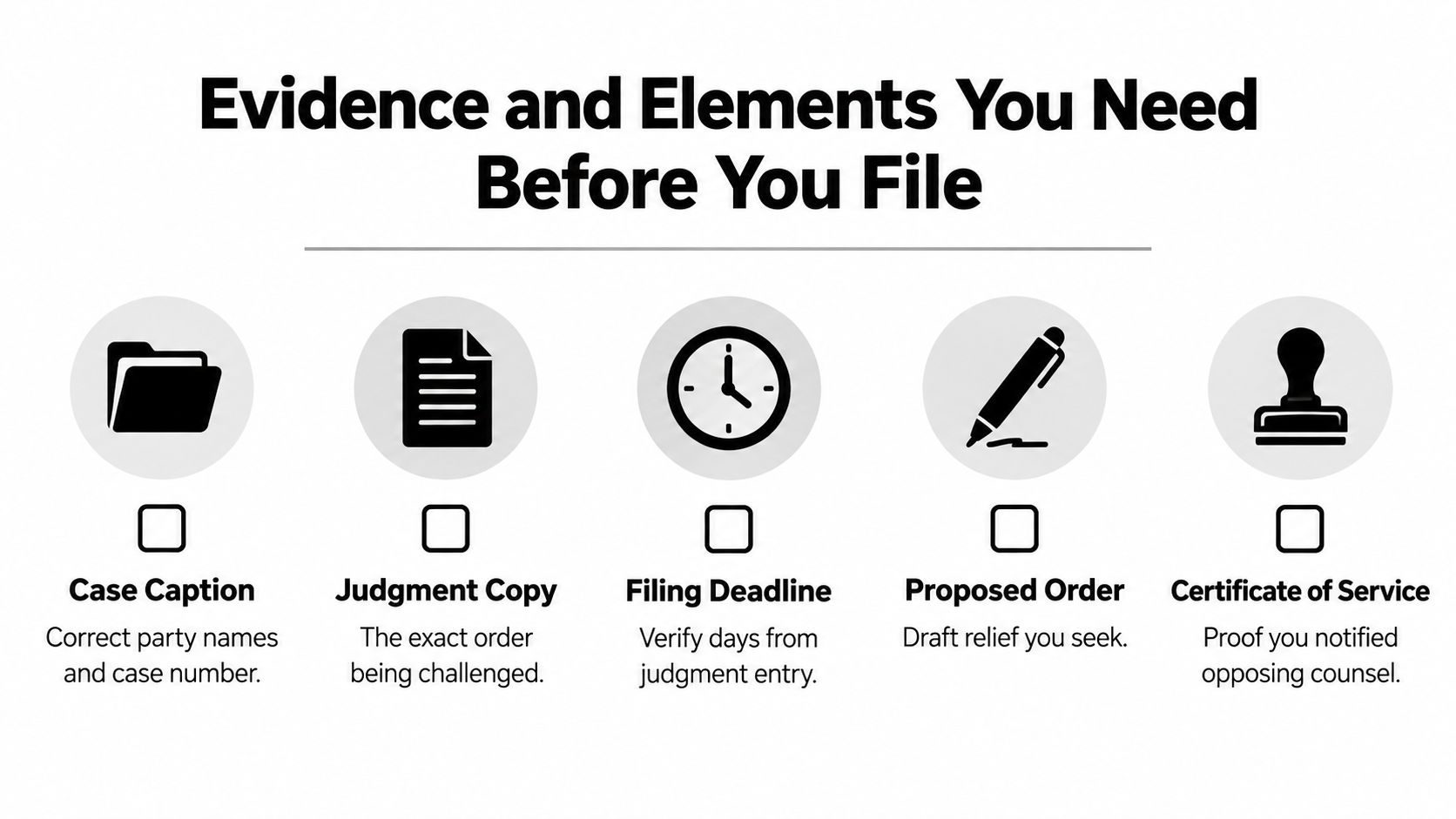
A motion should identify the case, the judgment at issue, the rule relied on, the relief requested, and the facts and legal grounds supporting it. North Carolina court guidance generally calls for motions to be written, filed as separate documents, and served on every other party. Filing and service follow the applicable civil rules, while local hearing procedures may differ.
Before filing, check that the packet includes:
- Caption and case number: Match the parties' names and court file information to the case.
- Judgment copy: Attach or clearly identify the entered order at issue.
- Rule and requested relief: State the procedural basis and specify what you want the court to do.
- Supporting evidence: Select records that fit the issue, such as hearing excerpts, financial documents, communications, medical records, parenting records, or valuations.
- Affidavits and service: If affidavits support a Rule 59 motion, serve them with the motion. The opposing party generally has 10 days to serve opposing affidavits. The court may extend that period by up to 30 additional days for good cause or written stipulation. Rule 59's affidavit provisions govern this exchange.
Keep a record of entry, filing, and service dates, and retain proof of service. A late filing or inadequate service can undermine an otherwise well-supported request. Filing the motion as a separate document, rather than embedding it in a brief, also helps keep the requested relief and its legal basis clear.
Why Deadlines Drive Everything in NC
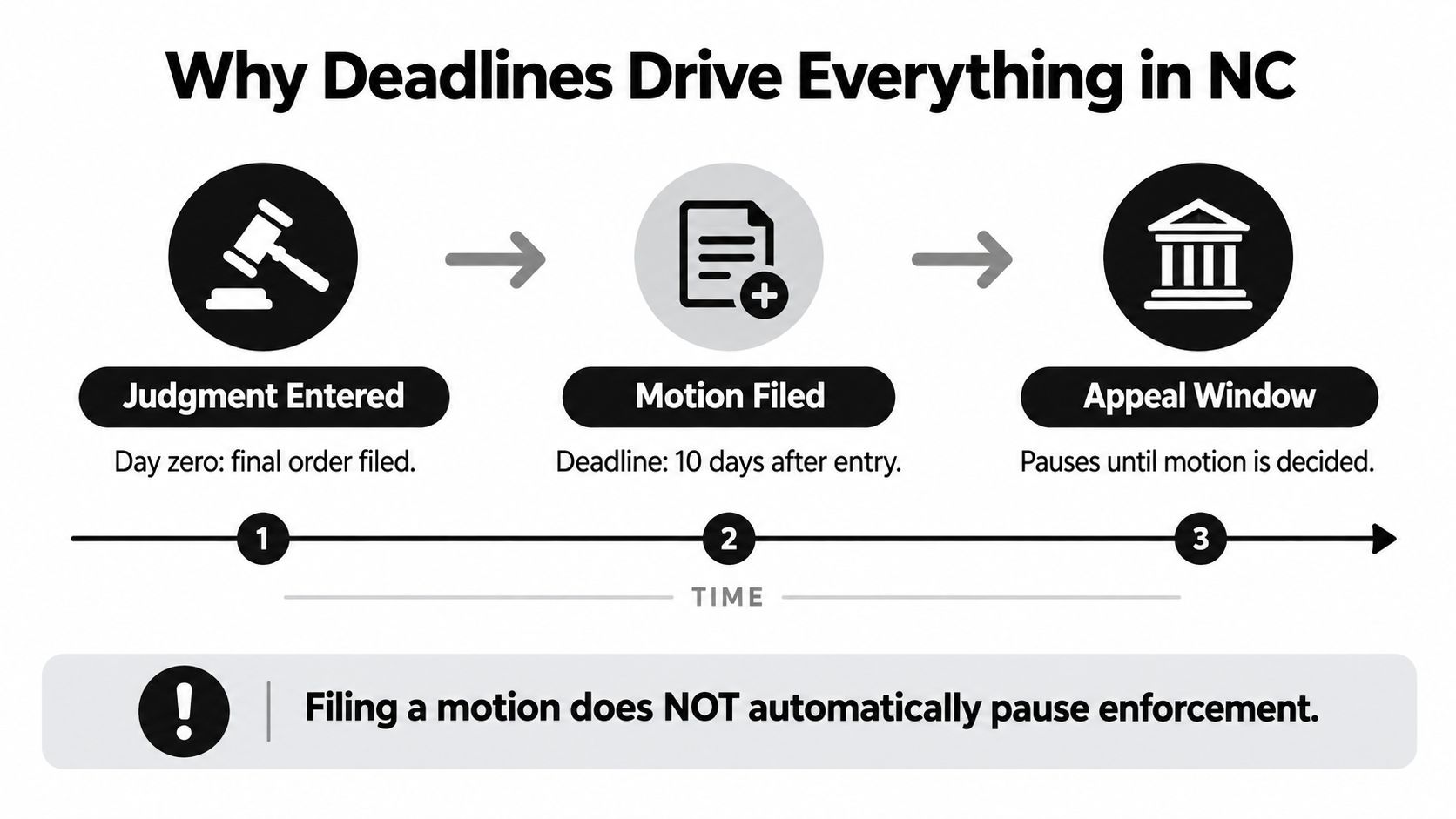
Filing a post-judgment motion does not automatically stop enforcement. It also doesn't automatically extend the time to appeal. Those are separate questions, and assuming that one filing solves both can put a party at risk.
For a civil appeal, the ordinary notice-of-appeal period is generally 30 days, subject to the applicable appellate rules. A timely motion under Rule 50(b), 52(b), or 59 tolls that period for all parties until the trial court enters an order disposing of the motion. A Rule 60 motion, by contrast, doesn't toll the appeal deadline for the underlying judgment. The North Carolina Rules of Appellate Procedure explain how timely post-trial motions affect the appeal clock.
The date calculation depends on the actual entry and service events. Without a qualifying motion, the ordinary appeal period generally runs from entry when the judgment is served within Rule 58's three-day period, or from service if service is late. A motion that is untimely or procedurally defective may not toll the period, so a party shouldn't assume the appeal deadline has paused without checking the rule and the court record.
Keep enforcement and appeal planning separate
Even a properly filed motion doesn't automatically stay enforcement of the judgment. If an order requires support payments, property transfer, or other action, a party may need to seek a separate stay or other appropriate relief. The right step depends on the order and the procedural posture.
Practical rule: Calendar the motion deadline and the appeal deadline separately. After the court decides a tolling motion, calculate the renewed appeal period under the applicable rule rather than relying on a prior calendar entry.
A post-judgment motion can be part of an appeal-preservation strategy, but it isn't a replacement for one. If you're weighing a trial-court motion against an appeal, review the North Carolina family court appeal process promptly, because the remedy selected and the filing dates work together.
Walking Into the Hearing Prepared
At a post-judgment hearing, the judge will consider the motion, the response, the relevant record, and the legal basis for the requested relief. The moving party should be ready to explain the specific error or change in circumstances and connect it to the evidence. Repeating the history of the relationship or trial without linking it to the rule may distract from the issue the court must decide.
Bring organized copies of the judgment, motion, supporting affidavits, and exhibits. If you rely on a transcript or hearing record, identify the relevant portions in advance. An attorney can also prepare the legal authorities and a proposed order that clearly states the relief requested.
The court may grant a motion in whole or in part, deny it, dismiss it as moot, or refer a matter for further handling. North Carolina's 2023–24 appellate statistical and operational report recorded 5,527 appellate motions, including 4,901 allowed, 269 denied, and 229 dismissed motions. The category covers appellate motions generally, not only trial-level Rule 59 filings, so those figures aren't a prediction of how a particular post-judgment request will turn out. The North Carolina Judicial Branch appellate report shows the scale of motion-related work in the appellate courts.
If you're representing yourself, bring a concise written outline and answer the judge's questions directly. If enforcement needs to pause while a motion or appeal is pending, ask about a separate stay or other appropriate relief; a motion alone doesn't provide that protection.
Common Questions and When to Call an NC Attorney
How long do I have to file a post-judgment motion in North Carolina?
Rule 59 motions and Rule 52(b) motions generally must be served or made no later than 10 days after entry of judgment. Rule 60 has different timing requirements, and some grounds have a one-year limit.
Does a Rule 60 motion stop enforcement or pause my appeal deadline?
No. A Rule 60 motion doesn't itself stay enforcement or toll the appeal period for the underlying judgment. A separate stay or timely appeal may need to be considered.
Can I change child support or alimony after divorce?
Possibly, but a request to modify a continuing obligation is different from an attempt to undo the original judgment. For alimony or postseparation support, North Carolina law allows a motion in the cause based on changed circumstances; the evidence must relate to the obligation and the requested change.
When should I talk to an attorney?
Seek advice promptly if you've just received a judgment, discovered a possible error, or need to change or enforce an order. The right path depends on the facts and the dates, and no outcome is guaranteed.
The Law Office of Bryan Fagan helps North Carolina residents assess whether a post-judgment motion, a modification request, an appeal, or another step fits their situation. If you're facing a deadline or trying to address a family-court order, visit the Law Office of Bryan Fagan to schedule a consultation about your options.