You've reviewed the North Carolina Child Support Worksheet, and the monthly figure doesn't make sense. Perhaps your child has ongoing medical or educational expenses the worksheet doesn't seem to capture. Perhaps the other parent earns substantially more, yet the calculation appears too low. Or perhaps your income has fallen and the existing order no longer reflects what you can realistically pay.
That frustration is understandable, but a court won't change child support just because a number feels unfair. A support order is a legal obligation, and a different amount requires a specific legal showing. The key is to separate two questions: does the guideline amount apply, and if it does, has the evidence proved that a different amount is necessary?
When the Worksheet Number Feels Wrong
Consider a parent in Wake County who receives a completed worksheet before a support hearing. The figure seems disconnected from reality. The child attends therapy every week, health expenses keep rising, and the other parent has resources that the worksheet may not fully reflect. The parent's first instinct is often, “The judge should just use a different number.”
That instinct skips an important step. North Carolina courts start with the presumptive guideline calculation, then examine whether applying it would fail to meet the child's reasonable needs, exceed those needs, or otherwise be unjust or inappropriate. A request for a different amount must be tied to evidence, not just disagreement with the worksheet.
For a parent preparing for court, the practical roadmap is:
- Identify the presumptive guideline obligation.
- Gather proof of the child's reasonable needs.
- Document both parents' financial circumstances.
- Show why the guideline figure is inadequate, excessive, unjust, or inappropriate.
- Present a method for calculating the substituted amount.
- Make sure the final order contains the findings North Carolina law requires.
The same framework applies whether you're asking for more support, seeking a lower amount, or responding to the other parent's request. A useful overview of the state's calculation process is available in North Carolina's child support guidelines. The worksheet matters, but it may be only the beginning of the analysis.
The Presumption That Starts Every NC Child Support Order
North Carolina treats its Child Support Guidelines as a rebuttable presumption. In plain English, the guideline amount is presumed correct unless legally sufficient evidence supports a different result. It isn't an inflexible answer, but neither is it a suggestion that parents or judges can casually replace.
Under N.C. Gen. Stat. § 50-13.4, the Conference of Chief District Judges establishes uniform statewide guidelines and must review them at least once every four years. The current guidelines became effective January 1, 2023, as reflected in the North Carolina Child Support Guidelines. Courts must use the guidelines in temporary and permanent support orders, including contested hearings, unless the evidence establishes a lawful basis to deviate.
What the presumption means in practice
The court generally follows this sequence:
- The parties provide financial, custody, insurance, and childcare information.
- The court identifies the appropriate worksheet and calculates the presumptive obligation.
- A parent may request a deviation.
- The court hears evidence about the child's needs and the parents' relative ability to pay.
- The judge decides whether the guideline result should remain in place or whether a different amount is justified.
Parents sometimes assume the worksheet is a ceiling, meaning the court can never order more. Others view it as a floor, or believe they can privately negotiate any amount without court scrutiny. Neither assumption accurately describes North Carolina law. The worksheet is the required starting point, and a departure requires proof connected to the statutory standard.
Practical rule: A judge must know the presumptive guideline amount before deciding whether the evidence justifies something different.
That starting figure gives the court a reference point. Without it, there's no reliable way to explain what the deviation changes or why the substituted award is connected to the child's needs and the parents' financial capacities.
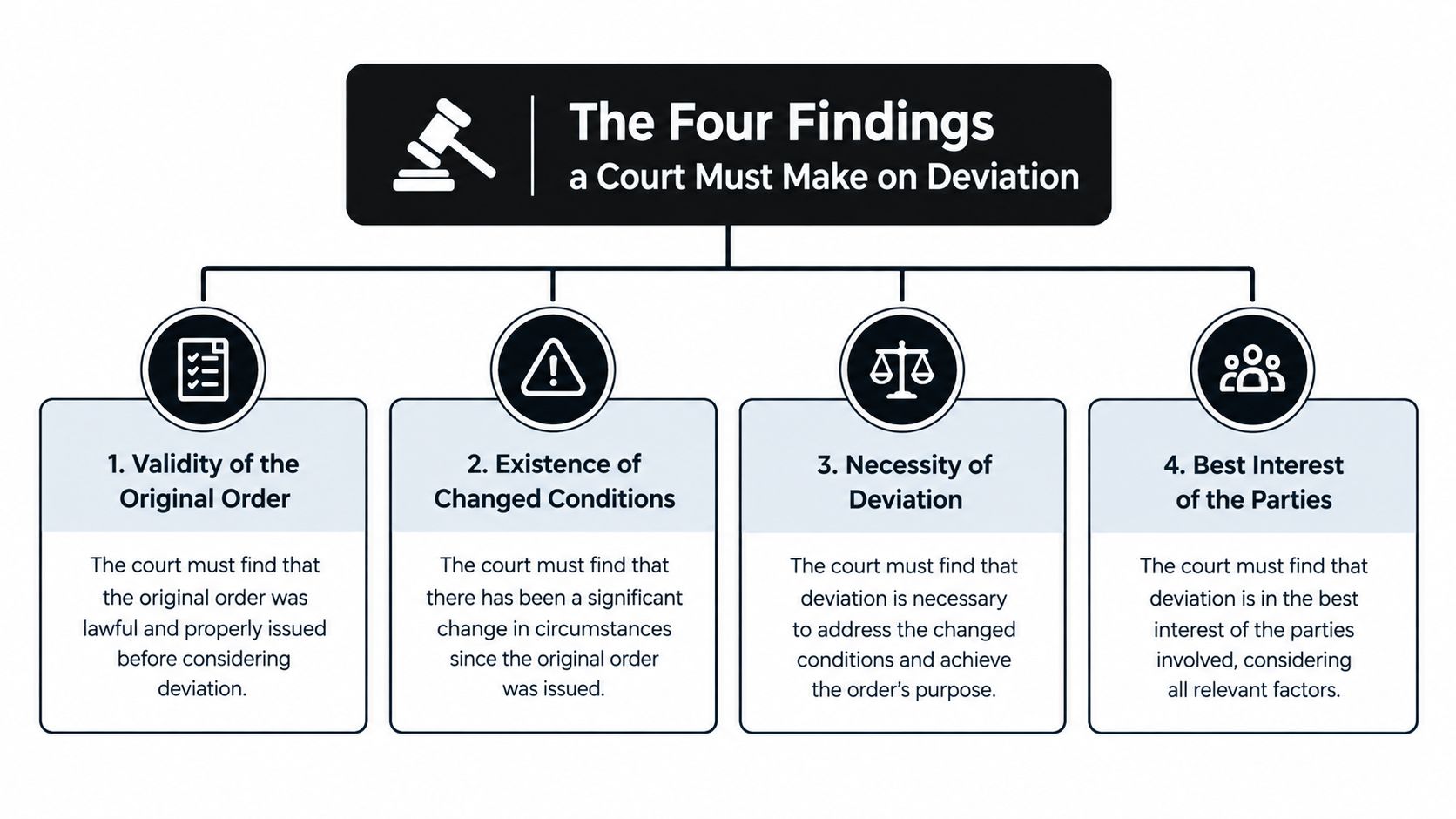
The Four Findings a Court Must Make on Deviation
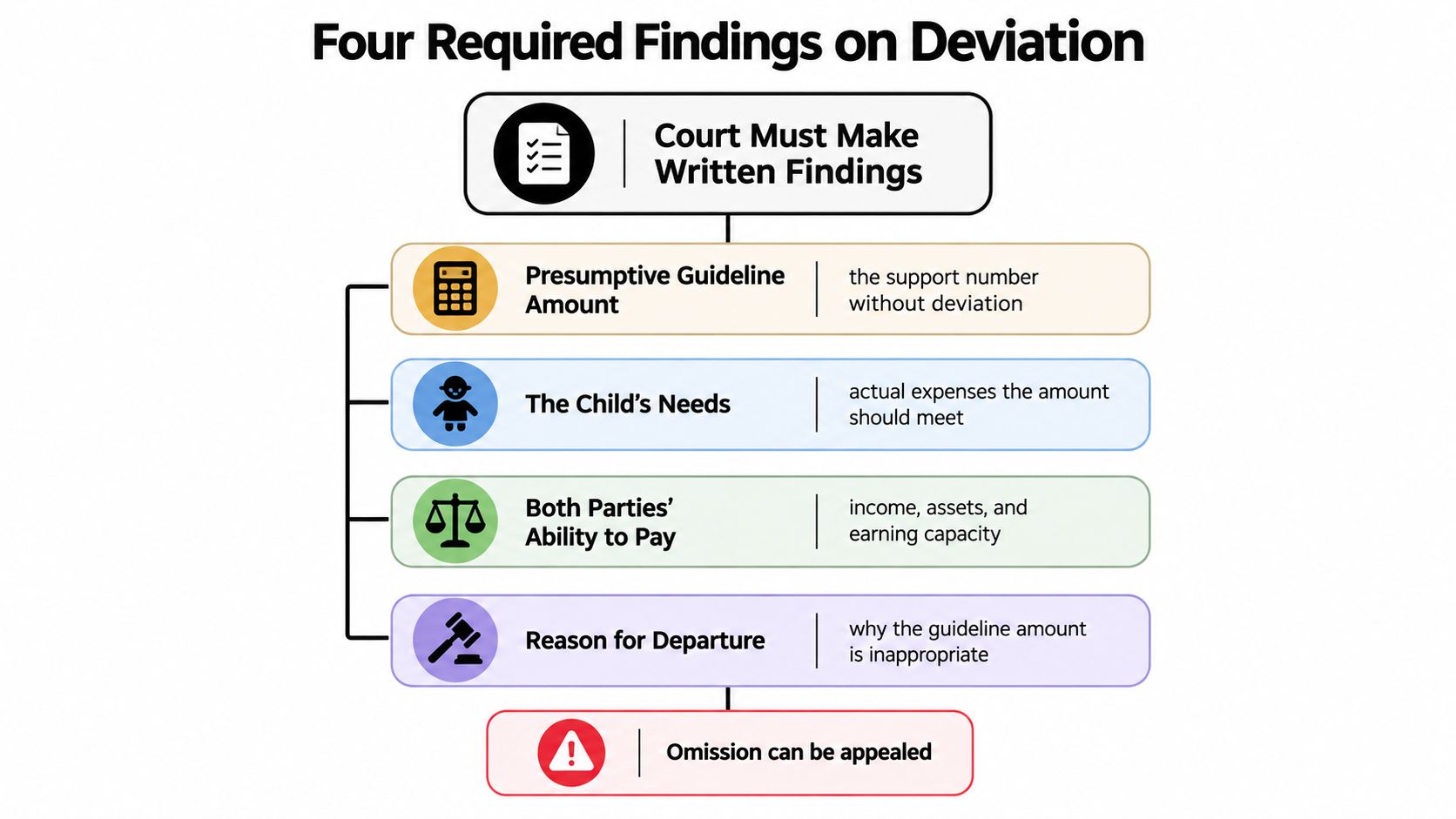
A North Carolina deviation order needs more than a sentence saying that a different amount would be fair. The written findings must identify the presumptive guideline obligation, the child's reasonable needs, each parent's relative ability to provide support, and the evidence showing why the presumptive figure is inadequate, excessive, unjust, or inappropriate. The order must also explain the method or factual basis used to calculate the substituted amount.
Those requirements protect both parents and the child. They show the parties what the judge considered, make the decision understandable, and allow an appellate court to review whether the legal standard was followed.
The first finding identifies the baseline
The order should state the amount produced by the applicable worksheet. That figure may depend on the parents' income, custody arrangement, health-insurance costs, childcare, and other permitted inputs. A judge can't meaningfully explain a departure without identifying the amount from which the court departed.
The second finding addresses the child's needs
The court must determine what the child reasonably needs. Relevant proof may include recurring medical treatment, educational services, childcare, housing-related needs, or other expenses tied to the child's circumstances. A parent's general statement that expenses are high usually carries less weight than invoices, records, and testimony explaining why the costs exist.
The third finding compares financial capacity
The court must examine each parent's relative ability to provide support. That analysis can involve income, resources, expenses, and the financial facts shown in the evidence. The question isn't just which parent earns more. It's how the parents' respective circumstances relate to the child's needs and the requested amount.
The fourth finding explains why departure is justified
Finally, the order must connect the evidence to the conclusion that the guideline amount is inadequate, excessive, unjust, or inappropriate. In Guilford County v. Easter, decided by the North Carolina Supreme Court on July 31, 1996, the Court explained that § 50-13.4 requires evidence and factual findings concerning the child's reasonable needs and the parents' relative ability to pay when deviation is requested. The opinion is available at Guilford County v. Easter.
A conclusion that deviation is “fair,” without findings connecting the amount to the child's needs and the parents' financial capacities, doesn't satisfy the statutory structure.
For that reason, a parent seeking deviation should organize evidence around specific facts. Income records, medical expenses, custody information, insurance documents, school costs, and verified household obligations should help the judge understand not only what the expense is, but why it supports the amount requested.
Grounds Courts Actually Consider for Deviation
A deviation request becomes persuasive when it addresses a concrete mismatch between the worksheet result and the child's reasonable needs or the parents' financial capacities. North Carolina law doesn't authorize a different amount merely because one parent dislikes the calculation.
Medical, educational, and therapeutic needs
A child may require continuing therapy, specialized treatment, medical equipment, or care that ordinary worksheet inputs don't fully capture. A parent asking for additional support should gather medical invoices, insurance explanations of benefits, provider statements, and proof of unreimbursed costs. The evidence should identify the expense, its relationship to the child, and how the parents can fairly share it.
Unusual educational needs can raise similar questions. Private tuition, specialized instruction, or therapeutic educational services may matter when the evidence shows they serve a specific need rather than reflect a parent's preference.
Childcare and parenting arrangements
Work-related childcare can affect the calculation, particularly when the cost is necessary for a parent to work, attend school, or maintain employment. Provider receipts, enrollment records, and proof of the parent's work schedule can help establish the connection.
Parenting time also matters, but equal or substantial time doesn't automatically eliminate support. Shared physical custody can change the worksheet used, while differences in income and direct expenses may still leave one parent responsible for a payment. A deviation argument should focus on the actual financial effect of the schedule, not rely on the label “shared custody.”
Financial capacity and competing obligations
A high-income family may present evidence that the guideline amount doesn't reflect the child's reasonable needs in light of the parents' resources and accustomed standard of living. Conversely, a parent with extraordinary, documented expenses may argue that the ordinary calculation overstates what is fairly available for support.
A parent supporting children from another relationship may also present those obligations as part of the financial picture. The court still has to connect the evidence to the statutory questions. The existence of another obligation, standing alone, doesn't automatically produce a lower award.
| Deviation Ground | Statutory Tie-In | Evidence Typically Required |
|---|---|---|
| Extraordinary medical care | The child's reasonable health and maintenance needs | Medical invoices, treatment records, insurance statements |
| Specialized education or therapy | The child's reasonable educational needs | School statements, provider records, enrollment documents |
| Necessary private childcare | The child's needs and each parent's ability to pay | Childcare receipts, provider verification, work records |
| Significant custody-related costs | The child's needs and the parents' financial circumstances | Parenting schedule, transportation records, expense documentation |
| High resources or unusual financial strain | Relative ability to provide support | Verified income records, financial affidavits, proof of recurring obligations |
The North Carolina Child Support Guidelines Explained describes how North Carolina calculates support through its worksheet system. That calculation remains central even when a parent asks the judge to depart from it.
The strongest request usually presents a direct chain: this is the child's expense, this is the financial evidence, this is what the worksheet includes or omits, and this is why the requested amount follows from the facts.
How Deviation Changes a Worksheet Calculation
Suppose two North Carolina parents complete a worksheet for one child. Their combined monthly income, custody schedule, health-insurance arrangement, and ordinary childcare produce a presumptive support obligation. For purposes of illustration, assume the worksheet establishes a monthly amount, but the precise figure depends on verified inputs and the applicable worksheet.
At the initial hearing, the court would identify that presumptive obligation first. If neither parent presents evidence supporting a departure, the guideline figure ordinarily remains the support amount. The fact that one parent believes the number is inconvenient, or that the other parent expected a different result, doesn't change the legal analysis.
Now add documented facts. The child receives ongoing therapy, one parent pays unreimbursed medical expenses, and the records show that those expenses are recurring and connected to the child's needs. The parent requesting deviation could present provider records, invoices, insurance documentation, and proof of payment. The court would then consider whether the presumptive amount meets the child's reasonable needs and how the parents' relative financial abilities affect responsibility for those expenses.
The comparison looks like this
| Worksheet stage | What the court examines |
|---|---|
| Presumptive calculation | The guideline amount produced by the correct worksheet |
| Evidence of additional need | Verified therapy, medical, educational, or childcare costs |
| Financial comparison | Each parent's income, resources, and documented obligations |
| Possible substituted award | A method tied to the proven need and ability to pay |
The court might adjust the award upward, downward, or otherwise structure responsibility for the documented expense. It might also conclude that the guideline amount already accounts for the circumstances. The important point is that the judge must explain the result through written findings and a stated calculation method.
A parent preparing numbers can review the North Carolina child support worksheet before the hearing, but an online or proposed worksheet isn't itself proof that deviation is warranted. The evidence must support the inputs and the requested departure.
This example is educational, not predictive. Outcomes depend on the specific facts, the quality of the documentation, the arguments presented, and the judge's findings. No worksheet scenario guarantees what a court will order.
Why the 15% Rule Does Not Guarantee a Deviation
The 15% rule is often described too broadly. For an existing North Carolina support order that is at least three years old, a difference of 15% or more between the existing support amount and the guideline result based on current circumstances is presumed to be a substantial change warranting modification. The North Carolina Judicial Branch child support guidance explains this review framework.
That presumption opens the door to a modification inquiry. It doesn't automatically change the order, and it doesn't automatically authorize a deviation from the new guideline amount. The court still must determine the proper current guideline calculation.
Modification and deviation are separate questions
The process is easier to understand as two stages:
- Modification eligibility: Has a substantial change occurred, or does the three-year review presumption apply?
- Deviation proof: If someone seeks an amount different from the current presumptive guideline calculation, has the evidence satisfied the required findings?
A change in income may support review without proving that a non-guideline amount is appropriate. The same is true when custody changes, insurance costs shift, childcare becomes more expensive, or the child's needs increase. The 15% comparison may start the review, but it doesn't establish that the guideline result is unjust or inappropriate.
A 15% difference may open the modification door. It doesn't decide what amount belongs on the other side.
Parents should track three separate dates: the date of the existing order, the date circumstances changed, and the date used to measure current financial evidence. Treating those dates as interchangeable can lead to the wrong procedural path or incomplete proof.
Requesting a Deviation in the North Carolina Court
A deviation request may arise when the original support order is being established or when a parent seeks modification. The request should identify the guideline calculation, the specific departure sought, and the evidence supporting it. The court needs a workable alternative, not only a complaint about the existing number.
Prepare the financial record
Parents commonly need current financial affidavits, income documentation, expense records, insurance information, childcare proof, and a verified worksheet. The appropriate worksheet may be Worksheet A, Worksheet B, or Worksheet C, depending on the custody arrangement and the family's circumstances. The worksheet should be completed before asking the court to depart from its result.
Supporting documents should be organized so the judge can trace the request. A medical invoice should connect to the child. A childcare receipt should connect to employment or another recognized need. Income records should show the financial circumstances of both parents rather than presenting only one side of the household picture.
Present the request at hearing
The court may hear testimony, review exhibits, and consider objections from the other parent. If the other side disputes income, expenses, custody time, or the child's needs, the court may require additional documentation or discovery. In some cases, a guardian ad litem may be appointed when the court determines that representation of the child's interests is appropriate.
Common problems include submitting no worksheet, relying on unsupported statements, presenting documents without proper foundation, or treating a private agreement as a substitute for judicial findings. Parents can review the process for modifying child support in North Carolina when an existing order is involved. Information about Modifying Custody and Support Orders in NC can also help distinguish when existing orders may be changed.
The requested amount should follow a clear method. Explain the presumptive obligation, identify the proven need or financial circumstance, assign responsibility based on relative ability to pay, and show how the proposed amount results. Deviation requests are fact-intensive, so preparation with an attorney familiar with North Carolina district court practice can prevent a strong factual argument from failing because the procedure or evidence is incomplete.
Frequently Asked Questions About NC Child Support Deviation
Can a North Carolina court order more than the guideline amount when income is high?
It can, but high income alone doesn't guarantee an upward deviation. The requesting parent must show that the presumptive amount fails to meet the child's reasonable needs in light of the parents' resources, circumstances, and accustomed standard of living. The court must make the required written findings and explain the method used to reach a different amount.
Can deviation reduce support when the paying parent has limited means?
A parent may request a lower amount when applying the guidelines would exceed the child's reasonable needs or would otherwise be unjust or inappropriate in light of the parents' relative ability to pay. Limited means must be supported with reliable financial evidence. A parent cannot obtain a lower award by merely asserting that the worksheet is difficult to afford, particularly if the evidence doesn't accurately show income, resources, and necessary expenses.
Is deviation available at the original support hearing?
Yes. A deviation request isn't limited to modification proceedings. At the original hearing, the court still begins with the presumptive guideline amount and must hear evidence supporting a different award. During modification, the parent must first establish a basis to revisit the existing order, then separately prove why the resulting guideline amount should be changed through deviation findings.
How long does a deviation request take?
There isn't a single reliable timeline for every North Carolina case. The duration depends on whether the other parent agrees, whether income and expenses are disputed, whether discovery is needed, the court's schedule, and how much evidence must be presented. A request supported by organized records may be easier to evaluate than one requiring the court to resolve missing or conflicting financial information.
If the worksheet number seems wrong, don't assume the 15% review rule or a private agreement will solve the problem. The safer approach is to calculate the presumptive amount, identify the precise reason it doesn't fit, and gather evidence that addresses the child's needs and both parents' ability to pay. The Law Office of Bryan Fagan helps North Carolina parents evaluate child support calculations, prepare deviation and modification arguments, and present the financial evidence courts require. To discuss whether a deviation request is realistic in your circumstances, visit the Law Office of Bryan Fagan and schedule a consultation.