Service by publication extends North Carolina's ordinary divorce waiting period from 30 days to 40 days, measured from the date of the first newspaper notice. It's available only after reasonable efforts to locate your spouse have failed and the court accepts your proof of due diligence.
You may be dealing with that problem now. Your spouse moved without leaving a forwarding address, stopped answering calls, and no longer appears to live at the last known home. You've filed, or you're preparing to file, and the case can't move forward until the other spouse receives legal notice.
Publication may provide a path forward, but it isn't a shortcut. North Carolina courts treat it as an exceptional method that requires documented search efforts, strict notice procedures, and careful attention to timing. A weak record can lead to a denied request or later challenge to the service.
Why You Might Need Service by Publication
Suppose a North Carolina resident has been separated from a spouse for the required period and is ready to pursue an absolute divorce. The spouse once lived in the same county, but has since moved. The last known phone number is disconnected, mutual friends have no current address, and mail comes back undelivered. The filing spouse wants to proceed, but the sheriff can't serve papers at an address where the other person no longer lives.
That situation may justify considering service by publication in an NC divorce, but only after reasonable avenues have been exhausted. Publication is designed for cases in which the defendant spouse cannot be located despite diligent efforts. It is not intended for someone who merely declines to spend time locating the other person.
When an unknown address is not enough
A spouse's address being unknown doesn't automatically authorize publication. North Carolina court materials describe searches such as internet research, contacting family and friends, checking DMV information, reviewing law-enforcement websites, or hiring a private investigator before asking the court to approve publication. Those efforts help show that the filer isn't using publication merely because another method feels inconvenient. North Carolina court guidance on proof of service explains why the method is treated as a last resort.
The practical distinction matters. If your spouse refuses to sign an acknowledgment or won't cooperate with the divorce, that doesn't necessarily mean publication is appropriate. Refusal to participate and genuine inability to locate the person are different problems. Guidance about what to do if your spouse refuses divorce in North Carolina may be more relevant when you know where the spouse lives.
A realistic decision point
Before pursuing publication, ask whether someone else can lawfully complete service. A sheriff or authorized process server may succeed at a workplace, a relative's residence, or another location discovered through a careful search. If you have a reasonably ascertainable mailing address, Rule 4 may require mailing a copy of the notice at or before the first publication.
The emotional pressure is understandable. You may feel that your spouse is deliberately keeping you trapped in an unfinished marriage. The court, however, needs a reliable record showing that the defendant had a meaningful opportunity to receive notice.
Understanding the Legal Requirements Under NC Rule 4
North Carolina's service-by-publication procedure comes from Rule 4 of Chapter 1A, which was materially modernized by Session Law 2008-36. The rule requires a last-resort showing of due diligence before publication is allowed. The statute is available through the North Carolina General Statutes Rule 4 text.
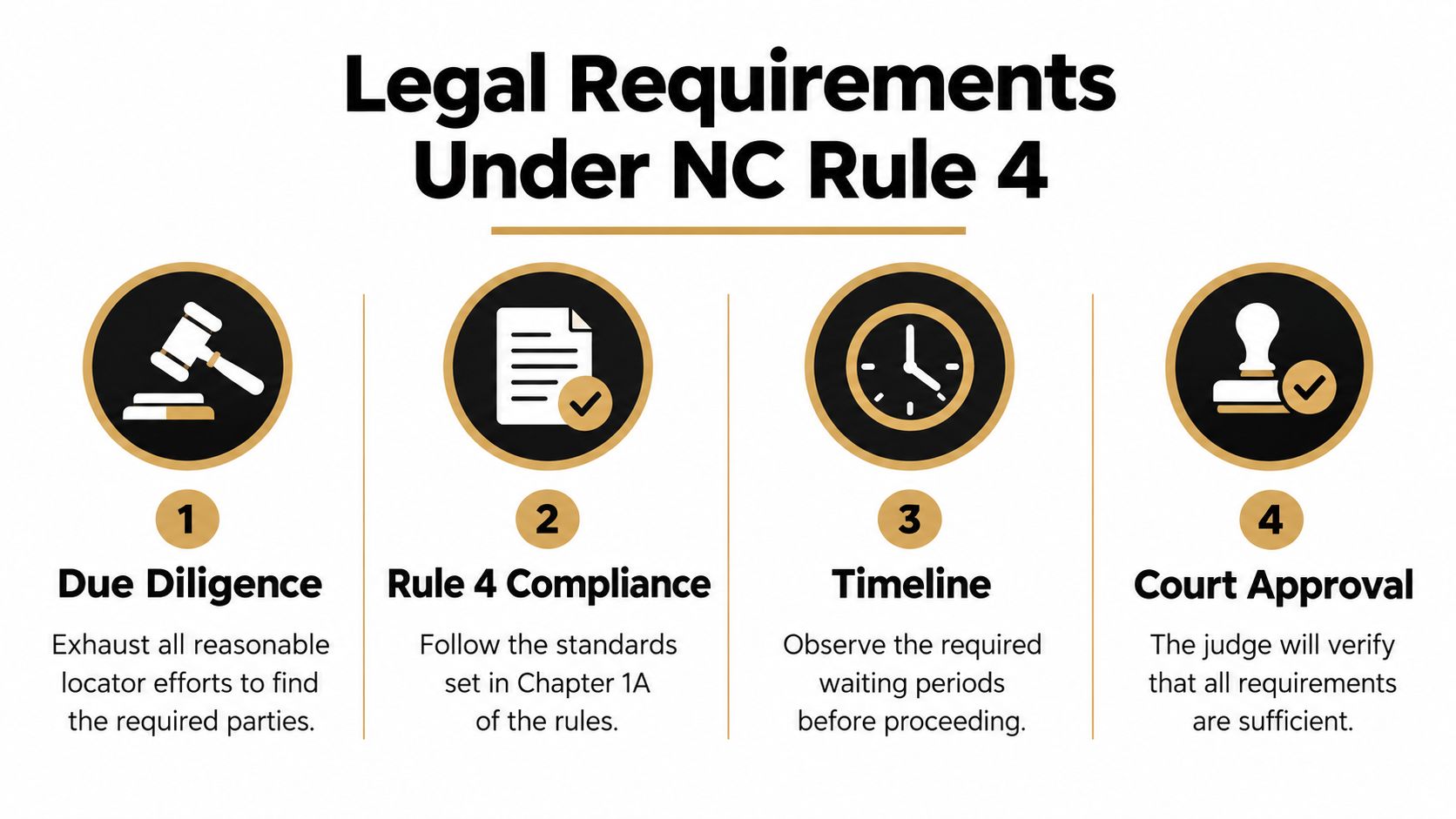
Due diligence means a documented search
Due diligence is the central issue. In plain English, the judge wants to know what you did, when you did it, and why those efforts didn't reveal a usable address or location.
A persuasive record may identify:
- Internet searches: Search engines, public records, social media, professional listings, and other lawful online sources may provide leads.
- Family and friends: Record whom you contacted, the date of each contact, and what information the person provided.
- DMV inquiries: A lawful DMV check may help determine whether a current address is available.
- Law-enforcement websites: Review available records or websites that may identify a recent location.
- Private investigation: A private investigator may be appropriate when informal efforts have produced nothing useful.
A statement that says “I looked everywhere” is much less useful than a dated log with names, methods, results, returned mail, failed calls, and attempted service records. The court materials emphasize that publication is expensive and time-consuming, which is another reason the judge may scrutinize the supporting proof.
Publication and mailing requirements
If the court permits publication, the notice must appear once a week for three successive weeks in a qualifying newspaper. The requirement is not satisfied by a casual online post, an ordinary social-media message, or a single newspaper announcement.
If your spouse's address is known or reasonably ascertainable, a copy must also be mailed to that address at or before the first publication. This requirement can apply even when you believe the spouse may not collect the mail. The important question is whether the address was reasonably available to you, not whether you can guarantee that the spouse opens the envelope.
Practical rule: Treat every search as evidence. Preserve returned envelopes, screenshots, call records, investigator reports, and written notes rather than relying on memory.
If the court finds that you skipped a reasonable service method, the request may fail. A consultation about what to do after being served divorce papers in North Carolina can also help a spouse who later learns that publication was used and wants to understand the procedural options.
The Step-by-Step Process for Publication
Publication works best when you approach it as a court-proof problem, not a newspaper-advertising problem. The notice itself is only one part of the process. Your file must also show why publication became necessary.
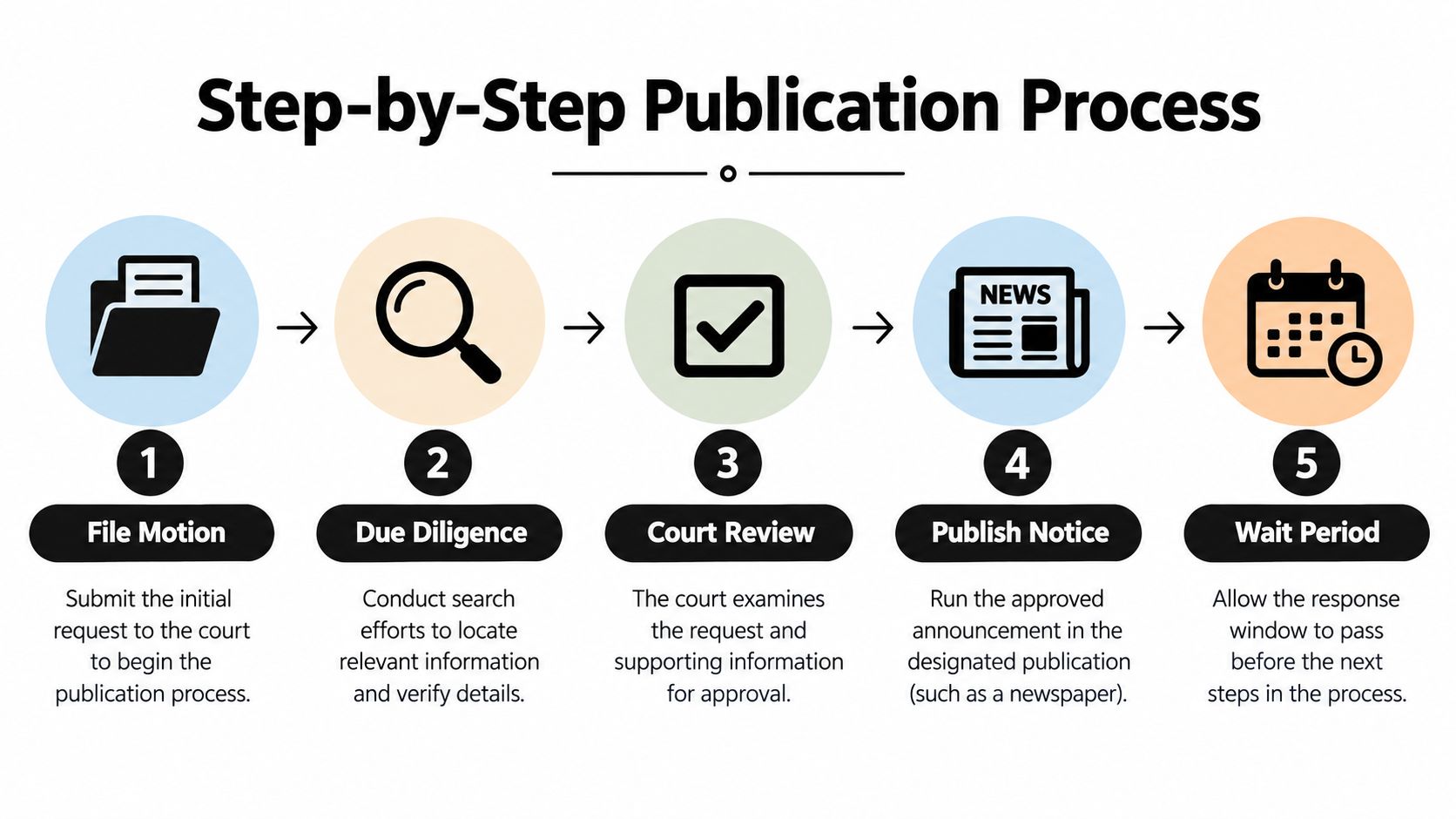
Start with the court request
1. File the divorce materials and request publication. After filing the divorce case, prepare the motion, affidavit, or other paperwork required by the clerk or court to request service by publication. The filing should identify the spouse, the last known information, and the facts supporting the request.
2. Build the diligence record. List every reasonable search attempt. Include dates, addresses, phone numbers, search terms, contacts, results, and the reason each lead did or didn't work. If certified mail, sheriff service, or another delivery method was attempted, keep the documentation.
3. Wait for judicial review. A judge or court official must determine whether the record supports publication. Don't publish first and ask for approval later unless the applicable court procedure expressly permits that sequence. An incomplete request can cost time and require renewed efforts.
Publication changes the timeline
4. Publish the notice correctly. Once authorized, arrange publication in a qualifying newspaper. The notice must run once a week for three successive weeks, as required by Rule 4. If an address is known or reasonably ascertainable, mail a copy at or before the first publication.
5. Track the response period from the first notice. North Carolina court materials state that service by publication extends the ordinary divorce waiting period from 30 days to 40 days, calculated from the first newspaper notice, not from the final publication. Keep the publisher's affidavit or other proof showing when the notice ran.
This timing issue can affect hearing preparation and expectations. A filer who counts from the wrong date may request a hearing too early or assume the case is ready when the court still needs proof of service.
The divorce itself may involve rights beyond marital status. Before an absolute divorce is granted, equitable distribution and alimony claims need attention. Don't Lose Your Rights: Filing Claims Before NC Divorce Is Final addresses why those claims must be filed before the absolute divorce is granted.
Alternatives to Service by Publication
Publication should be compared with every lawful method that might reach your spouse. The right choice depends on what you know about the person's location, whether the address is reliable, and whether the method will produce acceptable proof for the clerk.
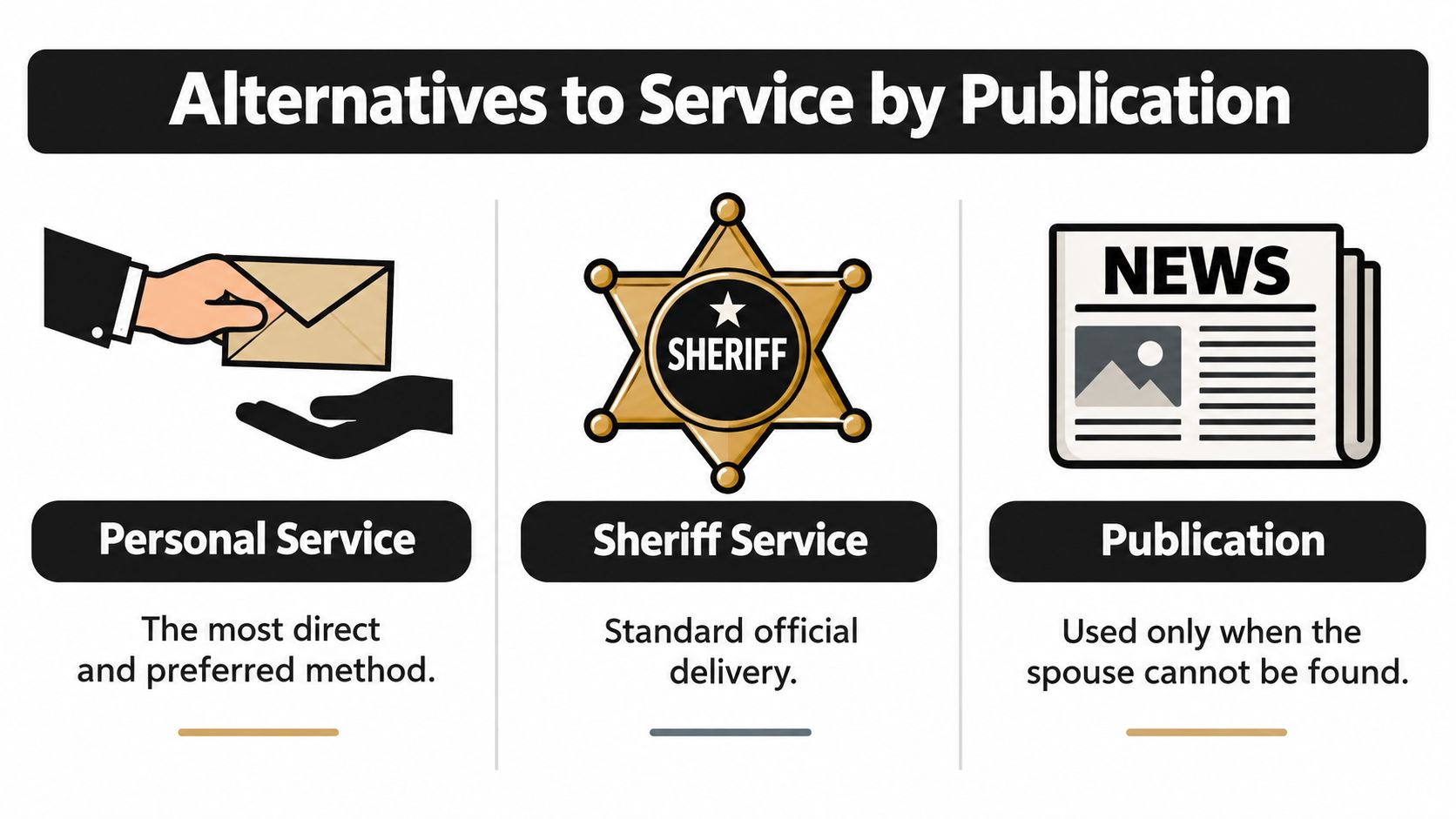
| Method | When it may fit | Practical advantage | Main limitation |
|---|---|---|---|
| Personal service | You know where the spouse can be found | Direct notice to the defendant | Impossible if the location is genuinely unknown |
| Sheriff service | A usable residence or workplace is available | Official delivery and proof | A failed attempt doesn't by itself establish due diligence |
| Publication | Reasonable searches haven't located the spouse | Provides a court-recognized last-resort route | Requires approval, documentation, publication, and added time |
Personal or sheriff service
If the spouse can be found, direct delivery is usually cleaner than publication. A sheriff may attempt service at a known residence or other lawful location. If the sheriff doesn't succeed, preserve the return or other documentation because the failed attempt may support a later request, but it won't replace the need for broader search efforts.
A known workplace can also matter. People often focus only on a home address and overlook an employer, professional office, or regular location. You shouldn't send someone to confront a spouse or create a scene. Give the information to an authorized server and follow the applicable procedure.
Other delivery routes
Depending on the facts and Rule 4 requirements, certified mail or designated delivery may be possible when you have a dependable address. A signed receipt or other official proof can be more straightforward than persuading a court that publication was necessary.
Posting or substituted service may be available in limited circumstances, but don't assume that leaving papers at a former home or handing them to an adult relative automatically completes service. The method must fit the rule and the facts. A clerk or attorney can help determine whether the proposed delivery is legally sufficient before you rely on it.
Common Problems and Defenses
The most common mistake is treating “last resort” as a conclusion rather than a burden of proof. Saying that your spouse disappeared doesn't establish that you made the searches Rule 4 requires.
North Carolina court guidance identifies internet searches, contacts with relatives or friends, DMV checks, law-enforcement website reviews, and private-investigator efforts as examples of diligence. It also confirms that publication must run once a week for three successive weeks and that mailing may be required when an address is known or reasonably ascertainable. The Mecklenburg County self-help guidance reflects the operational reality that publication is a notice method backed by a search record.
Records that weaken a request
A judge may question a request supported only by a conclusory affidavit. Other warning signs include:
- No timeline: The filer can't say when searches occurred or who conducted them.
- Narrow searching: The filer checked one old address but didn't investigate family, online, DMV, or law-enforcement leads.
- Ignored information: The filer knew of a possible mailing address but didn't send the notice.
- Unverified publication: The filer can't produce proof that the notice ran as required.
- Confused identity: The search record doesn't distinguish the spouse from people with similar names.
The spouse may later appear and challenge service, especially if the record shows that a reasonably available address was overlooked. The response isn't to argue that the spouse probably knew about the case. The stronger approach is to preserve evidence showing what you did before publication and to follow each notice requirement precisely.
A court doesn't need proof that your spouse actually read the notice. It does need proof that you followed the authorized process and made the required effort to locate the spouse.
If service is set aside, the divorce may be delayed and additional service work may be required. Publication therefore deserves the same care as any other major filing, including review of addresses, dates, affidavits, and proof before a hearing is requested.
When to Consult a North Carolina Divorce Attorney
A lawyer's value in a publication case is often concentrated before the notice appears. The attorney can assess whether your search was reasonable, identify overlooked leads, organize the evidence, and prepare the motion or affidavit in a way that answers the judge's likely questions.
Consider legal advice promptly if:
- Your spouse may be hiding: Intentional evasion creates both factual and procedural complications.
- Property or support matters remain: An absolute divorce can affect unfiled equitable distribution or alimony claims.
- Children are involved: Custody and support issues require separate planning and may not be resolved solely because service is completed.
- You have attempted service already: Failed delivery needs to be documented and evaluated, not merely repeated.
- You are unsure about the address: A known or reasonably ascertainable mailing address can trigger an additional requirement.
Court self-help materials are useful for general procedure, but they can't evaluate your specific search history or protect every legal claim in your case. The North Carolina divorce lawyer resources from the Law Office of Bryan Fagan provide a starting point for discussing service, divorce procedure, and related family-law issues.
No attorney can guarantee that a judge will approve publication. A consultation can, however, help you understand the weaknesses in your record before they become a court problem.
Frequently Asked Questions
Is service by publication automatic when my spouse's address is unknown?
No. North Carolina treats publication as a last resort. You must show due diligence, which may include internet searches, contacting relatives or friends, checking DMV or law-enforcement resources, and using a private investigator when appropriate. The court decides whether your efforts are sufficient.
How long must the notice run?
The notice must be published once a week for three successive weeks in a qualifying newspaper. If your spouse's address is known or reasonably ascertainable, you must also mail a copy at or before the first publication. The requirements come from North Carolina Rule 4.
Does publication change the divorce waiting period?
Yes. North Carolina court guidance states that publication changes the ordinary 30-day period to 40 days, measured from the first newspaper notice. Don't calculate from the last publication or from the date you filed the complaint.
What evidence should I keep?
Keep a dated search log, returned mail, service returns, notes of contacts with family or friends, online-search results, DMV or law-enforcement inquiry information, investigator materials, and the publisher's proof. The more clearly your records show what you tried and what happened, the easier it is for the court to evaluate the request.
Can my spouse challenge publication later?
A spouse may challenge service if the required procedure wasn't followed or the due-diligence showing was inadequate. Publication doesn't eliminate the need for accurate paperwork, proper notice, mailing when required, and proof filed with the court. A North Carolina attorney can review the record before you rely on it.
The Law Office of Bryan Fagan provides North Carolina-focused guidance on divorce, service issues, equitable distribution, custody, and support, including preparation for difficult publication cases. Visit Law Office of Bryan Fagan to schedule a consultation and discuss the search efforts, notice requirements, and legal claims that apply to your situation.