You and your spouse may already agree that the marriage is over. You may have divided the furniture, discussed parenting, and stopped arguing about who was at fault. Then you search for “no contest divorce NC” and discover that the phrase doesn't appear as a formal North Carolina divorce type. That confusion is common, and it matters because an uncontested divorce still requires the right separation, residency, filing, service, and court procedures.
North Carolina is a no-fault state for absolute divorce. The court generally doesn't need evidence of adultery, cruelty, abandonment, or other misconduct to end the marriage. It does need proof that the legal requirements have been satisfied. The safest approach is to treat an uncontested divorce as a real court case, not as paperwork that becomes effective merely because both spouses agree.
What No Contest Divorce Actually Means in North Carolina
Consider a Raleigh couple who agrees on nearly everything. They know where the children will spend school nights, how they'll divide their accounts, and who will keep the home. Online searches keep directing them to “no contest divorce,” but they aren't sure whether the label changes the legal process.
It doesn't. “No contest divorce” is a practical description, not the name of a separate North Carolina statute. In legal terms, the marriage ends through an absolute divorce. North Carolina's courts grant that divorce when the statutory requirements are met, even if the other spouse doesn't sign an agreement or actively participate, provided the other spouse receives legally sufficient notice.
The central rule is no-fault. Under North Carolina's separation and divorce guidance, the spouses must live separate and apart for at least one continuous year, and at least one spouse must have lived in North Carolina for six months immediately before filing. The court doesn't require proof that one spouse caused the breakup.
Agreement helps, but it isn't the divorce requirement
Cooperation can make related issues easier to resolve. A written agreement may address custody, support, property, debts, and spousal support. But mutual cooperation doesn't replace the legal requirements for the absolute divorce itself.
That distinction answers a frequent question: Can one spouse obtain a North Carolina divorce when the other spouse refuses to sign? Yes, potentially. The filing spouse still must prove separation, residency, and proper service. If the other spouse ignores the case after receiving valid notice, the divorce may continue without a signed agreement from that spouse.
North Carolina preserved a separate role for marital misconduct in matters connected to the marriage. Fault isn't required to dissolve the marriage, but conduct can remain relevant to issues such as alimony. North Carolina also recognizes divorce from bed and board, a separate fault-based remedy under G.S. 50-7, involving grounds such as abandonment, cruel or barbarous treatment, intolerable indignities, excessive alcohol or drug use, and adultery.
Practical rule: Treat “no contest” as a description of cooperation, not as permission to skip North Carolina's legal steps.
Residency and the One-Year Separation Requirement
Every North Carolina absolute divorce starts with two eligibility gates. At least one spouse must have lived in North Carolina for six months immediately before filing, and the spouses must have lived separate and apart for one continuous year. The statutory language appears in North Carolina's absolute divorce statute.
The residency rule is usually straightforward. If either spouse has maintained North Carolina residency for the required period, the filing can generally occur once the separation period has also expired. Keep documents that support the residence, such as a lease, utility records, driver's license history, or other ordinary records. The court may not need every item, but you shouldn't rely on memory alone.
What separate and apart means
Living in separate bedrooms under one roof doesn't automatically establish the required separation. The spouses must live separate lives and maintain the intention that the separation be permanent. Shared meals, presenting yourselves publicly as a married couple, exchanging anniversary presents, or resuming an intimate relationship can create problems.
A couple who moved into different apartments and stopped holding themselves out as married has a much cleaner fact pattern. By contrast, a couple who separated, reconciled for three months, and then separated again may need to calculate the year from the later separation date. Don't assume a short attempt at reconciliation is harmless.
North Carolina law contains a narrow exception involving incurable insanity. That exception is unusual and shouldn't be treated as a substitute for ordinary separation planning.
Calculate dates before preparing the complaint
Write down the date the spouses physically separated and the date the separation became permanent in intent. If the couple separated on March 1 and remained continuously separate, the practical filing date is generally after one year and one day, assuming the residency requirement is satisfied. The same date discipline applies to the six-month residency period. A missed date can lead to a rejected or dismissed filing, creating avoidable delay.
A separation agreement can address property, support, and custody during this period. Separation Agreements in North Carolina may be useful when spouses want written terms before the absolute divorce.
For a focused explanation of the separation clock, review this North Carolina one-year separation rule resource.
The following video provides a visual overview of the process:
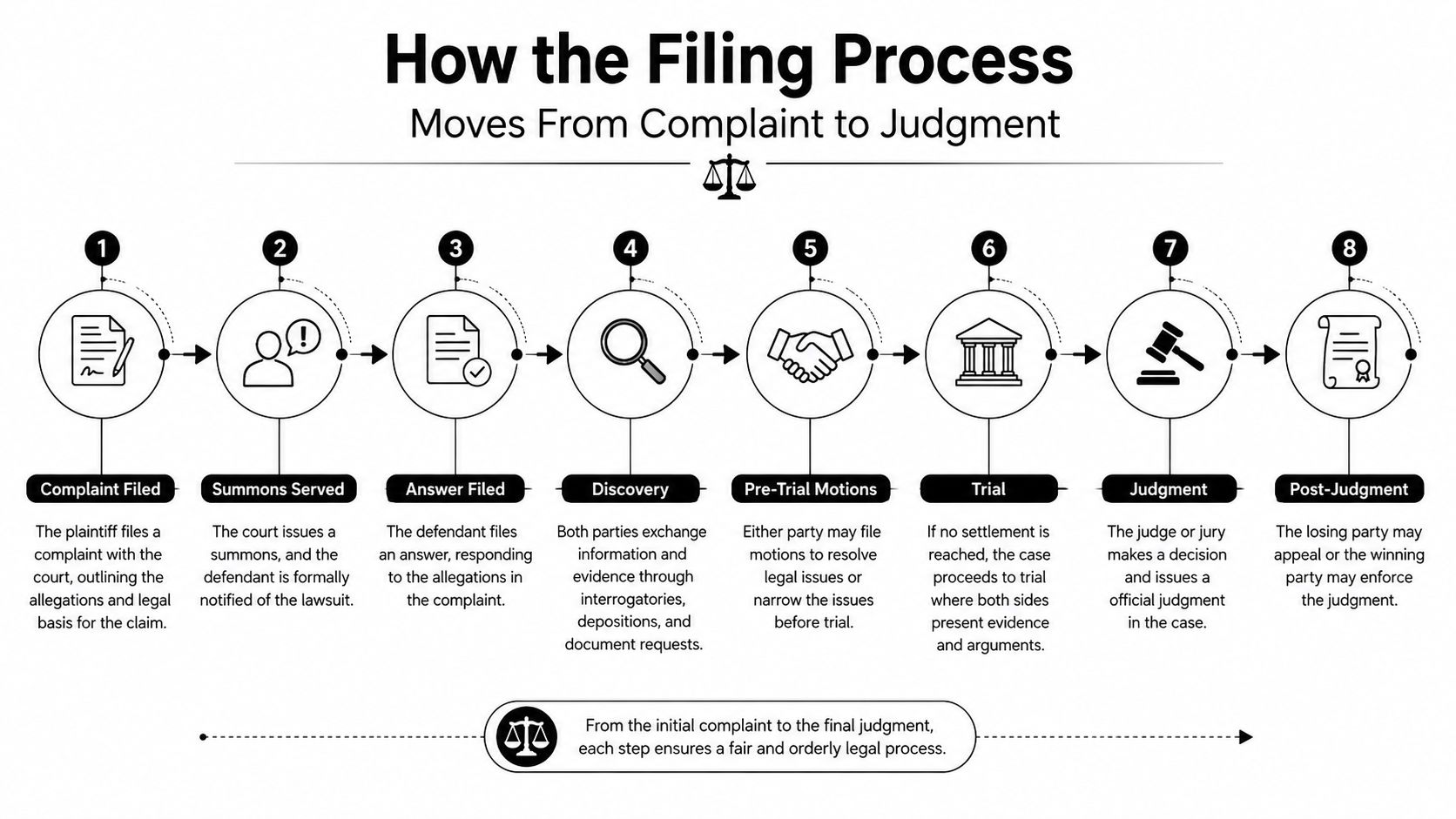
How the Filing Process Moves From Complaint to Judgment
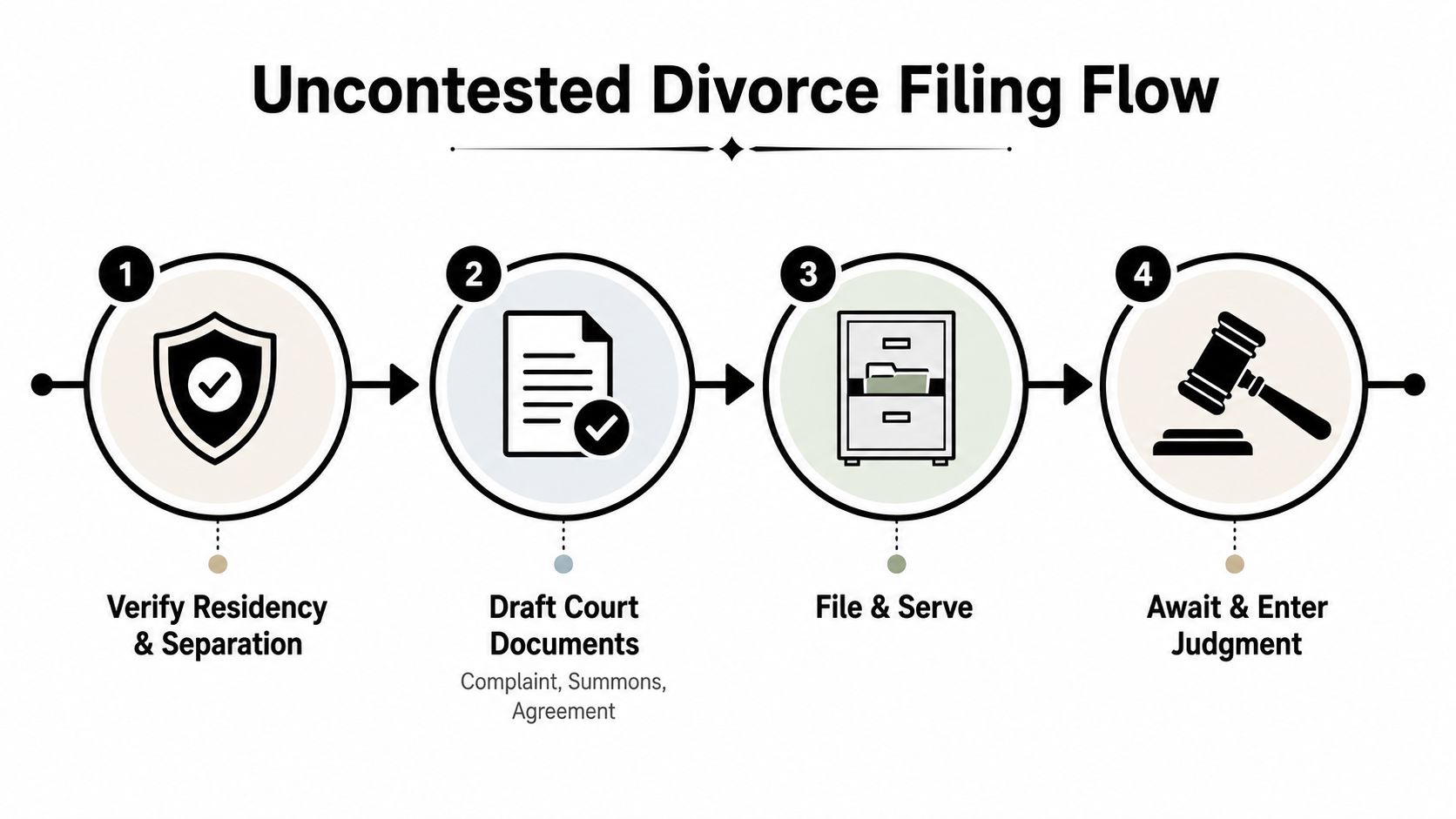
An uncontested case moves through court in a defined sequence. First, the filing spouse confirms the separation date, the permanent intent to remain separate, and North Carolina residency. Filing before those facts are established is one of the easiest ways to create a preventable problem.
The next stage is preparing the documents. The core filing is a Complaint for Absolute Divorce, accompanied by a Civil Summons and the required supporting materials. If the spouses have resolved property, custody, support, or other issues, the appropriate separation or settlement agreement should be prepared carefully. A divorce complaint alone doesn't transfer a retirement account, establish a parenting schedule, or divide marital debt.
Filing and service create the court's authority
The complaint is filed in the proper North Carolina county court, and the required filing fee must be paid. The plaintiff then must serve the defendant under North Carolina's service rules. A cooperative spouse may accept or waive service through the appropriate procedure. Cooperation doesn't mean the plaintiff can hand over papers informally and assume service is complete.
The North Carolina divorce discovery and financial affidavits resource can help identify financial information that may matter when the spouses are resolving property and support issues. Even friendly negotiations should be based on complete information.
If the defendant can't be located, service by publication may be available only as a last resort. North Carolina court guidance explains that publication generally requires notice in a newspaper in the county where the defendant last resided when the spouse can't be found. Personal service or certified mail creates a cleaner record when those methods are available.
The response window and hearing
After valid service, the defendant has a 30-day response window under the ordinary procedure. The defendant may file an answer, waive service through the proper form, or fail to respond. A failure to respond doesn't automatically grant every requested term, but it can allow the absolute divorce claim to proceed if the plaintiff proves the statutory requirements and follows the court's procedures.
Once the separation year, residency, and service are established, the plaintiff can request a hearing before a district court judge. The judge reviews the complaint, proof, service documents, and proposed judgment. In an uncontested matter, the hearing is usually limited rather than a trial about marital fault. Whether either spouse must appear depends on the county's procedures and the judge's requirements, so don't assume attendance is never necessary.
The judgment becomes the document that legally ends the marriage. Agreements addressing property, custody, or support should be drafted so those obligations remain clear and enforceable after the divorce.
Resolving Custody, Support, and Property at the Same Time
An absolute divorce ends the marriage, but it doesn't automatically resolve every financial or parenting issue. A couple can be emotionally finished and still face separate questions about child custody, child support, equitable distribution, and spousal support.
A written agreement is often the practical tool for resolving those subjects. The spouses can address where the children stay, how transportation works, how holidays are handled, who pays particular expenses, and how property and debt will be divided. The document should use precise terms rather than informal promises such as “we'll work it out later.”
Child-related terms require careful drafting
Child custody includes legal decision-making and physical schedules. A parenting plan should account for ordinary weeks, school breaks, holidays, transportation, communication, and future disagreements. A friendly relationship today doesn't guarantee that the same arrangement will work after the divorce, so the agreement should anticipate predictable changes.
Child support is governed by the North Carolina Child Support Guidelines. An agreed amount should be checked against the applicable worksheet and supported if the parties seek a different result. A judge may deviate from the presumptive calculation only with written findings. The divorce being uncontested doesn't prevent the court from examining whether the child-support terms satisfy legal requirements.
Property division has long-term consequences
North Carolina uses equitable distribution, which means marital property and debt are divided under a fairness-based legal framework, not necessarily split into identical shares. Homes, vehicles, bank accounts, businesses, pensions, and retirement accounts may require different treatment.
Retirement interests can require a Qualified Domestic Relations Order, commonly called a QDRO, or another appropriate order. A sentence in a separation agreement may not be enough to transfer or divide an account. Spousal support is also distinct from the absolute divorce. Post-separation support and alimony involve their own legal analysis, and a spouse shouldn't waive those rights casually.
A quick agreement is only useful if it still protects you after the bank, retirement plan administrator, school, and court must interpret it.
Uncontested Versus Contested Divorce in NC
Both an uncontested and contested case can end in an absolute divorce. The difference is whether the spouses have resolved the issues and whether the judge must decide disputed terms.
In an uncontested case, the spouses generally agree on the matters they want resolved, prepare the required documents, complete service, and present the case for judicial review. In a contested case, disagreement may require discovery, financial documentation, depositions, motions, mediation, or trial. The dispute, not the label, determines the workload.
The North Carolina uncontested divorce guide offers another discussion of that distinction.
| Factor | Uncontested | Contested |
|---|---|---|
| Agreement | The spouses have resolved the relevant issues | One or more important issues remain disputed |
| Court's role | Reviews the filings and proposed judgment | Decides disputed matters through litigation |
| Control | The spouses shape the terms | The judge may impose terms after litigation |
| Stress | Usually less conflict when the agreement is genuine | Greater pressure because positions are opposed |
| Privacy | Fewer public disputes are placed before the court | Motions, hearings, and evidence may expand the record |
| Risk | A poorly reviewed agreement can create lasting problems | Litigation creates cost, delay, and uncertainty |
Don't choose an uncontested path merely because it appears easier. Choose it when the agreement is informed, complete, and voluntary. If a spouse is pressured, hiding assets, or refusing to address support, the case may need a more protective strategy.
Common Pitfalls That Derail a No Contest Case
Most failed no contest divorce filings don't fail because the couple misunderstood whether North Carolina is a no-fault state. They fail because someone treated a legal requirement as an informal detail.
The separation clock is fragile
A single overnight stay together can raise questions about whether the spouses reconciled. The safer practice is to document the separation date, maintain separate residences and finances where practical, and avoid conduct that contradicts the intent to remain permanently separated.
If the couple briefly resumes the relationship, don't guess whether the original date survives. Ask for legal advice and calculate from the facts, not from the date that feels most convenient.
Service can't be skipped
Every defendant must receive legally sufficient notice. North Carolina recognizes personal service, certified mail with return receipt and restricted delivery, and publication in limited circumstances. The North Carolina court FAQ on service procedures explains why publication is generally a last resort when a spouse can't be located.
A spouse's text message saying “I know about the divorce” isn't necessarily valid service. Use a method that produces a document the court can verify.
Agreements must answer the real questions
A vague agreement may leave property, debt, custody, or support unresolved. Before signing, identify accounts, vehicles, real estate, retirement interests, business interests, tax responsibilities, and debts. Consider what happens if a payment is late or a parent needs to modify the schedule.
Child support should be checked against the Guidelines worksheet. Retirement divisions should be reviewed for the order required by the plan administrator. A document that sounds fair can still fail to accomplish its intended result.
North Carolina Divorce Questions Readers Ask Most
How soon can I file after separation?
You generally must wait until the spouses have lived separate and apart for one continuous year. At least one spouse must also have lived in North Carolina for six months immediately before filing. Cooperation doesn't shorten either requirement.
What happens if we have no separation agreement?
You can still pursue an absolute divorce if the separation and residency requirements are met. But the divorce judgment won't automatically divide marital property, establish custody, set child support, or resolve spousal support. Leaving those matters open can affect your rights later, so determine which claims and agreements need attention before filing.
Does adultery or abandonment matter?
Fault isn't required for the absolute divorce. It may matter to alimony and other related issues, and North Carolina's separate divorce-from-bed-and-board remedy is fault-based. Don't assume that a no-fault divorce erases every legal consequence of marital conduct.
What if my spouse refuses to sign?
A spouse doesn't have to sign an agreement for the absolute divorce to proceed. The plaintiff must still complete valid service and prove the required facts. After service, the defendant has the ordinary 30-day period to respond. If the spouse doesn't respond, the case may move forward under the applicable default procedures, but the court still must be satisfied that the legal requirements are met.
What if I can't find my spouse?
Start by documenting reasonable efforts to locate the spouse. If personal service and certified mail aren't possible, publication may be available as a last resort under Rule 4. Publication requires notice in a newspaper in the county where the defendant last resided, and the court will expect the required procedural steps to be followed.
Don't assume an uncontested case eliminates every deadline. Claims involving equitable distribution and support can have separate timing consequences. A spouse who files for divorce without reviewing those claims may lose negotiating power or protection even if the absolute divorce itself is uncomplicated.
Talk With a North Carolina Divorce Attorney
An uncontested filing is still a legal proceeding. The judgment ends the marriage, and an agreement may bind you on property, debt, custody, support, and future financial rights. Fixing a poorly drafted or incomplete agreement after entry can be difficult.
A North Carolina family law attorney can verify that the separation date supports filing, confirm the residency requirement, review the evidence of separation, and select a valid service method. Counsel can also examine whether the agreement addresses retirement accounts, real estate, debt, child-related expenses, custody changes, and support claims rather than accepting broad language.
The attorney's role isn't necessarily to turn a cooperative divorce into litigation. A focused review may identify one overlooked account, one unclear parenting term, or one service defect before it creates a larger problem. You can ask whether the attorney offers a limited document review, agreement drafting, or another defined scope of representation that matches your needs.
The Law Office of Bryan Fagan handles North Carolina family law matters involving divorce, equitable distribution, child custody, child support, and spousal support. Scheduling a consultation doesn't commit you to filing a contested case. It gives you a chance to explain your dates, agreement, assets, children, and service concerns before submitting documents to the court.
For a no contest divorce in North Carolina, bring your proposed separation date, residency information, draft agreement, list of major assets and debts, and any concerns about custody or support. Those details allow the attorney to give practical guidance tied to your situation instead of generic instructions.
The Law Office of Bryan Fagan can review your North Carolina separation timeline, agreement, service plan, and related custody, support, or property issues before you file. Visit Law Office of Bryan Fagan to schedule a consultation and discuss the safest next step for your divorce.