You're finalizing a custody arrangement, comparing daycare invoices with paycheck deductions, and trying to understand why the number on a North Carolina child support worksheet doesn't match the “credit” discussed during tax preparation. That confusion is common because North Carolina uses separate systems for family court support calculations and state income-tax credits. The same child-care expense may matter in both systems, but it doesn't enter either one in the same way.
For court, work-related child care and the child's share of health-insurance premiums can adjust the presumptive support obligation. For taxes, qualifying child and dependent care expenses may support a North Carolina credit tied to the federal calculation, while ordinary health insurance generally shouldn't be confused with the state's separate long-term-care insurance credit. A careful review keeps your monthly support calculation and annual tax return from being treated as if they were one form.
Separating Child Support Forms From Tax Credit Worksheets
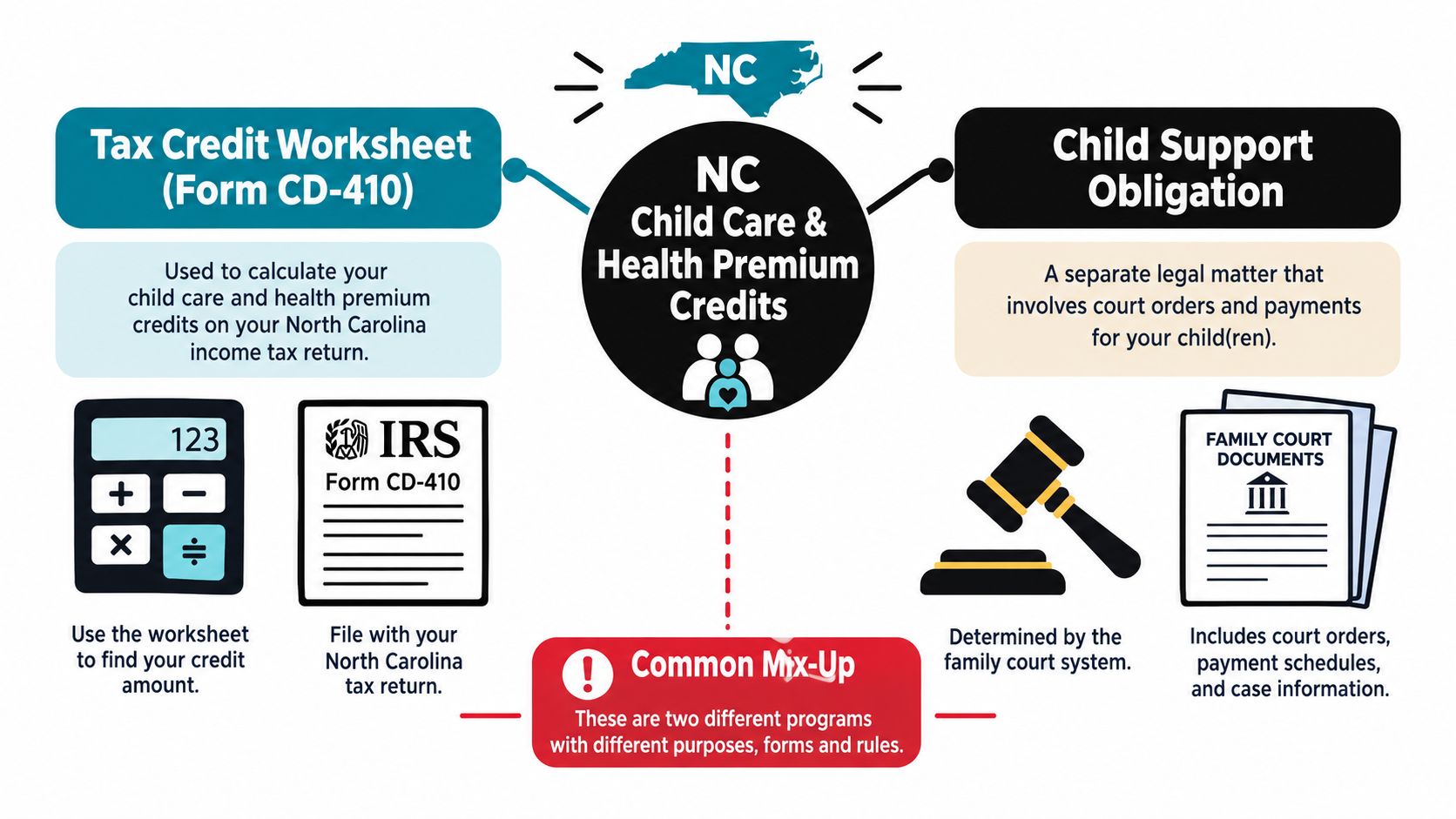
A parent often arrives with daycare receipts in one hand, payroll deductions in the other, and a search result for “work related child care and health premium credits NC worksheet” open on the phone. The confusion usually starts because North Carolina uses the word worksheet for two different jobs. One set of forms is for family court. The other is for state income taxes. Mixing them can skew settlement talks, affidavit prep, and tax filing decisions.
The court form is the North Carolina Child Support Worksheet. It is used to calculate monthly support based on the custody setup and each parent's financial information. A step-by-step walkthrough of the North Carolina child support worksheet helps show where each entry belongs and why the form chosen for the case changes the result. The tax materials from the Department of Revenue do something else. They address whether a parent may claim a state tax credit after the year ends.
The family court side
Under the official North Carolina child support worksheet, qualifying work-related child care and the children's share of health-insurance premiums are added into the support calculation and then divided between the parents by income. That figure can affect the presumptive support amount, whether the case is resolved by agreement or court order.
The worksheet selection still matters, but the larger point here is simpler. Court worksheets adjust support. They do not decide tax credits.
The tax side
Tax worksheets ask a narrower question. They examine whether certain expenses qualify under the federal rules incorporated into North Carolina's credit structure, and they do so on a tax return, not in a support order. That is why a child-care cost can matter in both places and still be treated differently. The same is true for insurance. A child's health premium may affect support, while state tax treatment may turn on a different credit altogether, as explained in North Carolina Child Support Guidelines Explained.
In practice, keep these calculations separate and compare them side by side. A tax benefit may matter in negotiation or a deviation argument, but it is not the same as a worksheet adjustment, and treating it that way is where avoidable mistakes begin.
Adjusting the Basic Support Obligation for Child Care and Health Premiums
A parent can pay every daycare bill and carry the insurance card, then feel blindsided when the worksheet does not reimburse that parent dollar for dollar. North Carolina's support calculation works differently. It starts with the basic support obligation, adds qualifying work-related child care and the children's share of health-insurance premiums, and then spreads those added costs between the parents based on income. That is why the court worksheet and the tax worksheets can involve some of the same expenses while producing different results.
A practical calculation usually works in this order:
- Select the custody worksheet. Use Worksheet A, B, or C as described earlier, then confirm you are using the right form before entering expense figures.
- Identify qualifying child care. Include child-care costs paid, or reasonably expected to be paid, because a parent is working or looking for work, and place that expense under the parent who pays it.
- Calculate the child-only insurance share. If a family policy covers people beyond the children in the case, divide the total premium by the number of covered individuals, then multiply that amount by the number of children subject to the support order.
- Add and prorate. Add those qualifying costs to the basic obligation, then assign each parent's share according to income.
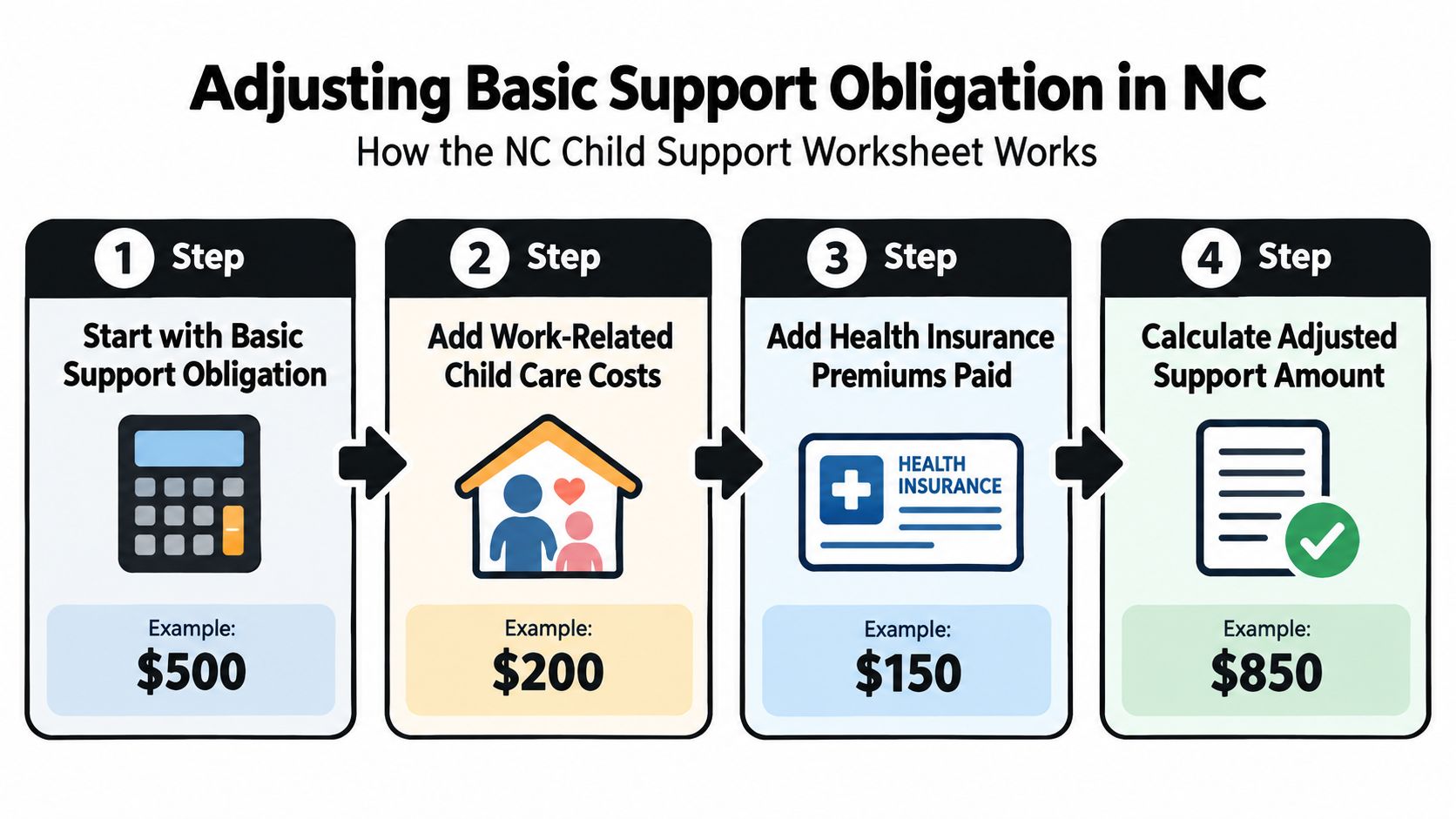
The graphic uses illustrative values of Basic Support $500, Child Care $200, Premiums $150, and Adjusted Total $850. Those figures show the math sequence only. They do not predict what any family will owe, because the actual number turns on income, custody, the number of children, and the other entries on the worksheet.
Practical rule: The worksheet allocates recurring child-related costs. It does not automatically repay the parent who fronts the bill.
Two mistakes show up constantly. First, parents often include the full family health premium instead of the child-only share. Second, they count premiums paid entirely by an employer, even though amounts not deducted from a parent's wages do not belong in that calculation. If coverage changes after a new job, remarriage, open enrollment, or the addition of another dependent, the child-only amount often changes too. Close enough is often wrong here.
A parent asking for a deviation from the North Carolina Child Support Guidelines still has to start with the guideline worksheet. Tax credits may matter in that argument, especially when one parent claims a financial benefit tied to care costs, but tax treatment does not replace the support calculation. Keeping those two systems separate is how you avoid inflated expense claims, weak settlement positions, and orders that are expensive to correct later.
Gathering the Right Documentation for Court and Negotiations
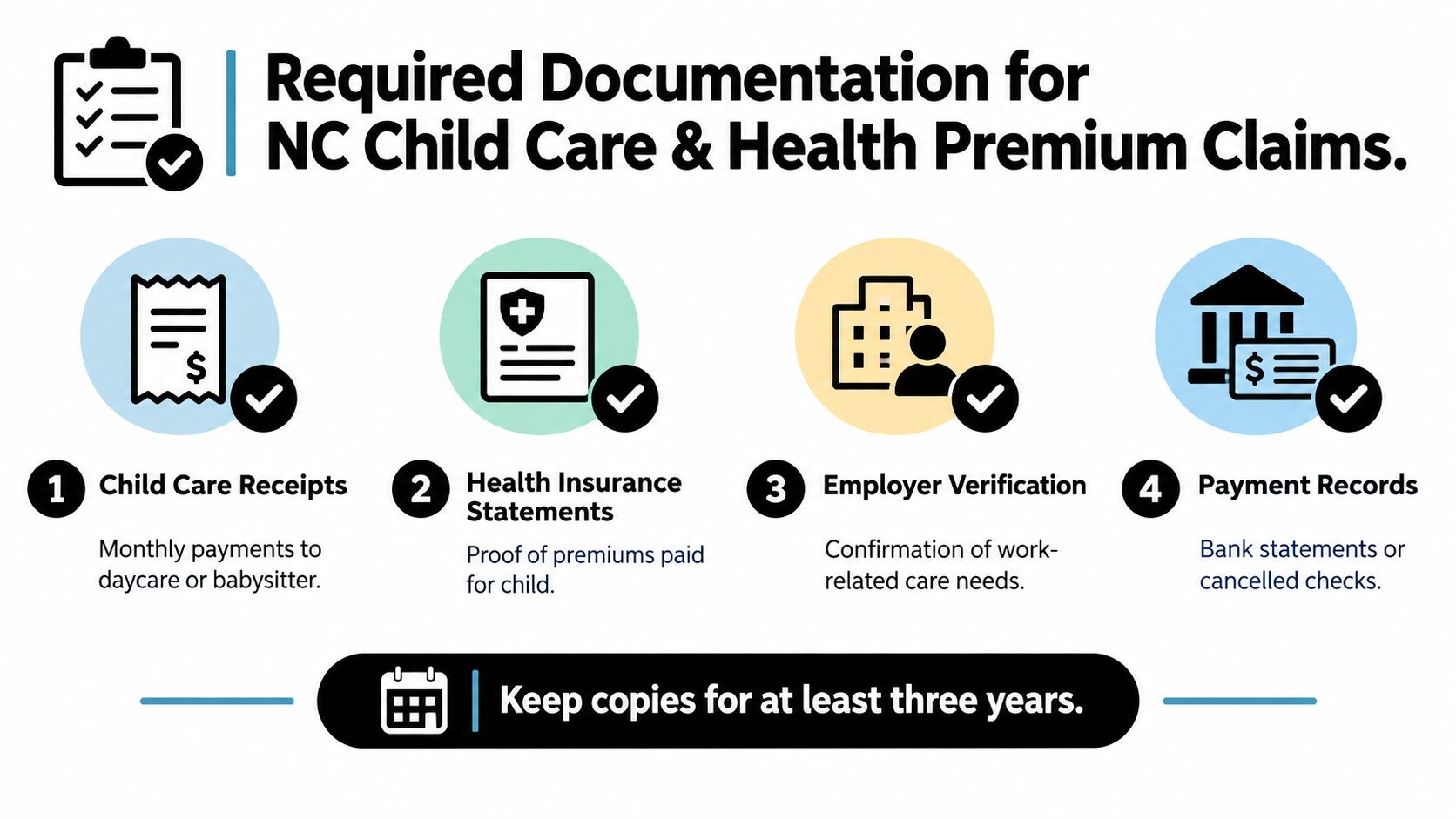
A judge can't reliably allocate an expense that exists only as a spreadsheet entry or a screenshot. The strongest presentation connects the cost to the child, the parent's employment or job search, and an actual payment record. The North Carolina Department of Health and Human Services materials advise preserving provider invoices, payment records, employment or job-search proof, subsidy information, and tax-credit documentation because courts may consider actual child-care tax credits in support decisions and deviation arguments. See the North Carolina child support documentation guidance.
Child-care proof
For daycare, after-school care, or a babysitter, organize:
- Provider invoices: Show the billing period, child, service, and amount charged.
- Payment records: Use bank statements, canceled checks, receipts, or other records that show payment rather than merely an outstanding balance.
- Employment evidence: Preserve schedules, employer statements, pay records, or job-search documentation connecting the care to work or a qualifying search.
- Subsidy information: Identify any public assistance or parent fee so the worksheet reflects the amount attributable to the family.
Care needed while a custodial parent attends school isn't automatically treated the same as employment-related care. That situation may require a deviation analysis. A parent shouldn't label all supervision costs “work-related” without addressing why the guideline language applies.
Health-insurance proof
For an employee-plus-child or family plan, request the employer benefit statement, enrollment record, and payroll deduction information. These documents help establish the total premium, the covered people, and whether the parent pays the amount through wages. The worksheet uses the portion attributable to the children in the support case, not automatically the entire family premium.
Evidence that survives negotiation is usually more persuasive than a rounded estimate that appears only after litigation begins.
Keep tax records with the support file. A tax return, federal care-credit worksheet, provider information, and proof of any credit received may affect how counsel evaluates a deviation request. Those records can also clarify whether the expense claimed in court matches the amount used for tax purposes. Issues concerning the child's living arrangements may arise alongside Child Custody in North Carolina, where the court focuses on the child's best interests.
Navigating North Carolina Tax Credits for Child Care and Long-Term Care
The tax-credit question begins after separating the court calculation from the return. North Carolina's individual income-tax credit for child and dependent care is tied to the federal credit. The calculation starts with the federal employment-related expense amount reported from Federal Form 2441 or the corresponding federal schedule, not automatically with every payment made to a daycare provider. The historical North Carolina instructions identify federal expense limits of $2,400 for one dependent and $4,800 for two or more dependents. See the North Carolina Department of Revenue child-care credit instructions.
The historical state schedule used different percentage ranges depending on the dependent's age and ability to care for themselves. For dependents age seven or older who weren't physically or mentally incapable of self-care, the cited range was 7% to 9% of qualifying federal employment-related expenses. For dependents under age seven, or dependents unable to care for themselves, the range was 10% to 13%. Because tax rules and forms change, verify the exact tax year before relying on those instructions.
| Expense Type | Child Support Worksheet Treatment | NC Tax Return Treatment |
|---|---|---|
| Work-related child care | Added to the basic support obligation and prorated between parents according to income when it qualifies under the guidelines. | Begins with the federal employment-related expense amount, subject to federal limits and applicable state rules. |
| Child's health-insurance premium share | The child-only attributable amount is included in the support calculation when properly documented. | Ordinary health-insurance premiums shouldn't automatically be entered as a child-care credit. |
| Qualified long-term-care premiums | Not the ordinary child health-insurance entry on the support worksheet. | North Carolina materials describe a separate credit of 15% of qualifying premiums, capped at $350 for each qualified long-term-care insurance contract, subject to eligibility rules. See the North Carolina tax manual discussion of the long-term-care credit. |
This is why the phrase “health premium credit” can mislead parents. The located North Carolina materials describe a specific long-term-care insurance credit, not a general credit for ordinary medical insurance, employer-paid coverage, or marketplace premiums. A parent reviewing Alimony in North Carolina may be dealing with a separate support analysis entirely, so the tax label shouldn't be carried into family-court calculations without checking the form.
A parent should compare the provider records with Form 2441 and the relevant North Carolina return before claiming an amount. Dependency status, federal child-credit eligibility, and work-related care expenses involve separate requirements.
Avoiding Common Worksheet Errors and Low-Income Pitfalls
The most expensive mistakes often look reasonable at first. A parent enters the full family insurance premium, uses a daycare screenshot, or assumes that care purchased while attending school qualifies automatically. Each shortcut can distort the support calculation and create a credibility problem during negotiations or a hearing.
Errors that deserve immediate attention
Using the wrong worksheet can affect the entire calculation. Confirm the physical-custody structure before entering expenses. Worksheet A, B, and C aren't interchangeable forms with different labels.
Claiming the full insurance premium ignores the child-only allocation. Count the covered people, identify the children subject to the order, and verify the amount paid by the parent.
Treating school care as employment care can bypass the required analysis. If the expense arises from attending school rather than employment or job search, prepare to address whether a deviation is appropriate.
Relying on rounded figures makes later verification difficult. Payroll deductions, benefit statements, provider invoices, and payment records are more useful than a typed estimate.
The guidelines contain a particularly important low-income limitation. In a Worksheet A case, when the obligor's adjusted gross income falls within the shaded schedule range, child-care and health-insurance premiums shouldn't be used in calculating the obligation, although payment of those expenses may support a deviation. That rule can produce a result different from what a parent expects after adding every recurring expense.
Tax law creates another timing risk. North Carolina legislative materials, including Senate Bill 878, illustrate why proposed language and rules applicable to a specific tax year must be kept separate. A provision described in legislation isn't automatically a credit available on every return. Check whether the provision became law, identify the relevant tax year, and use the corresponding Form D-400 and schedules.
For a practical checklist of calculation problems, review mistakes on the North Carolina child support worksheet. The safest approach is to prepare the support worksheet and tax return independently, then compare them for consistency.
Protecting Your Financial Future With Experienced Legal Guidance
Child-care and insurance entries can look like routine numbers, but they affect negotiations, monthly support, tax planning, and potential modification requests. The right analysis asks where the expense came from, who paid it, whether it qualifies under the current North Carolina guidelines, and what evidence supports the amount. It also distinguishes a court adjustment from a tax credit before either figure is used in an agreement.
The Law Office of Bryan Fagan assists North Carolina parents with child support calculations, custody-related financial issues, documentation, negotiations, modifications, and courtroom representation. A consultation can help identify the correct worksheet, test the child-only insurance allocation, evaluate employment-related care, and organize tax records without promising a particular result.
Don't leave a support agreement to an online calculator or an unverified premium estimate. Have the figures reviewed before signing an order, negotiating a settlement, or filing for modification.
The Law Office of Bryan Fagan helps North Carolina parents connect child-care and health-insurance evidence to the correct support worksheet and tax-year analysis. Schedule a consultation to review your documentation, understand your options, and protect your financial interests in custody or support proceedings.