In North Carolina, an infraction is a noncriminal violation capped at a $100 penalty with no jail time, while a misdemeanor is a criminal offense that can result in fines up to $1,000 or more and potential jail time. The classification on the citation determines whether you're dealing with a penalty-only matter or a criminal case.
You may have just left a traffic stop with a citation in your hand and no clear idea what happens next. The officer may have used familiar words such as “ticket” or “charge,” but those words don't tell you whether the offense is an infraction or a misdemeanor. That distinction affects the court process, possible penalties, and whether the matter creates a criminal conviction.
North Carolina's statutes draw a firm legal line, but the motor-vehicle laws don't always make that line easy to see. Two driving incidents can look similar from the roadside and still fall under different statutes. Read the exact offense listed on the citation before deciding that the matter is minor.
What Separates an Infraction From a Misdemeanor in North Carolina
A driver receives a citation for failing to stop at a stop sign. The immediate concerns are familiar: jail, a criminal record, and whether hiring an attorney is necessary. Under NC Courts guidance on infraction vs. misdemeanor distinctions, failing to stop at a stop sign is commonly treated as a noncriminal infraction. The statute listed on the citation still controls.
North Carolina defines an infraction as a noncriminal violation that cannot be punished by imprisonment. Unless another law provides a different amount, the general penalty is no more than $100 (North Carolina General Statutes, Chapter 14). Because an infraction is not a crime, it does not produce a criminal conviction.
A misdemeanor is a criminal offense. Depending on the charge and its classification, it can expose a person to fines, court supervision, and jail. The distinction is one of legal status, not just the size of the fine. That status affects the court process, available consequences, and the record left behind.
Why the classification matters
The classification answers several practical questions:
- Imprisonment: An infraction cannot carry jail time. A misdemeanor can.
- Criminal status: An infraction is noncriminal. A misdemeanor is a crime.
- Court process: Infractions generally use an admit-or-deny responsibility process. Misdemeanors proceed through criminal court procedures.
- Record consequences: An infraction does not create a criminal conviction. A misdemeanor conviction can create longer-term record concerns.
North Carolina's statutory patchwork can make the boundary difficult to recognize from the facts alone. Similar traffic conduct may fall under different statutes, and a statute's classification, not the officer's casual description, determines whether the matter remains an infraction or becomes a misdemeanor.
The criminal code also provides default rules for offenses that do not clearly state their classification. A crime not otherwise defined is generally treated as a misdemeanor, under a rule with roots in an 1891 enactment identified in the current code.
Read the citation carefully. The statute number and offense description determine the legal category, while the classification determines the consequences that follow in court and on a criminal record.
Comparing Penalties and Court Procedures
The practical difference becomes clearer when the two matters are placed side by side. An infraction is built around responsibility for a noncriminal violation. A misdemeanor is a criminal prosecution with greater procedural protections and greater potential consequences.
| Factor | Infraction | Misdemeanor |
|---|---|---|
| Legal status | Noncriminal violation | Criminal offense |
| Standard penalty structure | Generally no more than $100 | Depends on classification and offense-specific law |
| Jail exposure | No imprisonment | Jail may be available |
| District court procedure | Admit or deny responsibility | Criminal case procedures, including pleas and trial processes |
| Jury trial in district court | No right to a jury trial for the infraction hearing | Criminal defendants have criminal-case trial rights, subject to the applicable court and procedure |
| Criminal conviction | Doesn't create a criminal conviction | A conviction can create criminal-record consequences |
North Carolina law allows a person charged with an infraction to admit or deny responsibility. The law also provides no right to a jury trial in district court for an infraction hearing (North Carolina statutes governing infraction procedures). That doesn't mean an infraction should be ignored. It means the case follows a different, less formal path than a misdemeanor prosecution.
Misdemeanors involve more than paying a ticket
A misdemeanor can require court appearances, formal charging documents, plea discussions, motion practice, and potentially a trial. The precise path depends on the charge, the evidence, and the person's prior record. A defendant may also face conditions such as probation or other court-ordered consequences, depending on the disposition.
Court costs deserve separate attention. The headline fine isn't necessarily the entire financial obligation associated with resolving a case. An infraction can involve court costs in addition to its penalty, while a misdemeanor can create broader financial and personal consequences.
A six-month residency rule for filing divorce in North Carolina is a separate family-law issue, addressed in North Carolina Divorce Residency Requirements. It doesn't determine whether a traffic citation is an infraction or misdemeanor, but it illustrates why the governing legal rule must be identified before someone relies on a general legal summary.
Practical rule: Read the statute number and classification on the citation before deciding whether to pay, appear, contest responsibility, or seek advice.
Understanding North Carolina Misdemeanor Classifications
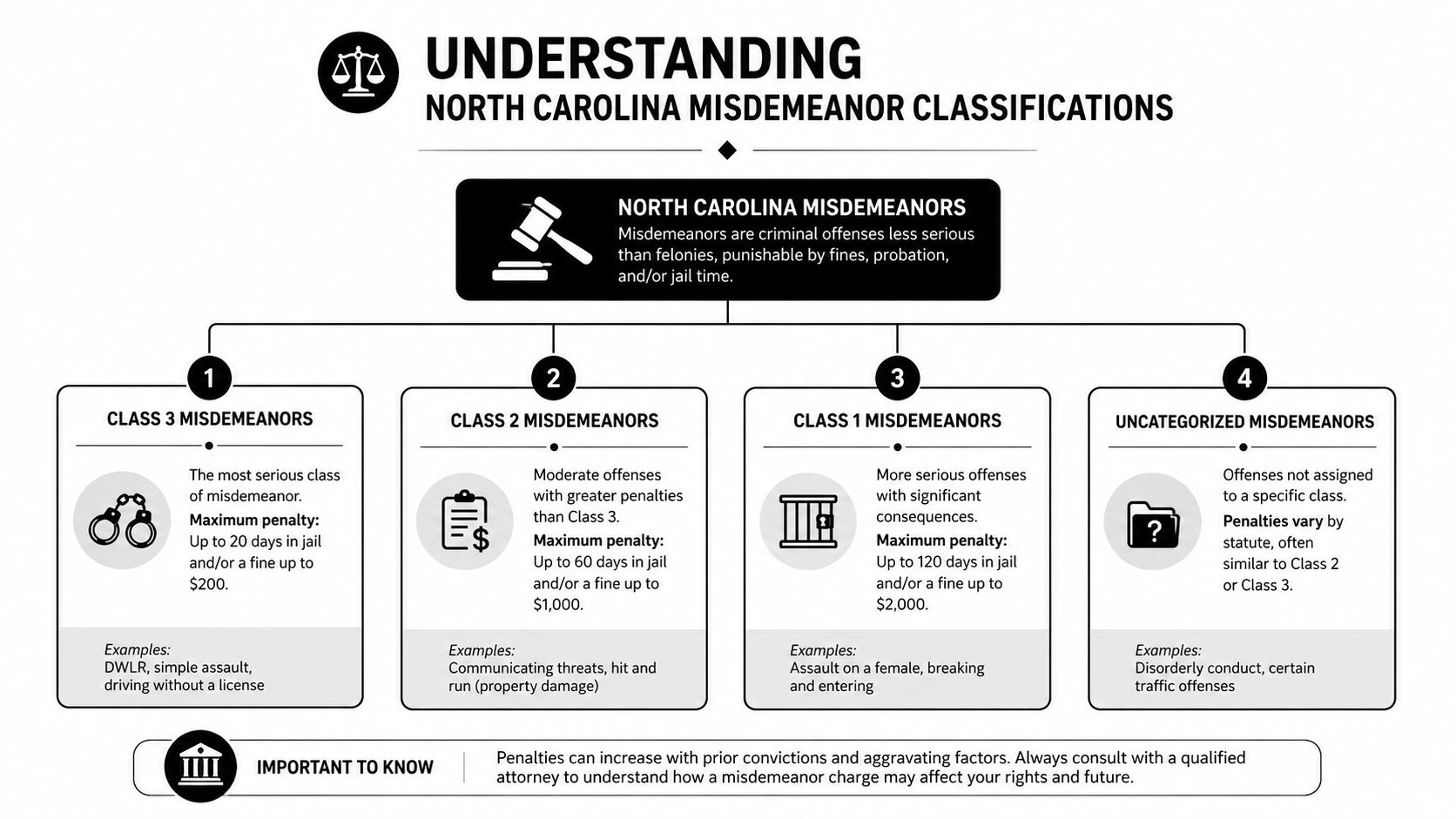
Under GS 14-3, North Carolina assigns an uncategorized misdemeanor a default class based on its maximum punishment. That rule matters when a statute describes prohibited conduct but does not clearly label the offense. A citation that looks similar to an infraction can therefore enter the criminal system if the governing statute supplies misdemeanor treatment.
North Carolina General Statute § 14-3 provides two default paths. An offense with no specific classification and no specific punishment is generally punished as a Class 1 misdemeanor. If the statute states a maximum punishment but does not name a class, the offense is classified by that maximum as Class 1, Class 2, or Class 3 (North Carolina General Statute § 14-3).
The classification structure
The statutory thresholds are:
- Class 1: More than six months of maximum imprisonment.
- Class 2: More than 30 days and up to six months of maximum imprisonment.
- Class 3: 30 days or less, or an offense punishable only by a fine.
The fine limits reinforce the distinction. A Class 3 misdemeanor can carry a maximum fine of $200, while a Class 2 misdemeanor can carry a maximum fine of $1,000, unless an offense-specific statute provides otherwise (NC GS 15A-1340.23 misdemeanor fine limits by class).
Why the class on the citation matters
A Class 3 charge does not carry the same statutory exposure as a Class 1 charge. The underlying facts, prior convictions, and offense-specific sentencing rules can change the practical result. Classification is a starting point, not a promised sentence.
The general limits may also yield to a statute with its own punishment. Review the exact statute, charging language, and sentencing provisions before deciding how seriously the case may affect your record, court obligations, and total cost.
Common Examples of Infractions and Misdemeanors in North Carolina
Failing to stop at a stop sign typically falls under North Carolina's noncriminal infraction rules. The result changes if the citation relies on a different statute or alleges additional conduct. The statute number and wording on the citation control, not the driver's description of what happened.
A stop-sign citation generally raises questions about responsibility, the penalty, and court costs. It does not usually create a criminal prosecution. The classification still deserves careful review because a similar roadside event can cross into misdemeanor treatment under another provision.
Similar traffic conduct can carry different labels
North Carolina motor-vehicle law is a statutory patchwork. Some violations are infractions unless another law specifically makes them misdemeanors or felonies. Other provisions begin with misdemeanor treatment unless the legislature reclassifies the conduct (North Carolina motor-vehicle infraction statute).
Two drivers may describe their conduct in nearly identical terms and receive different charges. One citation may allege an equipment or moving violation handled as noncriminal. Another may allege criminal conduct involving licensing, impairment, dangerous operation, leaving a scene, or another circumstance identified by statute.
That difference affects more than the label. A misdemeanor creates a criminal record risk and can require criminal-court appearances, while an infraction still carries a financial obligation and may affect the person's driving-related interests.
Common misdemeanor examples
North Carolina misdemeanors are criminal offenses that can carry fines or jail, depending on the statute and facts. Examples include:
- Driving while license revoked: The license status, statutory subsection, and surrounding circumstances can change the charge.
- Reckless driving: The allegation concerns operation that violates the applicable safety standard and may support criminal prosecution.
- Impaired driving: DWI requires prompt review because the charge carries criminal exposure. North Carolina DWI and impaired-driving defense resources address that separate area of defense.
- Simple assault, petty larceny, or trespassing: These non-traffic offenses can still produce a criminal case.
Read the citation before deciding that the matter is minor. Compare its statute number and charging language with the actual North Carolina law, then account for the possible record and court-cost consequences before choosing whether to resolve or contest it.
Hidden Consequences Many People Overlook
A ticket marked “noncriminal” can still disrupt a person's finances and driving status. An infraction avoids a criminal conviction and imprisonment, but the court may still impose a penalty and costs. Depending on the offense and applicable motor-vehicle rules, the matter may also affect a driving record, insurance, or driving privileges.
Those consequences turn on the precise violation, the driver's history, and the governing rules. Paying a ticket may resolve the court date without ending every practical effect. Before accepting responsibility, compare the likely cost and disruption with the consequences of contesting the citation.

Misdemeanor consequences reach beyond court
A misdemeanor conviction may appear on background checks and affect employment, housing, professional licensing, or immigration decisions. The result depends on the offense, the final disposition, the person's circumstances, and the rules applied by the decision-maker. No responsible attorney can promise that a particular resolution will erase every consequence.
Probation creates another layer of exposure. Violating a court condition can lead to enforcement proceedings and additional penalties. Anyone under supervision should understand the consequences of violating probation conditions in North Carolina before missing a requirement or assuming a violation is minor.
The statutory gray area deserves attention
North Carolina's traffic-code patchwork can place similar conduct on different sides of the infraction-to-misdemeanor line. The broad description of the driving behavior does not decide the classification. Review the exact statute, subsection, and charging language to determine whether the allegation is an infraction, misdemeanor, or another offense.
That review also identifies record and court-cost risks that generic summaries often miss.
An infraction may be less serious than a misdemeanor, but “less serious” is not the same as “no consequences.”
When to Contact a North Carolina Criminal Defense Attorney
A straightforward infraction may not require a lawyer when the citation is accurate, the deadline is clear, and no unusual licensing, insurance, employment, or immigration issue is present. Confirm how to respond before paying. Payment may be treated as an admission of responsibility.
A misdemeanor warrants at least a consultation. Its classification can affect the record and future options even when the charge seems minor. Counsel can review the offense class, possible defenses, procedural deadlines, and whether the prosecutor may agree to a different resolution.
Seek counsel promptly when potential penalties or collateral consequences are significant
Contact a North Carolina criminal defense attorney promptly if:
- Jail is possible: Any charge carrying custodial exposure requires careful review.
- Your license or job matters: A traffic conviction can affect driving privileges, while a criminal conviction may create employment or licensing problems.
- Immigration consequences are possible: Noncitizens should obtain advice before entering a plea.
- The charge is wrong: Disputed facts, an inaccurate citation, or mistaken identity may change the defense strategy.
- The stop may have been unlawful: The reason for the stop, the officer's observations, and available video can affect the case.
An attorney may negotiate a misdemeanor down to an infraction or pursue another disposition that avoids a criminal conviction. The result depends on the facts, prosecutor, court, statute, and person's record. No outcome is guaranteed.
The Law Office of Bryan Fagan handles North Carolina matters through its criminal defense practice. A consultation can clarify what the citation charges, what court costs and record consequences may follow, and which response protects your driving future.
Frequently Asked Questions About Infractions and Misdemeanors
Does an infraction show up on a North Carolina criminal background check?
An infraction is noncriminal and doesn't create a criminal conviction. It can still appear in driving-related records or matter to insurers and licensing agencies, depending on the offense and the type of search.
Can you go to jail for an infraction in North Carolina?
No. North Carolina defines an infraction as a violation that cannot be punished by imprisonment (North Carolina's statutory definition of an infraction). If jail is possible, review whether the citation charges a misdemeanor or another criminal offense.
How long does a misdemeanor stay on your record?
A misdemeanor conviction can create lasting criminal-record consequences. The answer depends on the charge, disposition, eligibility for relief, and applicable North Carolina law. Don't assume that time alone removes the record.
Do you need a lawyer for an infraction?
Not always. A consultation is sensible when the citation could affect your license, insurance, employment, immigration status, or when you dispute the officer's account.
What happens if you ignore a citation?
Ignoring a citation can lead to missed-court consequences or other enforcement problems. Check the citation for the required response and address it before the listed deadline.
If you're facing an infraction or misdemeanor in North Carolina, the Law Office of Bryan Fagan can review the statute charged, potential penalties, court process, and record implications with you. Visit Law Office of Bryan Fagan to schedule a consultation and discuss a practical defense strategy for your specific situation.