You're driving home in North Carolina when blue lights appear behind you. You pull over, provide your license and registration, and answer a few questions. Then the officer asks you to step out and perform a walk-and-turn, stand on one leg, or follow a pen with your eyes. You're tired, nervous, unsteady, or unsure what refusing will do to your license and your DWI case.
The most important point is the one many drivers miss: refusing a roadside field sobriety test is not the same decision as refusing a post-arrest chemical test. North Carolina treats those events differently under G.S. 20-139.1 and G.S. 20-16.2. You may decline roadside exercises, but that refusal can still become evidence. After arrest, refusing an evidentiary breath, blood, or urine test can create separate administrative and courtroom consequences.
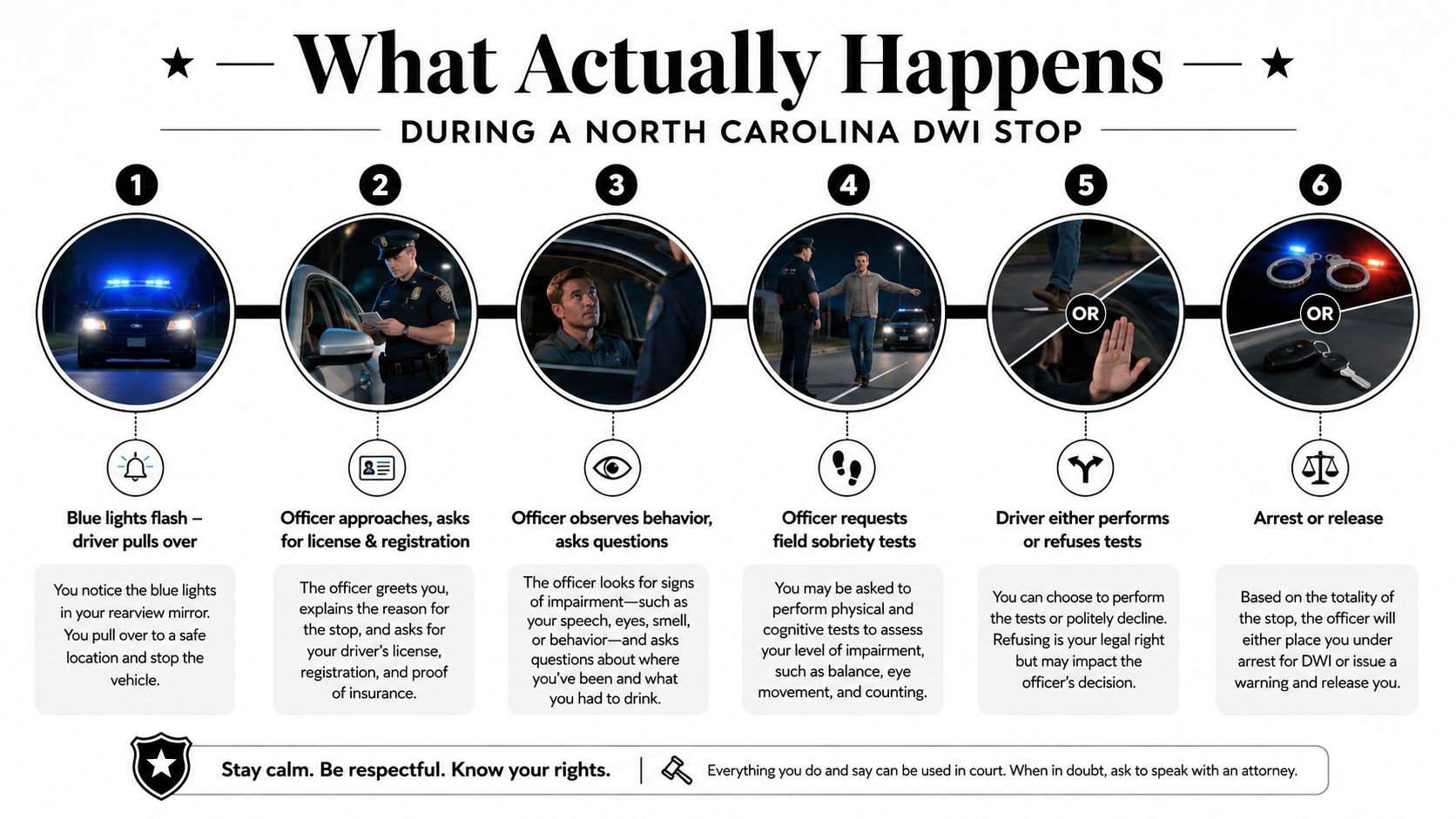
What Actually Happens During a North Carolina DWI Stop
You're on I-40, a Charlotte side street, or a Wilmington beach road when an officer sees conduct that raises concern. The officer may observe weaving, lane changes, a traffic violation, or another driving pattern associated with impairment. After the stop, the officer watches how you pull over, how you speak, whether you can locate your documents, and whether you show signs such as an odor of alcohol, slurred speech, red eyes, or poor balance.
The officer will approach your vehicle and ask for your license and registration. You'll likely hear questions about where you're coming from, where you're going, and whether you've been drinking. Those questions aren't the same as a field sobriety test. They're part of the officer's observations and investigation.
The legal thresholds in practical terms
A traffic stop requires a lawful basis, commonly a traffic violation or reasonable suspicion of criminal activity. Reasonable suspicion means the officer has specific facts suggesting that an offense may be occurring. It isn't a conviction, and it isn't proof beyond a reasonable doubt. It permits the officer to investigate the suspected impaired driving.
Probable cause is a stronger standard. It means the known facts would lead a reasonable officer to believe that a DWI offense has occurred. On a North Carolina road, the officer may build that conclusion from driving, conversation, physical behavior, odor, admissions, test results, and other circumstances.
The decision point arrives when the officer asks you to exit the vehicle and perform roadside exercises. At that moment, you're no longer deciding whether to hand over your license. You're deciding whether to provide a performance sample that the officer may describe in a report and later in court.
Stay calm, don't argue, and don't volunteer a story designed to persuade the officer. North Carolina drivers also need to keep unrelated legal deadlines separate. For example, Don't Lose Your Rights: Filing Claims Before NC Divorce Is Final addresses why equitable distribution and alimony claims must be filed before an absolute divorce is granted. A DWI stop involves different rights and deadlines, but both situations reward prompt legal advice.
Field Sobriety Tests Explained and How Officers Use Them
North Carolina officers commonly use the three NHTSA-standardized field sobriety tests, along with additional exercises that aren't part of the standardized battery. The tests are performed on the roadside or at a checkpoint, not at the station.
Horizontal Gaze Nystagmus, or HGN, involves moving a stimulus across your field of vision while the officer watches your eyes. The officer looks for involuntary eye movements and records observations according to the testing protocol.
The walk-and-turn asks you to take steps along an imaginary line, turn in a prescribed manner, and return. The officer may document difficulty maintaining balance, stepping off the line, using arms for balance, starting too soon, or misunderstanding instructions.
The one-leg stand requires you to balance while holding one foot off the ground. Swaying, hopping, putting the foot down, or using arms for balance may be recorded as clues.
| Test | What It Measures | Clues Officer Looks For | Key Limitations |
|---|---|---|---|
| Horizontal Gaze Nystagmus | Eye movement during visual tracking | Involuntary movement and difficulty following the stimulus | Medical conditions, lighting, glasses, improper distance, and administration can affect observations |
| Walk-and-Turn | Divided attention, balance, and instruction-following | Missteps, loss of balance, incorrect turn, or use of arms | Uneven pavement, footwear, injury, age, fatigue, and nervousness can affect performance |
| One-Leg Stand | Balance and divided attention | Swaying, hopping, putting the foot down, or arms raised | Leg, back, inner-ear, neurological, and environmental issues may matter |
Why the report matters
Officers document instructions, conditions, your responses, and the clues they believe they observed. That narrative can support the officer's decision to arrest and can later become part of the State's evidence.
The tests aren't perfect measures of driving ability. NHTSA materials have described the standardized battery as having an accuracy range of about 70 percent under ideal conditions, as summarized in the North Carolina field sobriety test legal framework. Roadside conditions are rarely ideal. Pavement, weather, lighting, injuries, fatigue, body mechanics, and anxiety can all affect what an officer sees.
North Carolina parents dealing with a separate support issue may also encounter a completely different analytical system. The North Carolina Child Support Guidelines Explained describes how the state uses worksheets to calculate child support. That worksheet process has no connection to DWI field testing.
Your Right to Refuse a Field Sobriety Test in North Carolina
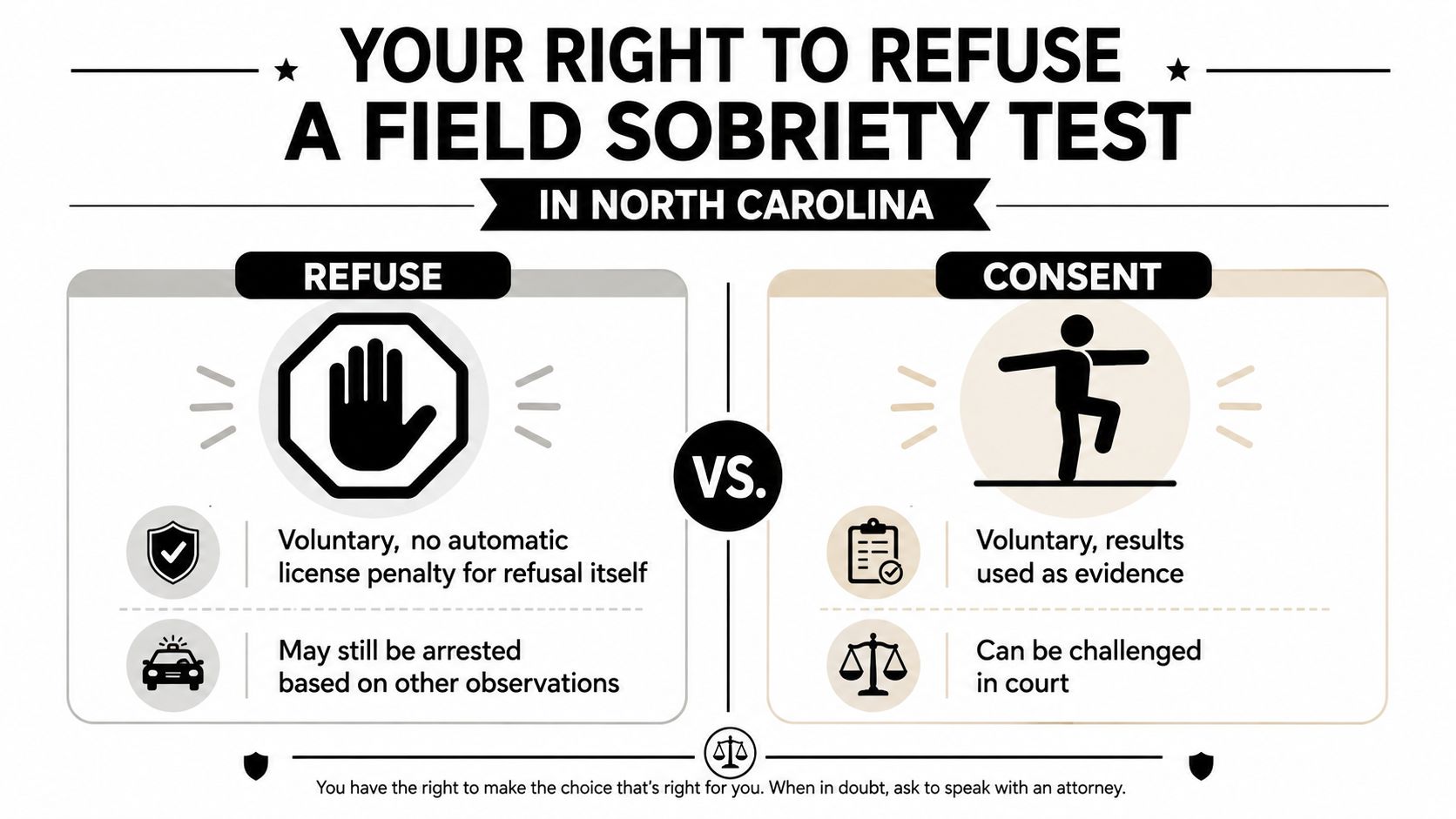
Roadside field sobriety tests are generally voluntary in North Carolina. Refusing them doesn't automatically trigger the one-year implied-consent revocation associated with refusing a post-arrest evidentiary chemical test. North Carolina legal guidance distinguishes the roadside exercises from the later station or DWI-bus test, including the practical difference between walk-and-turn exercises and the evidentiary breath test (North Carolina roadside field test guidance).
You can decline without physically resisting or debating the officer. A clear, respectful response is:
Officer, I'm not going to perform any field sobriety tests, and I'd like to speak with my attorney.
The officer can't physically force you to perform the exercises. But refusal doesn't end the stop, and it doesn't prevent an arrest. The officer may rely on driving behavior, odor, speech, balance, admissions, preliminary testing, video, and other observations.
What refusing does and doesn't accomplish
Refusing removes the officer's opportunity to document your performance on those particular exercises. That can matter because a performance sample may otherwise become detailed evidence about balance, coordination, eye movement, and instruction-following.
It also creates a trade-off. Under N.C.G.S. 20-139.1(f), evidence of refusing or failing to submit to requested field sobriety tests may be used in criminal, civil, or administrative proceedings. The statute therefore permits a driver to decline while allowing the State to argue that the refusal has evidentiary significance (North Carolina statute discussion on field sobriety refusal).
The roadside choice also differs from unrelated court filing decisions. For example, How to File for Absolute Divorce in North Carolina concerns residency, filing requirements, and the steps for obtaining an absolute divorce. Don't assume a rule from one area of North Carolina law carries over to another.
How Refusal Can Be Used Against You in Court
A prosecutor may present your refusal as part of the circumstantial evidence in a DWI case. The argument is usually that you declined because you knew the exercises would reveal impairment. That inference isn't conclusive, but North Carolina law recognizes that refusal evidence may be admissible, especially when the officer properly requested the test and explained the consequences where the law requires a warning.
The State still must prove the DWI charge. Refusal alone doesn't establish every element of impaired driving. But refusal may gain weight when combined with bad driving, an odor of alcohol, slurred speech, poor balance, an admission, dashcam footage, or a later chemical result.
Courts have also treated field sobriety requests as noncustodial and noninterrogative in relevant contexts, meaning Miranda warnings generally aren't required before the request itself. The legal question often turns on the exact request, the warning language, the officer's observations, and whether the jurisdiction authorizes the evidence (New York Court of Appeals discussion of refusal evidence).
| Prosecution Use of Refusal | Defense Counter | Likely Jury Interpretation |
|---|---|---|
| Claims refusal shows awareness of impairment | Explains that a person may reasonably decline subjective roadside exercises | Depends on the surrounding evidence |
| Combines refusal with odor or poor driving | Separates each fact and challenges weak or ambiguous observations | Stronger when several facts point in the same direction |
| Describes refusal as evasive conduct | Shows the driver remained polite and invoked a lawful choice | May view refusal as caution rather than guilt |
| Relies on the officer's report | Tests the report against bodycam, dashcam, timing, and exact wording | Inconsistencies can reduce credibility |
Where defense review becomes important
A defense lawyer should examine whether the officer extended the detention without adequate justification, whether the request was coercive, and whether the report accurately records what occurred. Bodycam footage may show that the officer's written description omits medical limitations, unsafe pavement, confusion about instructions, or the driver's clear statement that the exercises were being declined.
For a broader overview of North Carolina DWI defense issues, see North Carolina DWI charges and defense considerations. The refusal question is only one part of the investigation, but it can affect the State's probable-cause narrative and trial strategy.
Refusing the Post-Arrest Chemical Test and License Consequences
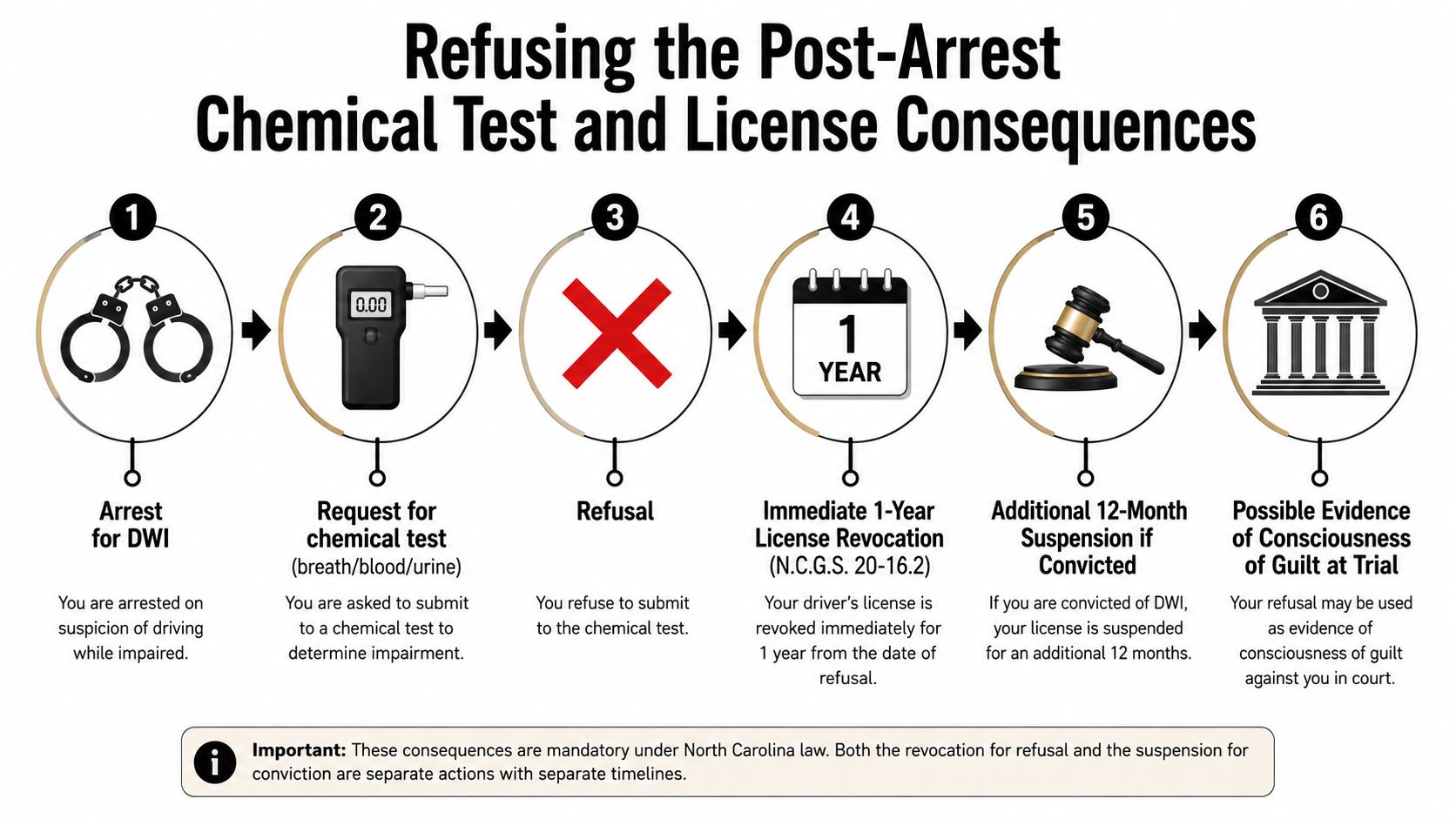
The post-arrest chemical test is a different decision. After an arrest for an implied-consent offense, North Carolina's G.S. 20-16.2 governs the evidentiary breath, blood, or urine test. Refusing that test can trigger a formal DMV revocation process, separate from the criminal court's handling of the DWI charge (North Carolina General Statute 20-16.2).
The practical distinction is straightforward:
- Roadside field tests: Generally voluntary, with refusal potentially admissible under G.S. 20-139.1.
- Post-arrest chemical test: Governed by implied consent, with refusal capable of triggering civil license consequences and evidentiary use.
North Carolina legal sources describe refusal of the post-arrest evidentiary breath test as causing an automatic one-year license revocation, while roadside exercises don't carry that same automatic statutory consequence (North Carolina DWI stop and arrest procedures). The revocation is an administrative matter handled through the DMV, not merely a punishment imposed by the trial judge.
Don't miss the DMV deadline
If you receive paperwork connected with a refusal revocation, contact counsel immediately. The request for a DMV hearing must be handled within the statutory deadline, and the paperwork may involve a short window to challenge the revocation or address a pretrial license consequence. Treat the DMV matter as urgent even if you believe the DWI charge will later be dismissed or reduced.
The chemical-test refusal can also be used as evidence in the criminal case. It doesn't produce a BAC number, but the prosecutor may argue that refusal reflects an awareness that the result could be unfavorable.
A limited driving privilege may be possible in some circumstances, but eligibility depends on the driver's record, the type of revocation, court orders, and statutory requirements. Don't assume the same rule applies to every driver. A detailed discussion of North Carolina license revocation and limited driving privileges is available in North Carolina DWI license revocation and limited driving privilege information.
Common Misconceptions About Refusing Field Sobriety Tests
Refusing roadside exercises can be a reasonable strategic choice, but it isn't a magic solution. The following assumptions cause problems for North Carolina drivers.
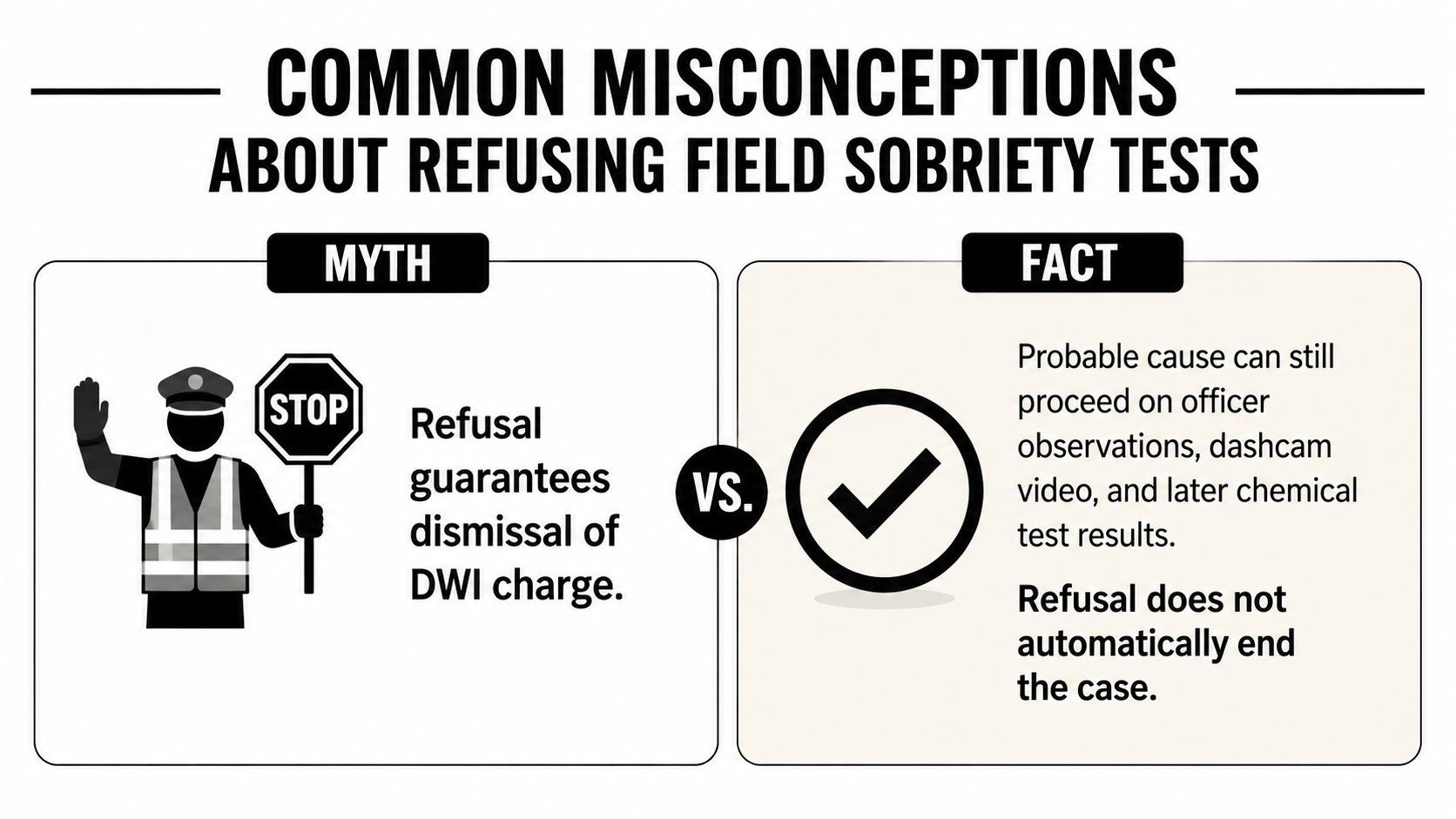
Myth one, refusal guarantees dismissal
It doesn't. An officer may still arrest you based on driving, speech, odor, balance, admissions, video, and other circumstances. The State may also obtain or rely on later chemical evidence. Refusal removes one category of evidence, but it doesn't erase the rest.
Myth two, the officer must tell you that refusal is legal
North Carolina's voluntary roadside framework doesn't mean the officer must give you a helpful explanation of every legal option before requesting the exercises. You can ask whether the request is voluntary, but don't expect the officer to advise you like a defense attorney.
Myth three, medical conditions automatically excuse poor performance
A medical condition, age, injury, fatigue, or nervousness may provide important defense evidence. It doesn't automatically prevent the officer from documenting what happened. Tell your lawyer about the condition and whether you disclosed it during the stop.
Myth four, refusal can't be mentioned in court
Under G.S. 20-139.1(f), refusal evidence may be admissible in North Carolina proceedings. The State may attempt to use it as circumstantial evidence, although the defense can challenge the foundation, wording, timing, and interpretation.
The most expensive misconception is treating the roadside request and the post-arrest chemical request as one event. They're separate decisions under separate legal frameworks. Your response should depend on what the officer is asking, whether you're under arrest, what warnings were given, and what paperwork you receive.
What to Do Before and After Refusing a Field Sobriety Test
The strongest approach is calm, brief, and consistent. Don't turn a lawful refusal into an argument.
Before and during the request
- Stay respectful: Keep your hands visible, follow lawful instructions about documents and vehicle safety, and don't make sudden movements.
- Use clear language: Say, “Officer, I choose not to perform any field sobriety tests.” Don't offer a long explanation.
- Ask for clarification: If you're unsure, ask whether the officer is requesting roadside exercises or a post-arrest chemical test. Those are legally different.
- Avoid admissions: Don't estimate how much you drank, explain why you're “fine,” or argue about whether the officer has enough evidence.
- Mention relevant limitations: If you have an injury, neurological condition, balance problem, or medication issue, state it briefly. Your lawyer can later investigate how it affected the encounter.
Afterward, write down the time, location, road conditions, lighting, weather, exact words used, and who was present. Preserve any available dashcam footage, receipts, phone location information, medical records, and witness contact details.
After arrest
Invoke your right to remain silent and request counsel. Don't assume that asking for a lawyer automatically pauses every testing decision. Listen carefully to the chemical-test advisement, avoid physical resistance, and contact a North Carolina DWI attorney as soon as possible.
If you receive DMV paperwork, act promptly. North Carolina's implied-consent process includes deadlines for requesting a hearing, and missing one can limit your ability to challenge the administrative revocation. Your lawyer should also review whether the detention, arrest, advisement, and chemical-test procedure complied with the statute.
Practical rule: Don't make the roadside decision based on an internet slogan. Make it based on the exact test requested, the timing, your physical condition, and the other evidence already developing.
Frequently Asked Questions About Refusing Field Sobriety Tests
Can police force me to perform roadside field sobriety tests?
Generally, no. North Carolina treats standardized roadside field sobriety exercises as voluntary. An officer may still order you out of the vehicle when legally justified and may arrest you based on the total circumstances, but refusal doesn't give the officer permission to physically force the exercises.
Is refusing roadside testing the same as refusing a breath or blood test after arrest?
No. Roadside field testing and post-arrest chemical testing fall under different frameworks. Roadside refusal generally doesn't create the automatic license revocation associated with chemical-test refusal, although G.S. 20-139.1(f) allows refusal evidence in relevant proceedings. Chemical-test refusal is handled under G.S. 20-16.2 and can trigger DMV consequences.
Can refusal alone convict me of DWI?
Refusal alone shouldn't be treated as the entire proof of impaired driving. The State must establish the DWI charge through admissible evidence, and prosecutors commonly rely on the combined circumstances of the stop, investigation, arrest, and testing.
What should I do if I'm charged with a first DWI?
Get case-specific advice quickly. A first-offense case can still involve license, employment, insurance, and court consequences. The North Carolina first-offense DWI resource explains issues that may arise, but it can't replace a review of your stop, video, reports, warnings, and test records.
If you've refused a field sobriety test or a post-arrest chemical test in North Carolina, the Law Office of Bryan Fagan can review the stop, arrest, refusal evidence, and DMV deadlines with you. Visit Law Office of Bryan Fagan to schedule a consultation about your case and legal options.