A family in Raleigh finds a typed will after a loved one dies. The document names beneficiaries, but one witness never signed. A notary stamped the last page, yet the family doesn't know whether that stamp can replace the missing witness. Probate becomes harder at the moment everyone is already grieving.
North Carolina will requirements can feel technical, but the basic questions are practical. Who can make a will? What must the document say and how must it be signed? Do two witnesses have to be present? Does notarization make a will valid? What happens when an original will is stored electronically or a person moves to North Carolina with a will signed elsewhere?
This guide focuses on North Carolina law, including the difference between a valid will and a self-proving will. It also addresses handwritten wills, out-of-state documents, electronic storage, safekeeping, and the mistakes that create avoidable probate disputes. For related planning concerns, families may also find guidance on avoiding probate in North Carolina useful.
Introduction to NC Will Requirements and Why Validity Matters
A will isn't valid merely because it reflects someone's wishes. North Carolina law requires the person making the will, called the testator, to satisfy legal requirements involving age, mental capacity, the document itself, signatures, and witnesses. A family can understand exactly what a loved one intended and still face a dispute if the document wasn't executed in a legally recognized form.
That distinction is especially painful after death. Suppose a parent writes a typed document at home, signs it alone, and leaves it in a desk drawer. The document may clearly identify the intended beneficiaries, but a typed will generally must be signed and attested by at least two competent witnesses under North Carolina law. A notary's presence doesn't automatically cure the absence of witness signatures.
Practical rule: A will should be evaluated by its execution formalities, not just by how clear or fair its instructions appear.
North Carolina statutes also recognize specific alternatives and safeguards. A holographic will may qualify if it meets strict handwriting requirements. A will executed under another jurisdiction's law may still be recognized in North Carolina. Beginning in 2026, North Carolina law also addresses the electronic storage of an attested written will and the later creation of a certified paper copy for probate, creating practical questions that older estate-planning articles often overlook. The legislature's changes are described in the North Carolina session law document.
The most important distinction for a family is between validity and probate convenience. A will can be valid without being self-proved, but the estate may then need additional evidence during probate. A self-proving affidavit can reduce that later burden, but it doesn't replace the witnesses required to execute an attested written will.
By the end, you should be able to identify the main NC will requirements, spot common signing errors, understand when a handwritten or out-of-state will may matter, and recognize when attorney review is appropriate. No checklist can resolve every family conflict, capacity concern, or drafting issue, but careful execution gives your wishes a stronger legal foundation.
Who Can Make a Will in North Carolina
North Carolina law starts with the person making the will. Before discussing witnesses or notarization, ask whether the testator meets the basic requirements for making a will. The state's statute requires the testator to be at least 18 years old and of sound mind. These requirements are addressed in North Carolina General Statutes Chapter 31.

Age and sound mind
The age requirement is straightforward. An adult may make a will if the other legal requirements are satisfied. The harder phrase, sound mind, refers to testamentary capacity. In plain language, the person should understand that they're making a will, understand generally what property they own, recognize the people who would ordinarily be considered in their plan, and understand the effect of signing the document.
Sound mind doesn't mean perfect memory, excellent health, or freedom from every medical diagnosis. A person may have physical limitations or periods of confusion and still have capacity at the time of signing. The timing matters, which is why a signing appointment should occur when the testator is alert and able to communicate choices.
Consider an older adult who reviews the will with an attorney, identifies family members, explains why certain people will receive property, and signs after asking sensible questions. That record may help show deliberate decision-making. By contrast, a person who can't understand the document or appears to sign only because someone is directing every action may require a pause and further legal assessment.
Writing wishes down isn't enough
A handwritten note on a kitchen counter isn't automatically a valid will. North Carolina recognizes more than one form, but each form has its own requirements. A typed document typically needs formal execution, while a handwritten document must satisfy the separate rules for a holographic will.
Safekeeping matters, too. The clerk of superior court in each North Carolina county must keep a receptacle where an original paper will may be deposited for safekeeping. A testator may also use another secure custodian, but the executor should know where the original can be found.
A practical self-check looks like this:
- Age: The testator is at least 18.
- Capacity: The testator understands the act of making a will and the choices being made.
- Recognized form: The document is prepared as an attested written will or satisfies the rules for another recognized form.
- Secure location: The original or legally relevant record is protected, and the person responsible for the estate can locate it.
If capacity may later be questioned, don't rely on a home signing or an online form alone. A North Carolina estate-planning attorney can help determine whether the circumstances call for additional safeguards, careful documentation, or a different planning approach.
How to Properly Execute an Attested Will in North Carolina
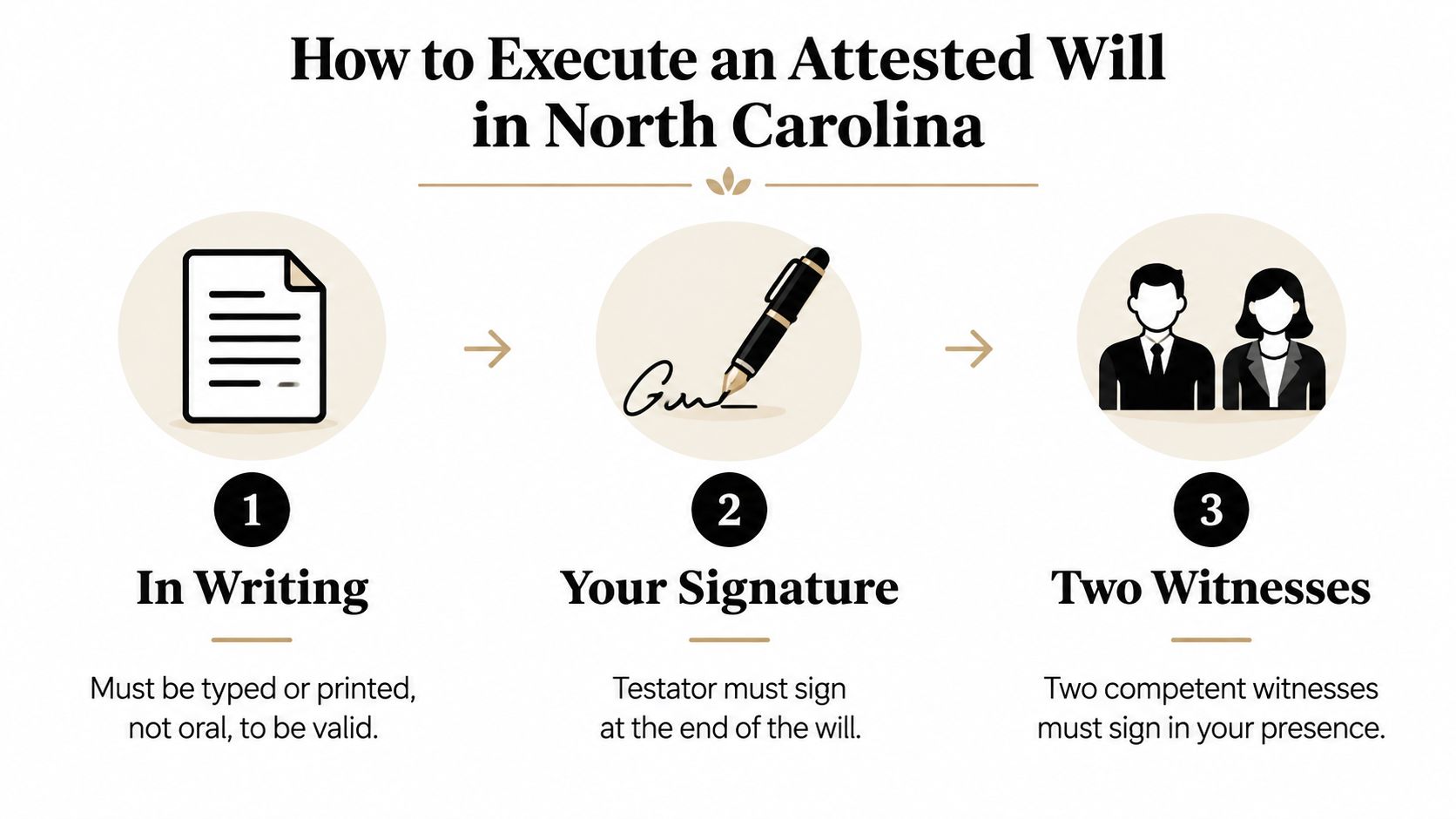
The most familiar North Carolina will is an attested written will. It must be in writing, signed by the testator, and attested by at least two competent witnesses. The governing execution rules appear in North Carolina General Statutes Chapter 31.
Start with a written document
The will must exist in writing. An oral promise, text message, or conversation about what should happen to property isn't the same as a properly executed attested will. A typed or printed document is easier to review for missing clauses, unclear names, and inconsistent instructions, but formatting alone doesn't make it legally effective.
The testator should read or review the document before signing. Names, family relationships, fiduciary appointments, and property instructions should be checked carefully. A document that is signed before its terms are understood can create later questions about capacity, undue influence, or intent.
Sign the will correctly
The testator must sign the will. The signature should be placed where the document indicates, typically at the end of the testamentary provisions. A person who signs a cover page but leaves the will itself unsigned may create an execution problem.
If the testator can't physically sign in the usual way, North Carolina law may involve additional procedures and factual questions. That situation deserves individualized guidance rather than an improvised shortcut. The signing process should make clear that the testator is adopting the document as the will.
Have two competent witnesses attest
At least two competent witnesses must attest to the will. They should be present for the testator's signing or acknowledgment and then sign as witnesses in the manner required by the execution process. The witnesses aren't just people who happen to sign later without knowing what they're witnessing.
A careful signing appointment commonly follows this sequence:
- The testator reviews the final document and confirms that it expresses the intended plan.
- The testator signs the will, or acknowledges the signature, in the presence of the witnesses.
- The witnesses observe the signing or acknowledgment and sign as witnesses.
- The completed document is checked for missing pages, signatures, or attachments.
For example, a parent who signs a finished will in front of two competent witnesses, followed by both witnesses signing during the same appointment, is using the formal process the statute contemplates. A parent who signs privately and later asks one neighbor to sign, while a notary stamps the document, has created a very different evidentiary record.
The witnesses don't need to know the value of the estate or every private reason behind the plan. They do need to participate as witnesses to the execution. If a beneficiary serves as a witness, the legal consequences can depend on the circumstances and the document, so an attorney should review the choice of witnesses before signing.
A will that meets these formalities may be valid even if the family later has to provide witness testimony during probate. That leads to a separate question: whether the will is self-proved.
The signing process can be demonstrated visually in the North Carolina will execution video.
Self Proving Affidavits and Why Notarization Alone Is Not Enough
A self-proving affidavit doesn't create the will. It helps establish the will's authenticity during probate. North Carolina law allows an attested will to be admitted without live witness testimony when it has been self-proved under G.S. 31-11.6. The probate materials from the UNC School of Government explain the practical difference between a self-proved will and one that requires additional proof.
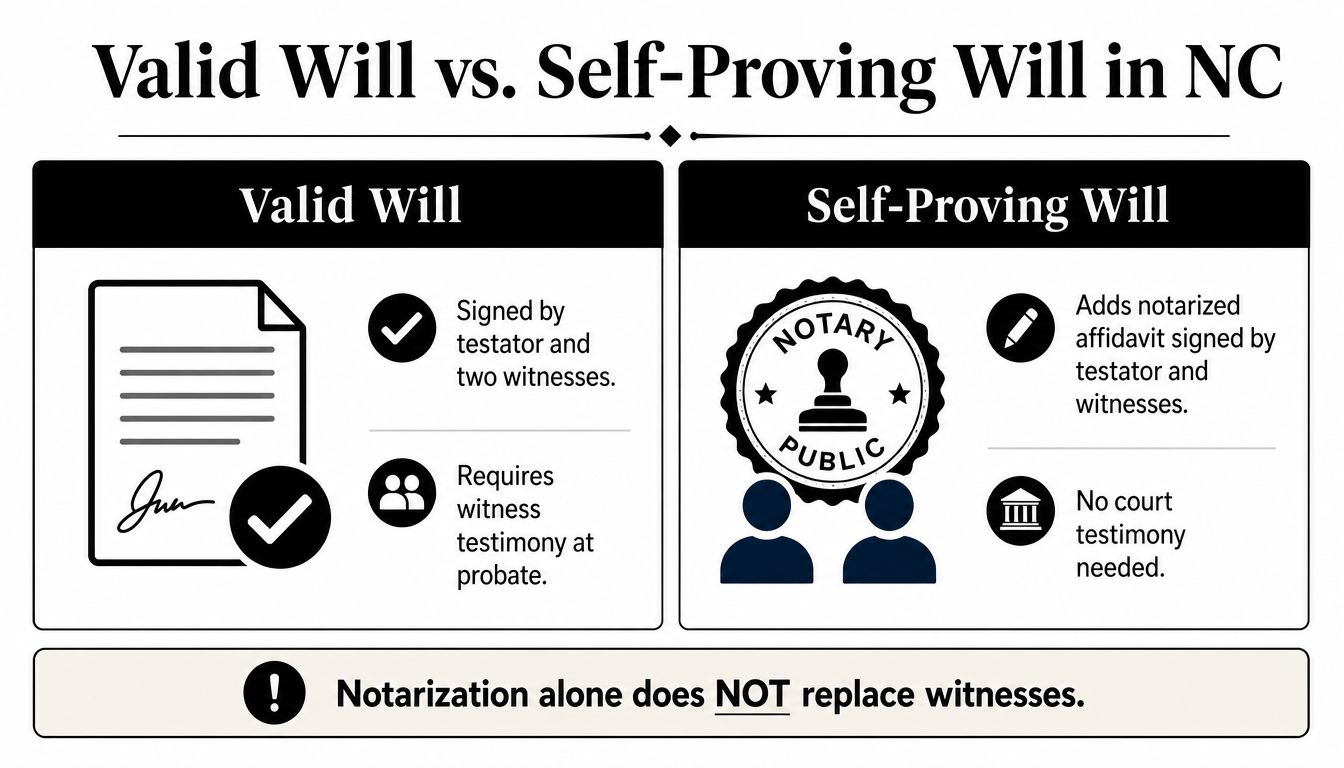
A valid will versus a self-proving will
These concepts are related but not identical.
| Document status | What it means | Possible probate consequence |
|---|---|---|
| Valid but not self-proved | The testator and two competent witnesses completed the required execution steps, but no self-proving affidavit was attached. | Witness testimony or another authorized proof method may be needed. |
| Self-proving will | The will was properly executed and includes the required acknowledgment and witness affidavits before an authorized officer. | The will may be admitted without live witness testimony. |
The self-proving process can happen during the original signing appointment or later. The testator acknowledges the will, and the witnesses complete affidavits before an officer authorized to administer oaths. The officer's certificate, under official seal, is attached to the will.
This arrangement can be valuable for a family handling probate after a death. Witnesses may have moved, become ill, forgotten the signing, or be difficult to locate. A self-proving affidavit can address that later evidentiary problem, provided the will itself was properly executed.
Why a notary alone doesn't work
A common misconception is that a notary makes a will valid. In North Carolina, an attested written will still requires witness attestation. A notary may complete the self-proving affidavit, but notarization alone doesn't substitute for the two competent witnesses.
Think of the process as having separate functions:
- Testator: Signs or acknowledges the will.
- Witnesses: Attest to the execution.
- Authorized officer: Administers oaths and completes the self-proving certification.
A notary who only stamps the testator's signature hasn't necessarily completed any of those other functions. The safest approach is to arrange the witnesses and notary together at the signing appointment, review every page, and confirm that the affidavit and certificate are attached correctly.
The notary supports the self-proving process. The notary doesn't replace the witnesses.
If a will is already signed, don't automatically discard it because it isn't self-proved. It may still be valid, and North Carolina law includes fallback proof methods when witness testimony isn't available. An attorney can review the document and advise whether a later self-proving procedure or another probate step is available.
Special Rules for Holographic Wills Out of State Wills and Electronic Storage
North Carolina recognizes several situations that don't follow the standard typed-and-witnessed pattern. These aren't informal shortcuts. Each has separate requirements, and the facts surrounding execution and storage can determine whether the document is accepted.
Holographic wills
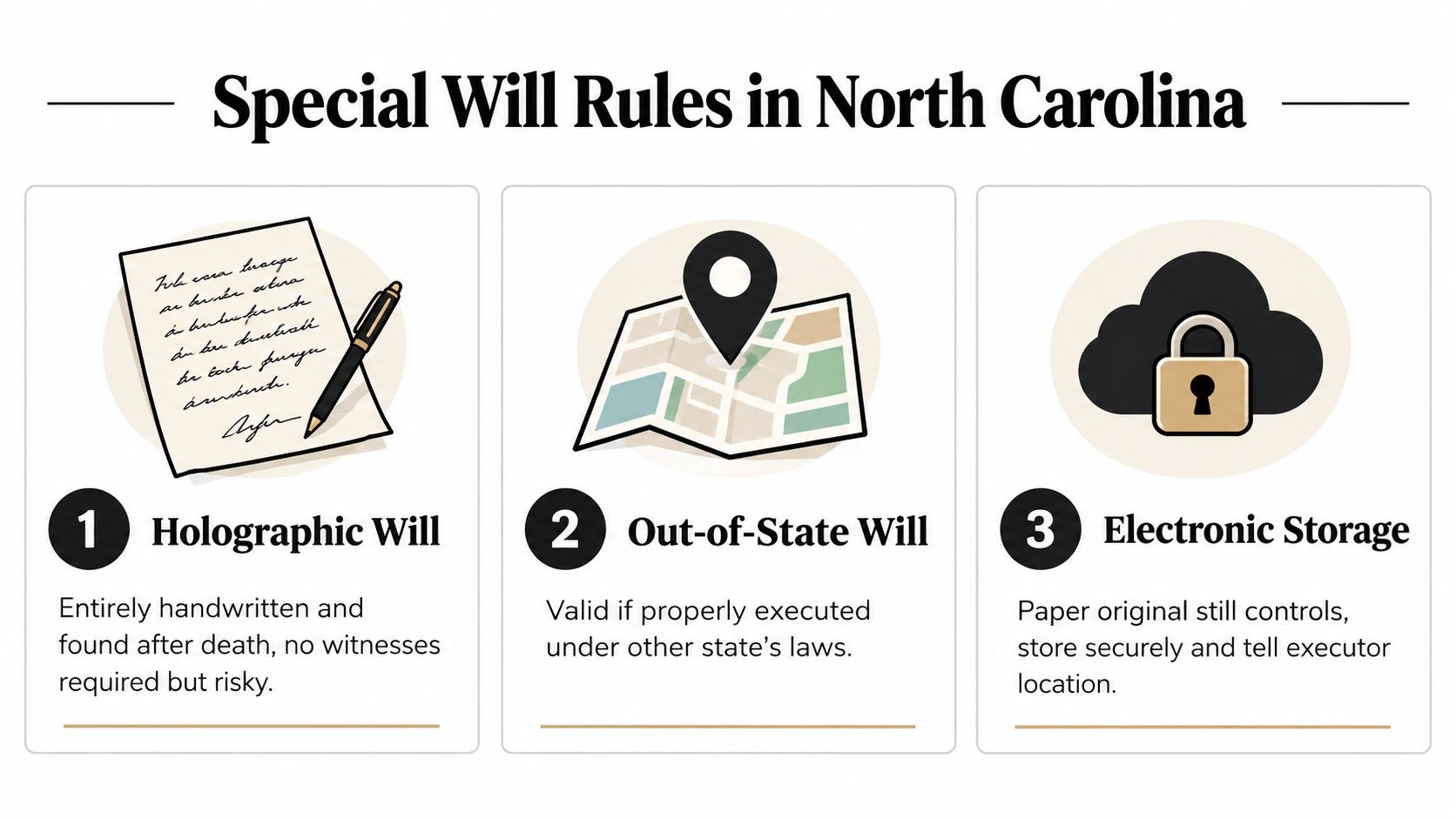
A holographic will is handwritten by the testator. North Carolina law requires the document to be written entirely in the testator's handwriting, with the testator's name subscribed or written in the testator's own handwriting. No attesting witness is required when the document qualifies as holographic.
That doesn't mean probate is simple. At least three competent witnesses must provide proof that they believe the will and the signature or name are entirely in the testator's handwriting, as explained in G.S. 31-3.4. A handwritten emergency note may express genuine wishes, but the estate could face a difficult proof process if handwriting witnesses can't be found.
Wills signed outside North Carolina
A will signed in another state isn't automatically ineffective after the testator moves to North Carolina. Under North Carolina's validity statute, a will may be valid if it complied with North Carolina law at execution or death, or with the law of the jurisdiction where the testator was physically present when signing, the testator's place of domicile at execution or death, or applicable military testamentary rules under 10 U.S.C. § 1044d. The recognition rules are set out in G.S. 31-46.
A person who relocates from another state should have an attorney review the existing will rather than assume it is invalid or automatically perfect. Changes in residence, property, family relationships, and fiduciary appointments may all justify an update.
For people handling family legal matters at the same time, Don't Lose Your Rights: Filing Claims Before NC Divorce Is Final addresses why equitable distribution and alimony claims must be filed before an absolute divorce is granted.
Electronic storage and certified paper copies in 2026
North Carolina's 2025 legislation took effect January 1, 2026 and allows an attorney to upload an attested written will into an electronic record, attach a sworn affidavit certifying that the electronic record is a complete and accurate copy, and later create a certified paper copy for probate. The practical point isn't that every paper will has become an electronic will. Rather, the law creates a process for electronic storage and a certified paper copy when the statutory conditions are met.
Families should ask precise questions about custody of the original, the electronic record, the affidavit, access controls, and the procedure for producing the certified paper copy after death. An executor shouldn't assume that a scan saved on a personal device is equivalent to the legally maintained record.
This change is particularly important for people who signed a traditional paper will and want to understand how it may be stored and later presented for probate. Because the rules are new and document-specific, attorney review is prudent before relying on electronic storage.
Common Mistakes to Avoid and Your NC Will Checklist
Most will problems don't begin with an unusual legal theory. They begin with a rushed signing, an incomplete page, a missing witness, or an assumption that a notary stamp solves everything. A checklist won't replace legal advice, but it can help a family catch basic defects before leaving the signing appointment.
Mistakes that create trouble
- Using a notary alone: A notary may complete the self-proving affidavit, but an attested written will still needs two competent witnesses.
- Using only one witness: One witness doesn't satisfy the standard requirement for an attested written will.
- Forgetting the testator's signature: A document can state the person's wishes and still fail if the testator hasn't signed it.
- Signing different versions: The witnesses should sign the final document, not an earlier draft with different provisions.
- Assuming every handwritten note qualifies: A note must meet the specific requirements for a holographic will, including complete handwriting and later handwriting proof.
- Losing the original or relevant record: The executor needs to know where the legally important document is stored.
A simple example makes the risk clear. Someone prints an online template, signs it with a notary, and asks one relative to sign later. The family may believe the estate plan is complete, but the execution process may not satisfy North Carolina law.
A signing-day checklist
Before the appointment, confirm that the testator understands the plan and can communicate decisions. At the appointment, verify the following:
- Document form: The final will is in writing and contains the intended provisions.
- Testator signature: The testator signs or properly acknowledges the signature.
- Two witnesses: At least two competent witnesses participate and sign as required.
- Self-proving affidavit: The testator and witnesses complete the affidavit before an authorized officer if the family wants to reduce later witness testimony.
- Attached certificate: The officer's certificate and official seal are attached correctly.
- Safekeeping plan: The original paper will or authorized electronic record is stored securely.
- Executor notice: The person likely to handle the estate knows where the document can be found.
A template may help someone organize thoughts, but it can also leave unanswered questions about execution, beneficiaries, fiduciaries, and changing family circumstances. Before relying on a form, compare it with North Carolina will template guidance and consider whether attorney review is appropriate.
When to Seek Help From a North Carolina Estate Planning Attorney
Attorney guidance is especially important when family relationships are strained, a beneficiary may challenge the plan, the estate includes substantial or unusual assets, or the testator's capacity could later be questioned. It also makes sense when the will was signed in another state, when a person wants to use electronic storage, or when a handwritten document is the only available record.
A lawyer can review execution, explain self-proving options, identify conflicts, and help coordinate wills with beneficiary designations and other planning documents. No attorney can guarantee that relatives won't contest a will or that every probate issue will disappear, but careful planning can make the legal record clearer.
Frequently asked questions
Does a will in North Carolina need to be notarized?
Notarization alone isn't enough for an attested written will. The testator must sign and at least two competent witnesses must attest. A notary can administer the self-proving affidavit, which may allow probate without live witness testimony.
Can I write my own will in North Carolina?
You may prepare your own document, but validity depends on the form and execution requirements. A typed will generally needs the testator's signature and two competent witnesses. A handwritten will must satisfy the separate holographic rules.
Is a handwritten will valid in North Carolina?
It may be, if it's entirely in the testator's handwriting and meets the statutory requirements. Probate generally requires proof from at least three competent handwriting witnesses, so a handwritten will can create practical difficulties.
Can I use an out-of-state will after moving to North Carolina?
Possibly. North Carolina law recognizes wills that complied with specified North Carolina, other-state, domicile, or military rules. An attorney should review the document before you rely on it.
Can an electronic copy be used for probate?
North Carolina's 2026 rules address electronic storage by an attorney, a sworn certification that the record is complete and accurate, and the later creation of a certified paper copy. A casual scan isn't automatically the same thing.
If you're concerned that someone may challenge a will, a North Carolina caveat proceeding and will contest may involve highly fact-specific court procedures. Separate family-law matters may also require a North Carolina Divorce Lawyer for representation involving absolute divorce and related claims under North Carolina law.
North Carolina residents don't have to sort through these questions alone. The Law Office of Bryan Fagan provides estate-planning services involving wills, trusts, and probate guidance, with attention to execution, storage, and the family circumstances surrounding the plan. Visit the Law Office of Bryan Fagan to learn more and schedule a consultation about creating or reviewing your North Carolina will.