A North Carolina parent receives notice that a disabled adult child may inherit money from a grandparent. Another family is waiting for a personal injury settlement to arrive in the beneficiary's name. In both situations, the family may worry that the funds could interfere with Medicaid, SSI, or other means-tested benefits that help pay for essential care.
A special needs trust in North Carolina can provide a way to hold and manage assets for supplemental needs without treating the beneficiary as the direct owner of those assets, provided the trust complies with applicable federal and state rules. The right choice depends on where the money comes from, the beneficiary's circumstances, the trustee's responsibilities, and what may happen when the trust ends.
Introduction to Special Needs Trusts in North Carolina
Consider a family in Raleigh whose disabled son receives Medicaid and relies on SSI. His grandmother wants to leave him an inheritance, but the family knows that placing money directly in his name could create an eligibility problem. They aren't trying to replace his public benefits. They want to pay for transportation, technology, recreation, therapies, and other needs that public programs may not fully cover.
That's the central purpose of a special needs trust. The trust holds assets for the beneficiary, while a trustee controls distributions for supplemental needs. The beneficiary can receive additional support without automatically receiving the assets outright. The arrangement must be drafted and administered carefully because a trust that uses the wrong language, receives funds incorrectly, or makes unsuitable distributions can create serious benefits complications.
North Carolina families also need to understand the state-specific framework. Chapter 36D, the North Carolina Community Third Party Trusts, Pooled Trusts Act, authorizes community third-party trusts and pooled trusts in alignment with 42 U.S.C. § 1396p(d)(4). That alignment connects North Carolina law to the federal Medicaid trust exceptions created after the Omnibus Budget Reconciliation Act of 1993, commonly called OBRA ’93. North Carolina's statutory framework provides a state pathway for preserving public-benefit eligibility when a qualifying trust holds assets for supplemental needs.
The difficult question usually isn't whether a trust exists. It's which trust fits the source of the money. A settlement, an inheritance already received by the beneficiary, and money contributed by parents can require different planning. North Carolina's rules on Medicaid reimbursement and estate recovery can also affect the family's decision.
This guide explains the basic mechanics, compares first-party, third-party, and pooled trusts, addresses the 2025 rule affecting certain pooled-trust transfers by people age 65 or older, and outlines practical funding and administration steps. Families can also review general trust concepts through what a trust is and how it works, then obtain advice based on the beneficiary's actual benefits, assets, and family structure.
What a Special Needs Trust Does and How It Works
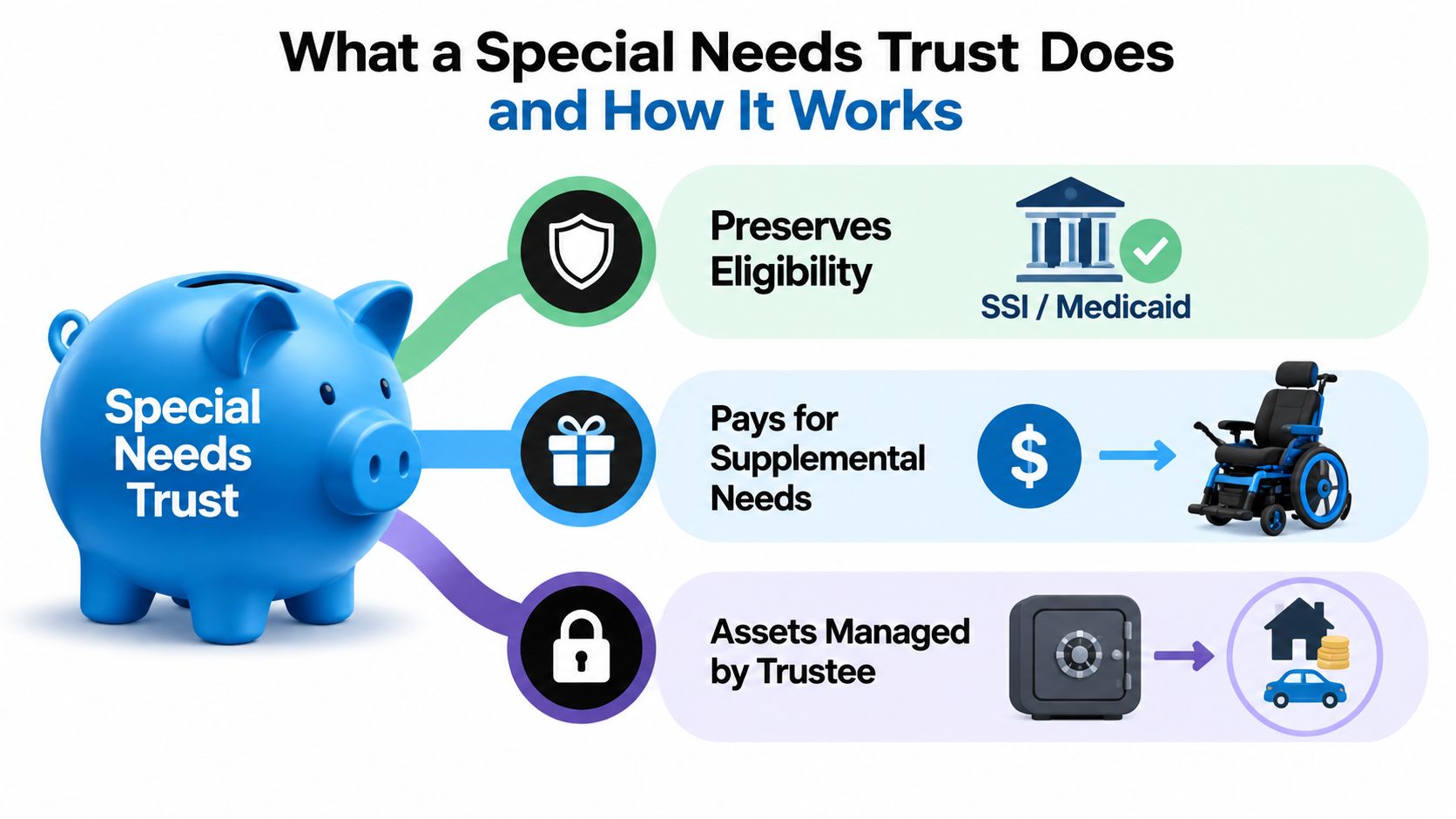
Think of a special needs trust as a supplemental support fund, not a replacement for Medicaid or SSI. Public benefits may provide the foundation for medical care or basic support. The trust can help pay for additional goods and services that improve the beneficiary's quality of life.
The trustee, not the beneficiary, manages the trust property. The trustee decides whether and how to make distributions, follows the trust document, keeps records, and considers the effect of payments on benefit programs. The beneficiary receives the benefit of the trust, but doesn't necessarily have the right to demand the money.
The ownership distinction matters
Means-tested programs examine available resources under their governing rules. Assets held in a properly structured qualifying trust may receive different treatment from assets owned directly by the beneficiary. North Carolina's statutory scheme states that a beneficiary's interest in a qualifying trust isn't counted as an available asset for eligibility purposes when the trust complies with Chapter 36D and the governing requirements. Chapter 36D also addresses pooled-trust administration and reimbursement mechanics.
That protection isn't automatic. The trust must fit the correct legal category, and the trustee must administer it consistently with the document and benefits rules. Direct payments to the beneficiary, unrestricted access to trust funds, or poorly documented expenditures can create questions even when the original trust document was carefully prepared.
A family may want the trust to pay a vendor directly for a wheelchair modification, communication device, or accessible transportation. The trustee should examine each payment under the applicable program rules and preserve records showing the purpose, recipient, and connection to the beneficiary's supplemental needs.
Why North Carolina law is part of the analysis
Federal law supplies the Medicaid trust exceptions, but North Carolina families still need a trust that works under North Carolina's statutory framework. Chapter 36D recognizes community third-party trusts and pooled trusts, while federal law provides the underlying exception in 42 U.S.C. § 1396p(d)(4).
State-specific planning can matter even in an unrelated family-law matter. For example, someone researching North Carolina Divorce Residency Requirements will find that North Carolina uses a six-month residency rule for filing divorce. That rule has no direct connection to trust eligibility, but it illustrates why legal planning should be based on the governing North Carolina rule rather than a generic national checklist.
Practical rule: The trust should be designed before money changes hands whenever possible. Once the beneficiary receives funds directly, correcting the problem may become more complicated.
Types of Special Needs Trusts Available in North Carolina
The source of the money usually drives the trust selection more than the diagnosis does. A personal injury settlement already belonging to the disabled beneficiary presents a different problem from money a parent contributes for a child's future care.

First-party trusts
A first-party special needs trust uses the disabled beneficiary's own assets. Examples include a settlement, an inheritance received outright, or other funds already owned by the beneficiary. Under federal 42 U.S.C. § 1396p(d)(4)(A), the trust must be established for a disabled person who is under age 65, and it must include a Medicaid reimbursement provision. The federal statute supplies the framework North Carolina families must follow.
The payback provision means that remaining trust assets may be used to reimburse the state for Medicaid assistance paid on the beneficiary's behalf. A first-party trust can protect eligibility while holding the beneficiary's own money, but it doesn't provide the same inheritance flexibility as a properly structured third-party trust.
Third-party trusts
A third-party special needs trust is funded with assets belonging to someone other than the beneficiary. A parent, grandparent, sibling, or family friend may contribute money during life or direct assets to the trust through an estate plan or beneficiary designation.
Because the beneficiary never owns the contributed assets, the trust can be useful for planning an inheritance without placing the money directly in the beneficiary's name. The trust document can identify who receives any remaining assets after the beneficiary's death. The family should still use careful drafting and administration, because the absence of a first-party payback obligation doesn't eliminate all benefits-planning concerns.
Pooled trusts
A pooled trust is administered by a nonprofit organization and uses a separate subaccount for each beneficiary. The nonprofit manages the overall arrangement, while the beneficiary's subaccount remains separately identified. Federal law recognizes pooled trusts under 42 U.S.C. § 1396p(d)(4)(C).
Pooled trusts can be relevant when a family wants professional nonprofit administration or when a first-party trust is needed but an individually drafted arrangement isn't practical. North Carolina law requires covered pooled-trust subaccounts to address repayment of medical assistance from remaining funds, and the statutory structure makes the subaccount irrevocable.
| Trust Type | Funding Source and Key NC Rule | Best For |
|---|---|---|
| First-party trust | The beneficiary's own assets, with federal eligibility requirements and Medicaid reimbursement language | A settlement or inheritance already owned by the beneficiary |
| Third-party trust | Family or friends contribute assets for the beneficiary | An inheritance or lifetime gift planned before the beneficiary receives it |
| Pooled trust | A nonprofit administers separate subaccounts under the federal pooled-trust exception and North Carolina law | Beneficiaries needing pooled administration or a first-party planning route |
A settlement deposited into a first-party trust may require payback. A grandparent's planned gift can generally be directed to a third-party trust instead. The same family may use more than one structure at different stages, but each transfer needs separate legal review.
The video below offers another visual explanation of the trust categories and planning distinctions.
How North Carolina Medicaid and SSI Rules Affect Your Trust
A family may establish a trust correctly and still create a benefits problem through one poorly timed transfer or distribution. Medicaid and SSI agencies look beyond the trust's name. They examine who owns the assets, who controls them, whether the beneficiary can access them, how the trust was funded, and what the trustee pays.
North Carolina applies federal exceptions alongside state requirements. Under Chapter 36D, a beneficiary's interest in a qualifying trust may avoid treatment as an available asset when the arrangement follows the governing statute and eligibility rules. That protection is limited. Each payment still needs review because cash, housing expenses, and other distributions can affect benefits differently.

Home equity and controlled thresholds
Federal Medicaid law provides a specific home-equity protection. Under 42 U.S.C. § 1396p, an individual's home equity may exceed the applicable long-term-care limit only up to $500,000 under the cited statute. The rule shows why a deed transfer or trust arrangement does not automatically resolve eligibility or estate-recovery questions. The home's use, ownership, equity, and the beneficiary's circumstances still matter.
Trust distributions require the same care. A trustee's payment for housing may receive different treatment from a payment for medical equipment or transportation. Before approving a distribution, the trustee should consider the beneficiary's current programs, living arrangement, and actual need.
Families can also review North Carolina irrevocable trust planning when deciding how ownership and control should be structured. An irrevocable arrangement may limit later changes, so its effect on benefits and estate recovery should be understood before assets move.
Payback and North Carolina estate recovery
A first-party trust generally must reimburse Medicaid from assets remaining at the beneficiary's death, up to the assistance paid on that person's behalf. NCDHHS guidance explains that the claim can reach all funds remaining in the trust and assets purchased with trust funds, subject to the amount of Medicaid assistance received. NCDHHS special-needs-trust guidance makes careful recordkeeping and remainder planning important.
North Carolina Medicaid estate recovery is limited to the probate estate. That limit can affect the comparison among first-party trusts, third-party trusts, and ABLE accounts when an estate contains both probate and nonprobate property. It does not remove the separate reimbursement rules for qualifying first-party and pooled trusts.
The 2025 pooled-trust rule for older adults
North Carolina's 2025 change created a specific planning consideration for people age 65 or older. For certain transfers into a pooled trust that conforms to 42 U.S.C. § 1396p(d)(4)(C), the Department of Health and Human Services is directed to treat the transfer as made for fair market value when the person demonstrates that the funds will be used within life expectancy to purchase goods and services of equivalent value.
The rule is limited, not a blanket exemption. A family should document the transfer, intended purchases, timing, and expected use of the funds. A transfer that fails the required conditions may receive different Medicaid treatment. This older-adult rule can affect the choice between a first-party trust, a pooled trust, and other planning options, especially when Medicaid estate recovery is also part of the family's decision.
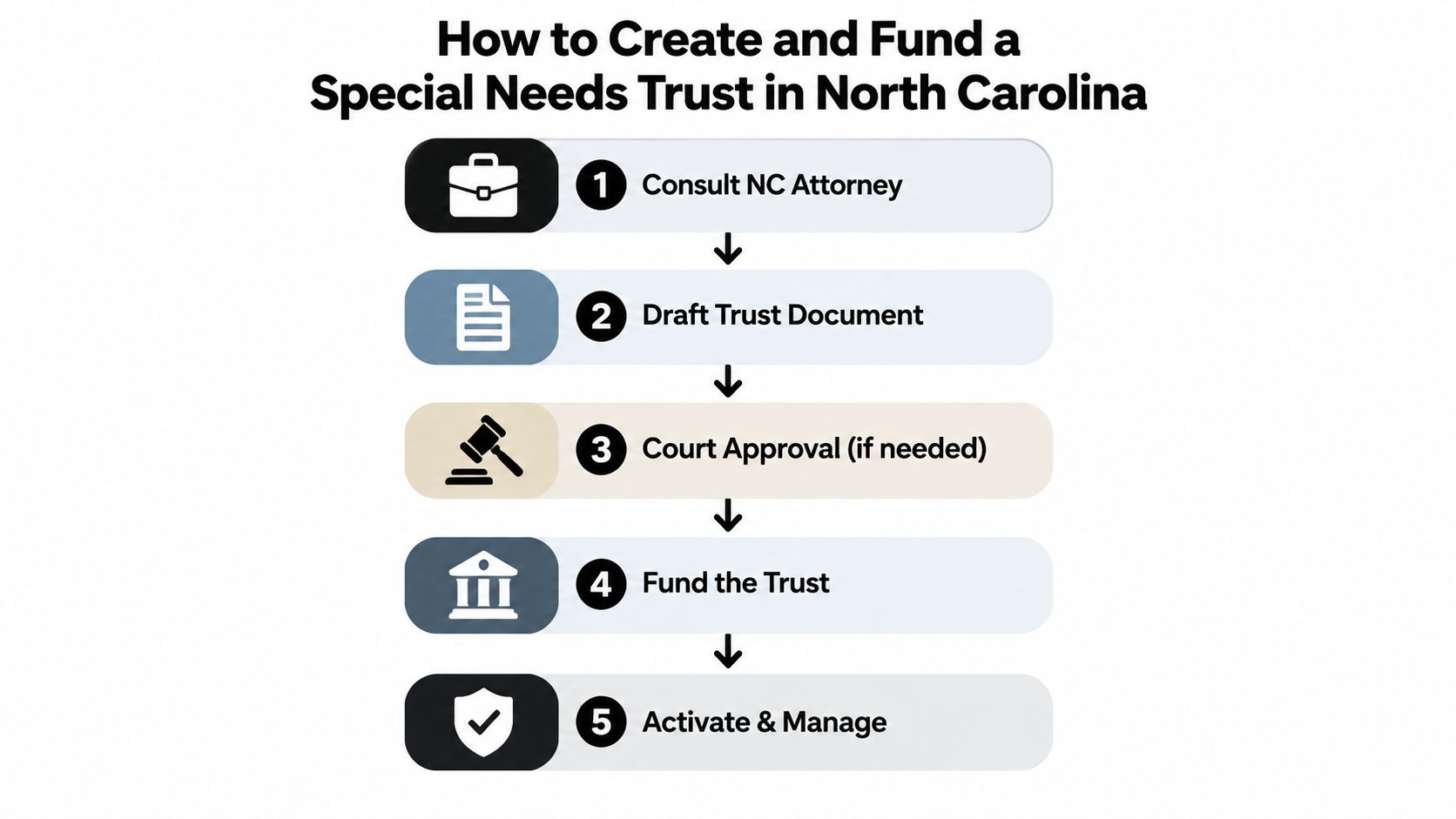
How to Create and Fund a Special Needs Trust in North Carolina
Creating the trust is only part of the work. Families also need to make sure the money reaches the trust correctly and that the trustee can administer it without undermining the beneficiary's benefits.
Start with the funding source
Identify whether the money belongs to the beneficiary or to someone else. A beneficiary's settlement or directly received inheritance may point toward a first-party trust or a pooled trust. A parent's assets, life insurance proceeds, or future inheritance plan may support a third-party trust.
Don't wait until the check arrives. An inheritance paid directly to the beneficiary can create a problem that a family could have avoided by changing the beneficiary designation or estate-plan language beforehand.
Draft and obtain approval when needed
The trust document should identify the trustee, beneficiary, distribution standards, successor arrangements, and applicable reimbursement provisions. It should also give the trustee appropriate discretion to make supplemental distributions rather than requiring payments the beneficiary can demand.
If the beneficiary is a minor or lacks capacity, court involvement may be necessary. North Carolina planning can also involve guardianship-adjacent concerns, court filings, and documentation explaining why the trust protects the beneficiary's interests. The attorney should coordinate the trust with any support order, custody arrangement, or estate plan rather than drafting it in isolation.
Select the trustee carefully
The trustee controls distributions and records. A relative may understand the beneficiary's daily needs, while a professional or corporate trustee may offer administrative experience. The right choice depends on reliability, financial judgment, willingness to follow benefit rules, and the availability of a successor.
Trustee duties commonly include:
- Distribution review: Evaluate whether each payment serves a supplemental need and may affect benefits.
- Recordkeeping: Keep invoices, receipts, account statements, and explanations for expenditures.
- Coordination: Communicate with caregivers, benefits representatives, and professionals when necessary.
- Asset management: Preserve and invest trust property under the document and applicable fiduciary duties.
Fund and maintain the arrangement
Funding can involve retitling assets, transferring settlement proceeds, or changing beneficiary designations. Life insurance and retirement accounts need particular attention because the designation must identify the correct trust and coordinate with the overall estate plan.
A trustee should document why the trust paid for a service, who received the payment, and how the expense benefited the beneficiary. Families should also review the plan after divorce, a custody change, a new support order, a change in benefits, or a major inheritance.
For broader estate administration context, families can review guidance on how to avoid probate in North Carolina. Probate planning doesn't replace special-needs planning, but the two subjects can overlap when families decide how assets should pass.
Alternatives Pitfalls and Smart Planning Choices
A special needs trust isn't the only planning tool. An ABLE account may complement a trust by giving an eligible individual a way to save and pay qualified disability expenses under its own rules. A pooled trust may offer nonprofit administration, while an individually drafted trust may provide more customized instructions.
The choice should follow the money and the benefit. Ask:
- Who owns the funds now? If the beneficiary owns them, direct spending or transfer can affect eligibility.
- Who needs to control distributions? A trustee can provide oversight, while an account structure may offer a different level of beneficiary control.
- What happens at death? First-party and pooled arrangements may require Medicaid reimbursement, while a third-party trust can include family or charitable remainder beneficiaries.
- What administration is realistic? A family trustee must be able to maintain records and follow distribution rules.
Several mistakes appear repeatedly in North Carolina planning.
A direct inheritance can place assets in the beneficiary's name at the worst possible time. Relatives should be told to direct gifts to the third-party trust rather than to the beneficiary. Beneficiary designations should be reviewed alongside wills and trusts, because an outdated designation can defeat an otherwise careful plan.
Improper distributions can also create trouble. The trustee shouldn't treat the account like the beneficiary's personal checking account or distribute money without considering how the payment will be treated by SSI or Medicaid. The trustee needs a consistent process for reviewing and documenting expenses.
Families also misunderstand payback. For a covered first-party arrangement, the claim can reach remaining funds and assets purchased with trust funds, as NCDHHS guidance explains. In a pooled trust, North Carolina's statutory scheme requires reimbursement from the remaining subaccount balance up to the assistance paid by the Department. Leftover money doesn't automatically pass to heirs.
Finally, pooled trust subaccounts are irrevocable under North Carolina's statutory scheme. Once funds enter the arrangement, the family generally can't treat the account like an ordinary revocable account and return the money. That is why timing, structure, and professional review matter before a transfer occurs.
Next Steps for North Carolina Families and Frequently Asked Questions
Families don't need to solve every trust issue at the kitchen table. They do need to identify the source of the funds, the benefits at risk, the beneficiary's capacity, the desired trustee, and the family's goals for distributions and remaining assets.
A personalized review can reveal that a third-party trust is appropriate for a future inheritance, while a first-party or pooled trust is necessary for money already owned by the beneficiary. The 2025 pooled-trust transfer rule for adults age 65 and older adds another layer for older adults, and documentation may determine whether the transfer receives the intended treatment.
Frequently asked questions
Does Medicaid always get paid when the beneficiary dies?
Not every trust has the same reimbursement rule. A qualifying first-party trust must include reimbursement language, and North Carolina guidance states that the claim can reach remaining trust funds and assets purchased with trust funds, up to the Medicaid assistance paid on the beneficiary's behalf. Covered pooled trusts also require reimbursement from remaining funds under North Carolina law. A third-party trust is analyzed differently because the assets came from someone other than the beneficiary.
Is a North Carolina pooled trust irrevocable?
North Carolina's statutory scheme states that pooled-trust subaccounts are irrevocable and subject to repayment of medical assistance from remaining funds. Families should understand that an irrevocable transfer generally can't be undone just because circumstances later change.
Can someone age 65 or older use a pooled trust for Medicaid planning?
North Carolina's 2025 rule addresses certain transfers by individuals age 65 or older into a qualifying pooled trust when the person demonstrates that the funds will be used within life expectancy to buy goods and services of equivalent value. The rule requires careful documentation and doesn't mean every transfer will qualify. The federal statute governing pooled trusts should be considered with the North Carolina rule and the person's complete circumstances.
Can the family manage the money without a special needs trust?
The family may be able to provide support directly, but direct ownership or uncontrolled transfers can affect means-tested benefits. A trustee or pooled-trust administrator can separate supplemental spending from the beneficiary's personal resources, but the arrangement must be drafted and managed correctly.
North Carolina families should bring benefit notices, account statements, settlement documents, existing estate plans, and proposed inheritance information to a consultation. The details often determine whether the right solution is an individual trust, a pooled trust, an ABLE account, or a coordinated combination.
The Law Office of Bryan Fagan helps North Carolina families evaluate trusts, beneficiary designations, probate concerns, and related estate-planning issues involving disabled beneficiaries. Visit Law Office of Bryan Fagan to discuss the funding source, benefit-preservation goals, trustee choices, and next steps for your family.