A grandmother in North Carolina may have handled every school morning, medical appointment, meal, and bedtime for her grandchild while the child's mother moved in and out of the picture. Then the mother reappears and says she wants the child returned. The grandmother may feel that the history is obvious and that the child's stability should decide the case. North Carolina law makes the first question more difficult: does the grandmother have standing to ask the court for custody over the parent's objection?
That question comes before a comparison of homes, income, routines, or emotional bonds. In a North Carolina third party custody standing unfitness case, the nonparent generally must first overcome the parent's constitutionally protected status. Only then can the court fully address the child's best interests.
When a Grandparent or Relative Wants Custody in North Carolina
Assume the grandmother in the opening example has raised the child for several years. She enrolled the child in school, attended appointments, provided daily supervision, and became the person the child relies on. When the mother demands the child's return, the grandmother's natural response is to file for custody immediately.
That instinct is understandable, but filing a custody action doesn't guarantee that the court will reach the merits. North Carolina courts can dismiss a nonparent's claim before comparing the grandmother's home with the mother's home. The grandmother may have a stronger support system, more stable housing, and a closer relationship with the child, yet those facts alone may not overcome the parent's protected position.
The starting point is the North Carolina Supreme Court's decision in Petersen v. Rogers. The court recognized a biological or adoptive parent's constitutionally protected, paramount right to the care, custody, and control of the child. The North Carolina School of Government describes a nonparent's right to pursue custody or visitation over a parent's objection as “extremely limited” and explains that the pleading must contain facts supporting parental unfitness, neglect, or conduct inconsistent with protected parental status. See the North Carolina grandparents' rights resource for related issues involving relatives and visitation.
The two questions the court must separate
The grandmother's case has two distinct tracks:
- The statutory pathway: N.C. Gen. Stat. § 50-13.1(a) allows “any parent, relative, or other person” claiming a right to custody to institute a custody proceeding.
- The constitutional barrier: The grandmother still must allege and establish facts showing that the parent is unfit, has neglected the child's welfare, or has acted inconsistently with the parent's protected status.
That distinction matters. Section 50-13.1(a) can permit someone to file, but it doesn't automatically give every relative an enforceable right to pursue custody against a fit parent. A person's ability to submit a complaint is not the same as the court's authority to conduct a best-interest hearing.
The grandmother should therefore organize the case around specific parental conduct and its effect on the child, not just around the fact that she has been the better caregiver. Her relationship with the child matters, but she must also address why the parent's conduct has overcome constitutional priority. The next question is what North Carolina courts mean by that protected parental right.
How North Carolina Law Treats Parental Rights
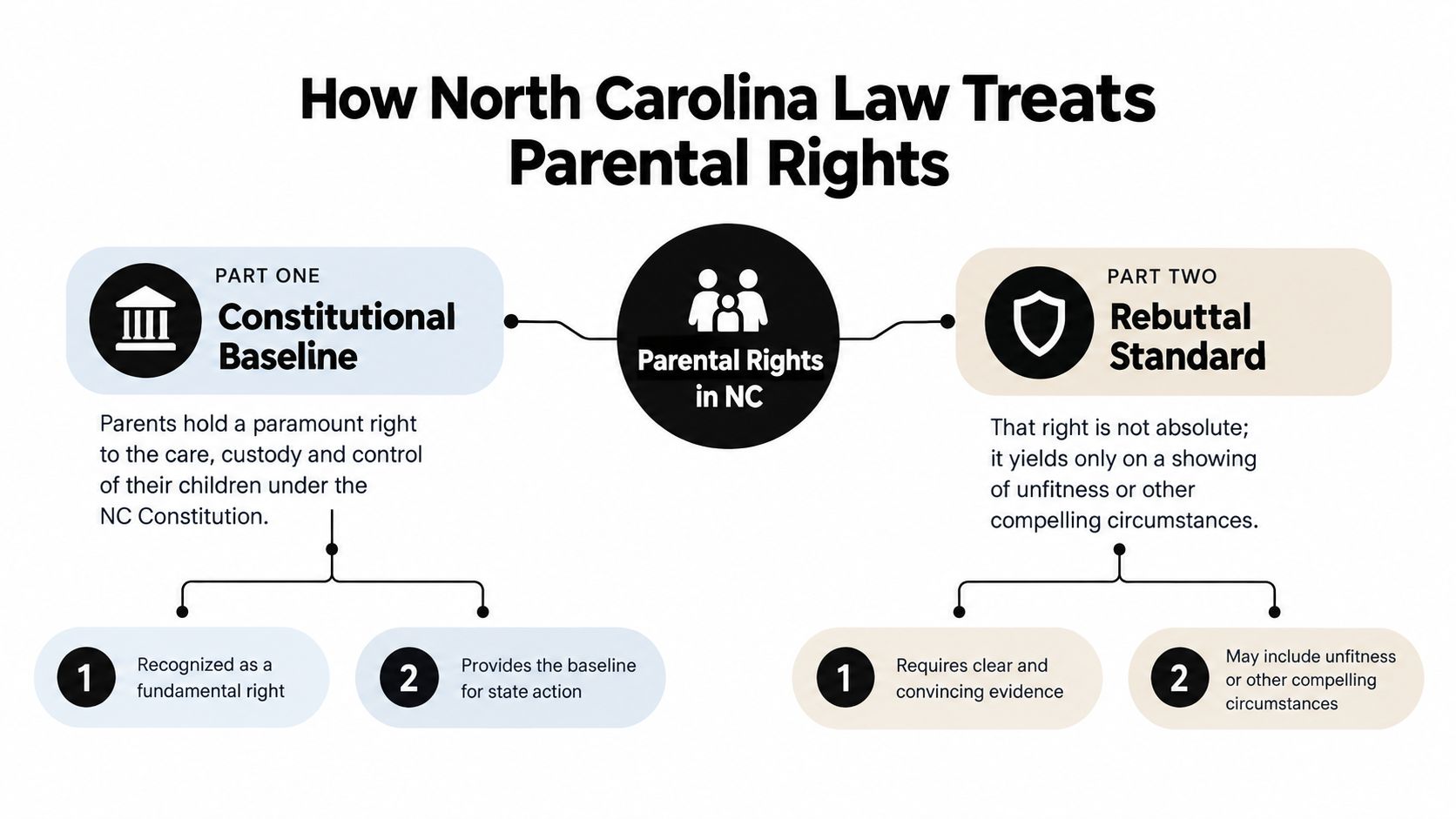
North Carolina custody disputes involving a parent and a nonparent begin with a rule that is stronger than an ordinary preference for the biological parent. In Petersen v. Rogers, the North Carolina Supreme Court recognized the parent's paramount right to the care, custody, and control of the child. In practical terms, a fit parent generally has priority over a loving grandparent, stepparent, relative, or family friend.
“Paramount” doesn't mean that a parent can never lose custody to a nonparent. It means the nonparent must first produce a legally sufficient reason for the court to set aside the parent's protected position. The court isn't supposed to begin by asking which household appears more attractive.
Step one is the constitutional baseline
The parent's status has legal force because the parent has a constitutionally protected relationship with the child. A third party must allege facts showing unfitness, neglect, abandonment, or other conduct inconsistent with the parent's protected role. A complaint that merely says, “The child is better with me,” is vulnerable because it asks the court to compare homes before overcoming the parent's right.
The North Carolina Supreme Court's decision in Price v. Howard reinforces this distinction. Ordinary best-interest analysis does not operate the same way in a parent-versus-nonparent dispute. Unless the parent is shown to be unfit or to have neglected the child's welfare, the parent's protected interest generally prevails. The North Carolina child custody guide describes how North Carolina courts decide custody under the best-interests standard, but that comparison is not the first step in a contested third-party case.
Step two is the statutory pathway
N.C. Gen. Stat. § 50-13.1(a) uses broad language. It permits a parent, relative, or other person claiming a right to custody to institute an action. That language explains who may invoke the custody process, but it doesn't erase the constitutional rule recognized in Petersen and Price.
A pleading must connect the facts to the legal standard. “The mother is irresponsible” is a conclusion. A stronger pleading identifies what the mother did, when she did it, how the child was affected, and why those facts show neglect, unfitness, or conduct inconsistent with parental status. Courts can dismiss a claim that lacks enough factual allegations to establish standing before they weigh competing homes.
That's why a consultation about terminating parental rights in North Carolina isn't interchangeable with a third-party custody consultation. The legal theories, requested relief, and required proof can differ substantially.
What Parental Unfitness Really Means in Court
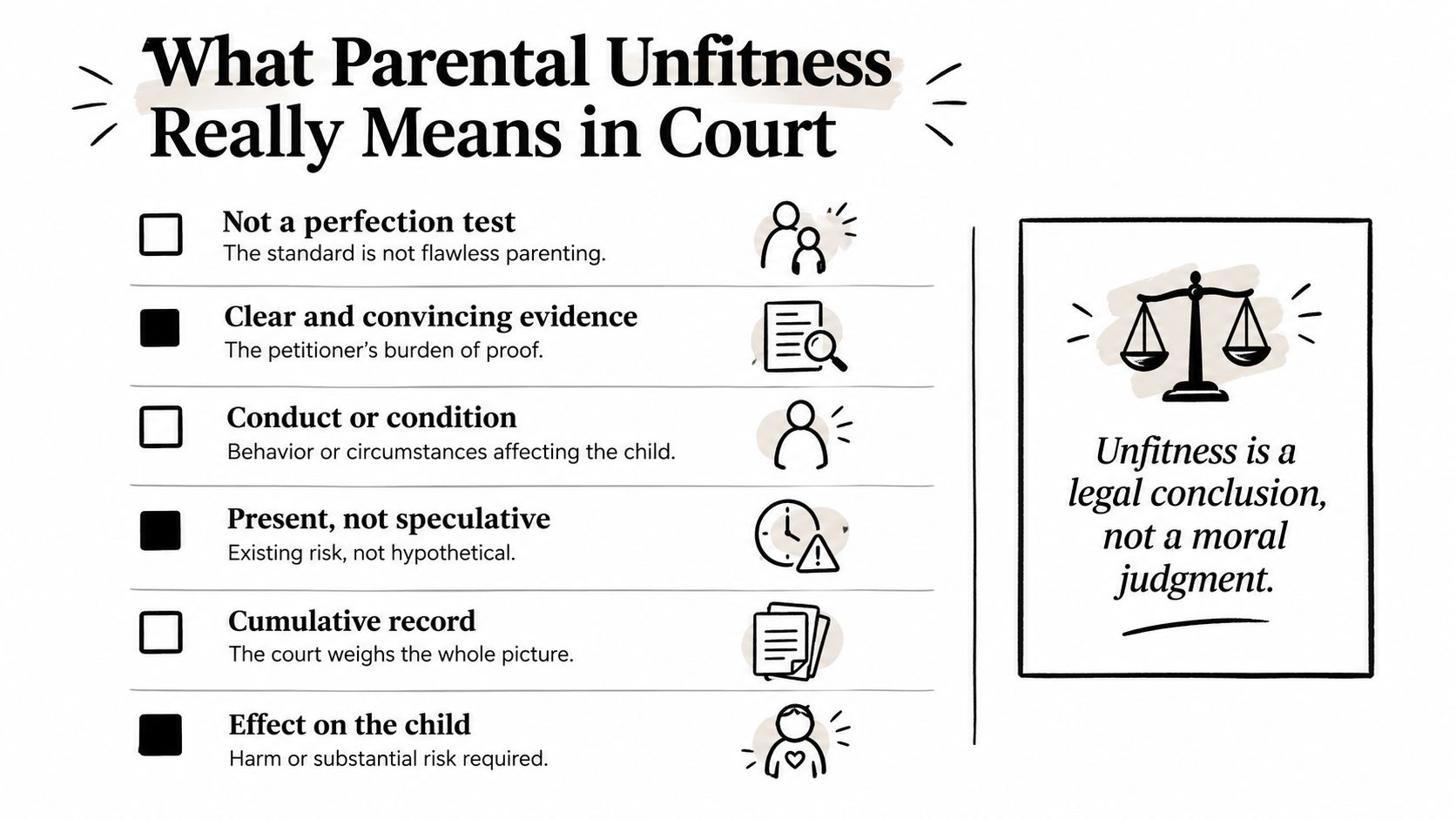
Parental unfitness isn't a perfection test. A parent doesn't lose constitutional priority because the parent has made mistakes, has less money, communicates poorly, or follows a different parenting style. The issue is whether the parent's conduct or condition is sufficiently serious to show unfitness, neglect, or inconsistency with the protected responsibilities of parenthood.
North Carolina courts require clear and convincing evidence before finding that a natural parent acted inconsistently with protected parental status. The standard requires evidence producing a firm belief or conviction. It isn't the criminal standard of proof beyond a reasonable doubt, but it is more demanding than a generalized accusation or a relative's sincere opinion.
What the pleading should show
A well-prepared pleading usually ties the legal theory to concrete events. Depending on the case, the relevant allegations may involve:
- Failure to provide necessary care: The parent repeatedly leaves the child without safe supervision or fails to provide basic necessities.
- Neglect: The parent's conduct creates an actual child-welfare concern rather than merely reflecting an unpopular choice.
- Abandonment: The parent stops exercising meaningful parental responsibilities or contact.
- Substance abuse or violence: The conduct matters most when it affects supervision, safety, medical care, or the child's home environment.
- Conduct inconsistent with parental status: The parent effectively transfers parental responsibilities to another caregiver and then later seeks to reclaim control without having exercised the responsibilities of parenthood.
The pleading should identify dates or time periods when possible, describe the conduct, and connect it to the child's condition or safety. A statement that the parent “doesn't care” is weak without facts showing missed care, prolonged absence, failure to support, unsafe supervision, or another legally significant pattern.
What evidence carries weight
Courts evaluate credibility, but corroborating records can make the difference between a claim that sounds persuasive and one that meets the legal burden. Useful evidence may include:
- School records identifying who handled enrollment, attendance, and communication.
- Medical records showing who arranged appointments or failed to obtain necessary care.
- Text messages and emails documenting abandonment, threats, or requests for care.
- Witness testimony from teachers, medical professionals, neighbors, or other neutral observers.
- Police, agency, or child-welfare records where they directly relate to the child's safety.
- A dated caregiving history showing who performed parental responsibilities.
A borderline case presents a serious risk. The court may find that the parent's conduct is troubling without finding that it defeated constitutional status. If the third party cannot establish the threshold showing, the case may end before the court conducts a full best-interest comparison.
Practical rule: Build the case around the child's concrete experience, not the adult conflict surrounding the child.
Facts That Count and Facts That Do Not
The central comparison is not “Which adult would raise the child better?” It is “Has the parent acted in a way that defeats the parent's protected constitutional status?” That difference prevents a nonparent from relying solely on a more attractive household.
A grandparent who has provided daily care may have powerful evidence of a parent-like relationship. But caregiving history doesn't automatically establish that the parent is unfit. The grandparent still needs evidence of parental conduct that meets the North Carolina threshold.
| Conduct That Defeats Parental Status in NC | Conduct That Usually Does Not Defeat Parental Status |
|---|---|
| Repeated failure to provide necessary care, when tied to actual harm or serious risk to the child | A larger home, higher income, or more comfortable household |
| Abandonment or prolonged failure to maintain meaningful parental responsibilities | The nonparent's stronger emotional bond with the child by itself |
| Serious domestic violence, unsafe supervision, or substance abuse that affects caregiving | A parent's different religious beliefs or preferred parenting style |
| Refusal or failure to obtain necessary medical care | A parent's disability without proof that it prevents safe parenting |
| Conduct that effectively transfers parental responsibilities to a third party while the parent stops acting as a parent | A parent's relocation by itself |
| A cumulative pattern showing that the parent isn't exercising protected parental responsibilities | An unconventional lifestyle without evidence of its effect on the child |
The right column doesn't mean those facts are irrelevant in every custody case. Once standing is established, stability, caregiving history, relationships, safety, and the child's needs may become important. The point is procedural: a better home usually doesn't replace the required showing of parental unfitness or inconsistent conduct.
For example, a grandparent may have more money and a calmer home, but that comparison alone ordinarily won't defeat the mother's constitutional priority. The analysis becomes different if the mother repeatedly leaves the child without care, refuses necessary treatment, exposes the child to serious violence, or voluntarily abandons parental responsibilities. Those facts address the parent's conduct rather than the grandparent's advantages.
A court also examines context. A parent's temporary inability to care for a child isn't automatically the same as voluntary abandonment. The evidence should show what the parent intended, what contact the parent maintained, what support the parent provided, and whether the parent exercised meaningful responsibilities.
How a Third-Party Custody Case Moves Through Court
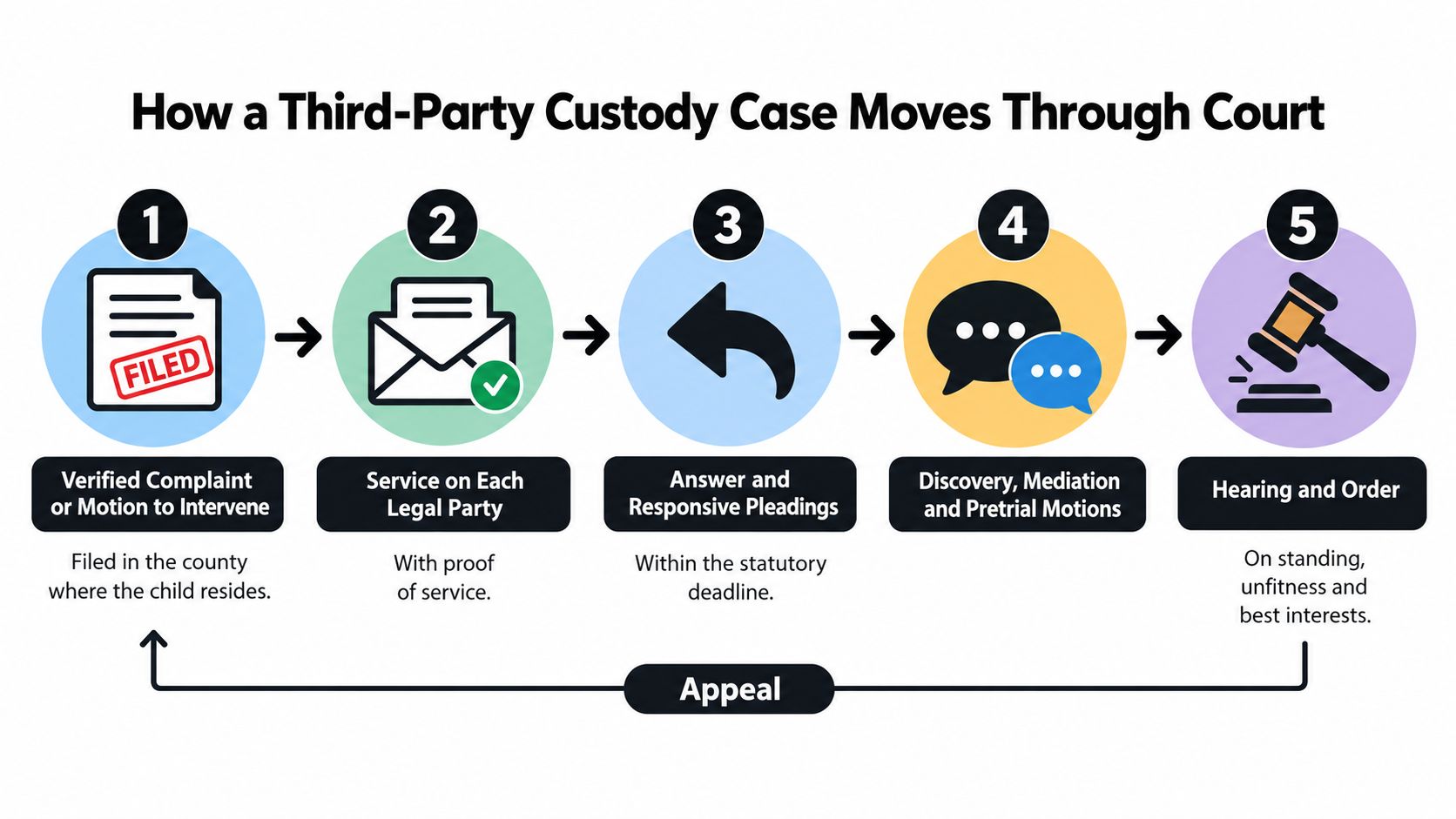
A North Carolina third-party custody case usually begins with a pleading that identifies the child, the parties, the requested custody arrangement, and the facts supporting the court's authority to hear the claim. Depending on the posture, the filing may be a custody complaint, a motion involving an existing custody action, or another appropriate pleading. Venue and service require careful review, particularly when the child has recently moved or when another custody or juvenile proceeding is pending.
The procedural sequence
File the custody pleading. The third party must state more than a desire for custody. The filing should address the relationship with the child and the facts supporting unfitness, neglect, or conduct inconsistent with parental status.
Serve the legal parties. Each person whose rights may be affected must receive legally sufficient notice. A parent's failure to participate doesn't automatically eliminate the need to establish the required legal grounds.
Address responses and interim relief. The court may need to address temporary care, existing orders, or urgent safety concerns. Temporary relief doesn't guarantee that the third party will prevail at the final hearing.
Prepare for mediation, discovery, and motions. North Carolina custody matters may involve mediation and discovery, subject to the governing rules and the case's posture. Counsel may seek school, medical, agency, communication, and other records that test the allegations.
Present the standing issue and the merits. If standing is contested, the court may decide whether the third party has alleged and proved enough to overcome the parent's protected status. Only after that threshold is cleared does the court move into the best-interest analysis.
A guardian ad litem may become relevant when the court determines that the child's interests require separate investigation or representation under the applicable North Carolina rules. The guardian's role isn't to replace the judge or guarantee a particular result. The guardian may investigate the child's circumstances and present information relevant to the child's welfare.
A Chapter 50 custody action also isn't the same as a guardianship proceeding. A lawyer should identify whether the requested remedy is custody, visitation, guardianship, or another form of authority before drafting the case.
The Best Interests Analysis After Standing Is Established
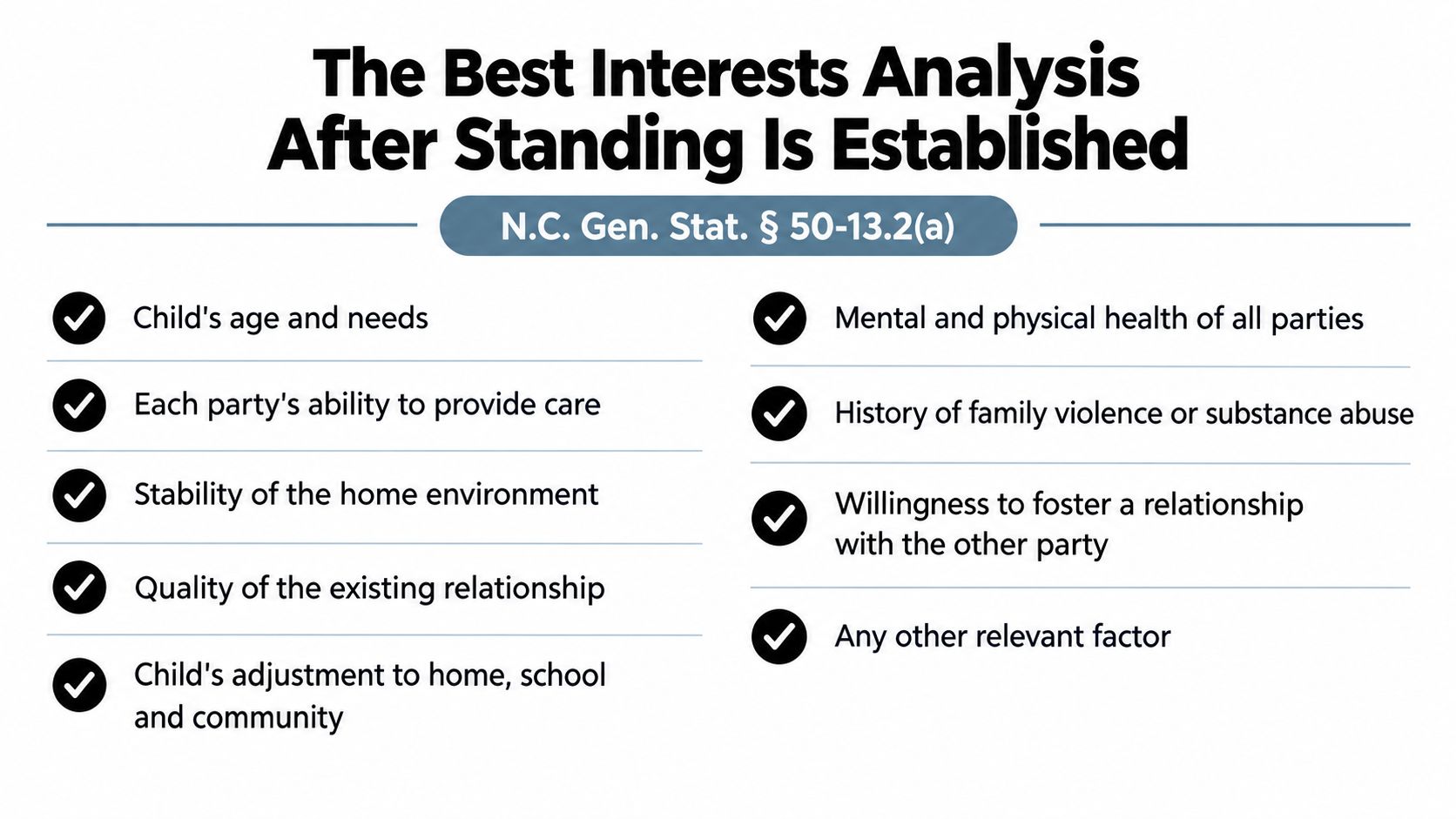
Clearing the standing barrier doesn't mean the third party automatically receives custody. It means the court can finally compare the available custodial arrangements under N.C. Gen. Stat. § 50-13.2(a), which directs custody to the person or entity that will best promote the child's interest and welfare.
The court may consider the child's needs, the parties' caregiving abilities, stability, relationships, education, medical continuity, safety, and other relevant circumstances. A grandparent who has established standing still must show why the requested arrangement serves the child better than the alternatives supported by the evidence.
The evidence changes after the threshold
Before standing, evidence should focus on the parent's protected status and the child-centered effects of the parent's conduct. After standing, the court can assess the proposed placement more broadly. Relevant evidence may include:
- Who has provided daily care and whether that arrangement supports continuity.
- Whether the proposed home can address educational and medical needs.
- The child's relationships with siblings and extended family.
- Safety concerns, including domestic violence or substance abuse.
- The child's adjustment to home, school, and community.
- Each caregiver's willingness and ability to support appropriate relationships.
- The child's views when the court considers the child sufficiently mature.
These factors don't erase the constitutional issue. They become available for comparison only after the third party establishes the required parent-like relationship and overcomes the parent's protected status. The best interests of the child explanation for North Carolina addresses that later custody analysis, but it shouldn't be used as a substitute for standing allegations.
Existing orders add another layer. In a modification case, a prior finding of parental fitness can make a later finding of unfitness legally significant as a change in circumstances. Raynor v. Odom illustrates why a third party must distinguish the initial standing question from the requirements for modifying an existing custody order.
Why Early Legal Guidance Changes the Outcome
A third party often waits to contact a lawyer because the family believes the facts speak for themselves. That can be dangerous. A pleading that describes years of caregiving but fails to allege facts showing parental unfitness, neglect, or inconsistent conduct may not reach a best-interest hearing.
The problem is usually not a lack of devotion. It's a mismatch between the evidence and the legal question. The grandmother may prove that she handled school, meals, and medical appointments, but unless the pleading also explains how the parent's conduct defeated protected parental status, the court may treat the case as an impermissible request to compare a relative's home with a parent's home.
A strong caregiving history helps, but it doesn't answer the constitutional question by itself.
The cost of correcting the case later
An early review can identify whether the case is truly a custody claim, whether another order controls, and whether a modification standard applies. It can also help preserve records before they disappear and prevent witnesses from being approached without a clear litigation strategy.
A lawyer may need to coordinate the custody case with pending agency or juvenile proceedings, evaluate whether a guardian ad litem request is appropriate, and structure discovery around school, medical, safety, and caregiving evidence. Those decisions are harder after an adverse dismissal or an order containing unfavorable findings.
The same caution applies when people confuse separate legal services. A North Carolina Divorce Lawyer may handle absolute divorce and related claims under North Carolina law, but a third-party custody dispute requires analysis of parental status, standing, custody jurisdiction, and child-welfare evidence.
Representation can take different forms. Some families seek full representation through the case, while others discuss limited-scope assistance for pleadings, evidence organization, or hearing preparation where permitted and appropriate. The realistic timeline depends on the county, the disputed facts, existing orders, service, mediation, and the court's schedule. No attorney can guarantee that the court will find standing or award custody.
Common Questions From North Carolina Families
Can a third party obtain custody if both legal parents agree?
Consent from both legal parents can materially change the posture of a custody case because the dispute may no longer be a direct parent-versus-nonparent contest. It doesn't mean every proposed arrangement is automatically approved, and the court may still need to address the child's welfare, legal authority, and the proper form of order.
The key distinction is whether the nonparent is proceeding with parental consent or asking the court to take custody from a parent who objects. The constitutional standing barrier is most significant in the second situation.
What if DSS or juvenile court is already involved?
A pending child-welfare or juvenile matter can affect where the child is placed and which court is addressing the child's circumstances. Findings or records from those proceedings may become relevant in a district court custody hearing, but the third party should not assume that agency involvement automatically establishes standing or guarantees custody.
The custody lawyer should identify the existing proceeding, orders, findings, and parties before filing a separate action. The analysis may differ when the child is already in state custody.
Is visitation easier than custody for a grandparent?
Custody and visitation are different forms of relief. Custody gives a person authority and responsibility for the child's care, while visitation generally concerns scheduled contact. A grandparent should not assume that proving a meaningful relationship automatically creates either remedy over a parent's objection. The applicable statute and constitutional facts must be evaluated together, including N.C. Gen. Stat. § 50-13.2 where visitation issues arise.
Can a grandparent intervene in an existing custody case?
Possibly, but intervention isn't automatic. The grandparent must address the existing case, the parties' rights, the child's relationship with the grandparent, and the facts supporting standing. Filing a separate action when an existing custody proceeding already controls may create procedural problems.
Does incarceration or de facto parent status automatically establish standing?
A parent's incarceration may be relevant to the child's care, but it doesn't automatically establish unfitness or eliminate the constitutional analysis. The court will examine the actual facts, including the parent's conduct and the child's needs. Likewise, North Carolina recognizes that a meaningful parent-like relationship can matter, but “de facto parent” status isn't a shortcut that automatically gives a nonparent the same position as a legal parent.
If you're a North Carolina grandparent, relative, stepparent, or family friend considering custody, gather the caregiving history, school and medical records, communications, and safety documentation before filing. A lawyer can evaluate whether the facts support standing, whether an existing order changes the strategy, and whether custody or another remedy fits the situation.
The Law Office of Bryan Fagan provides North Carolina family law representation for custody disputes, including cases involving grandparents and other third parties facing Petersen-based standing challenges. Visit the Law Office of Bryan Fagan to discuss your facts, the evidence available, and the next step toward a legally sound custody strategy.