North Carolina courts decide initial custody cases only when the child has lived in NC for at least six consecutive months immediately before filing, or was a NC home state within six months and a parent still lives here. For a child under six months old, North Carolina looks to where the child has lived from birth.
You may be facing this issue after a breakup, a sudden move, or a message from the other parent saying they'll file in another state. Perhaps your child has lived with you in Raleigh for eight months, and the other parent has now threatened to start a case in South Carolina. The question is not only where either parent lives today. The first question is whether North Carolina has authority to decide the initial custody case under the Uniform Child Custody Jurisdiction and Enforcement Act, commonly called the UCCJEA.
When North Carolina Courts Decide Custody Under the UCCJEA
Suppose your child has lived in North Carolina with you for eight consecutive months. The other parent moves to South Carolina and files there first. That filing doesn't automatically make South Carolina the proper forum. For an initial custody case, North Carolina generally has priority if the child lived here for at least six consecutive months immediately before the North Carolina case was filed.
That timing matters. If you wait to file in North Carolina and the other parent starts a case elsewhere, both courts may need to address jurisdiction. The first filing date can become central to the dispute, especially if the child's recent residence history is close to the six-month threshold.
North Carolina adopted the UCCJEA through Chapter 50A of the North Carolina General Statutes. The chapter runs from G.S. 50A-101 through G.S. 50A-317, creating a detailed interstate custody framework rather than a narrow local rule. The UCCJEA is also used in all 50 states plus the District of Columbia, which helps courts address competing custody filings across state lines. North Carolina's codified UCCJEA sets out the statutory structure.
Why the home-state rule exists
The home-state rule is designed to reduce the risk of competing custody orders. If a child has lived in one state for the relevant period, that state usually has the strongest access to school records, medical information, caregivers, and other evidence concerning the child's daily life.
North Carolina courts generally ask:
- Where did the child live?
- Did the child live there with a parent or person acting as a parent?
- Had the child lived there for the required period when the case began?
- Was another state already handling a substantially similar custody proceeding?
The University of North Carolina School of Government describes the six-month standard and explains that courts should communicate and defer when another state has a qualifying case. Its materials also discuss the limited situations in which North Carolina may proceed without current home-state status. The UNC School of Government custody jurisdiction overview is a useful reference for the statutory analysis.
If parents live in different states, the child's residence history often matters more than the parents' competing preferences. A North Carolina parent dealing with an interstate dispute may also review custody rules when parents live in different states while gathering dates and records for legal advice.
What Qualifies as a Home State Under North Carolina Law
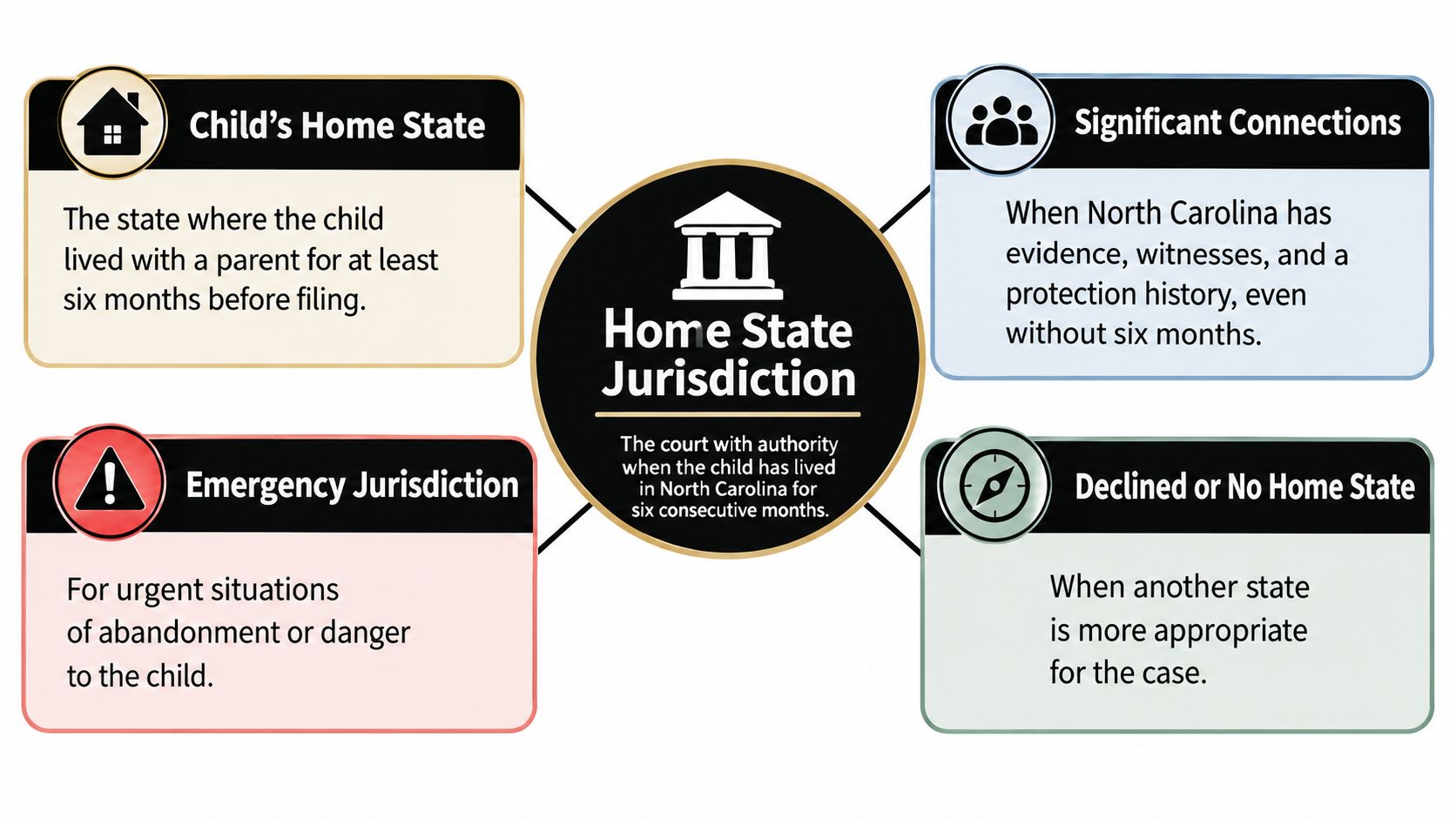
North Carolina's definition is specific. For a child who is at least six months old, the home state is generally the state where the child lived with a parent or person acting as a parent for at least six consecutive months immediately before the proceeding begins. The statute also counts temporary absences as part of that period. North Carolina's home-state statute contains the controlling language.
Think of the test as a residence timeline rather than a simple address check.
Start with the filing date
Take the date the custody action is filed and work backward. Identify where the child lived during the immediately preceding six months. A toddler who has lived with a parent in Charlotte for nine months will ordinarily have North Carolina as the home state, assuming the other UCCJEA requirements do not create a separate jurisdictional problem.
The child doesn't have to own a home, attend a particular school, or spend every night in the same bedroom. The focus is the child's lived residence with a parent or acting parent. School enrollment can support the overall evidence, but it isn't a substitute for the residence analysis.
Temporary absences usually count
A short vacation, school break, medical stay, or similar temporary absence generally doesn't restart the clock. If a child living in Durham spends a brief period outside North Carolina and then returns to the established home, that absence may still count toward the six-month period. North Carolina case law discussing temporary absences illustrates why a brief departure doesn't necessarily change the home state.
The facts matter. Keep calendars, travel records, school communications, medical records, lease documents, and messages showing where the child lived. Those materials can help distinguish a temporary absence from a genuine relocation.
Infants have a different rule
For a child under six months old, North Carolina treats the home state as the state where the child has lived from birth. For example, if a newborn was delivered in Georgia and lived there from birth before the parents moved to North Carolina, the birth-to-filing residence history becomes critical. The six-month formula used for an older child doesn't operate in exactly the same way for an infant.
This jurisdiction question is separate from the custody merits. North Carolina custody decisions themselves focus on the child's best interests, including the issues discussed in Child Custody in North Carolina. A court must first have authority to hear the case before it can make that best-interests determination.
Practical rule: Build a dated residence history before choosing where to file. A few weeks can change the jurisdictional analysis.
Three Ways North Carolina Courts Claim Custody Jurisdiction
North Carolina's initial-jurisdiction rules provide a primary route and limited alternatives. The distinction is important because parents sometimes hear that North Carolina has “connections” to a child and assume that connection alone guarantees a North Carolina case. It doesn't.
| Pathway | When It Applies | Practical Implication for NC Parents |
|---|---|---|
| Current home state | The child lived in North Carolina with a parent or acting parent for at least six consecutive months immediately before filing | North Carolina is ordinarily the principal forum for the initial custody determination |
| Former home state | North Carolina was the child's home state within the six months before filing, and a parent or person acting as a parent still lives here | A recent move may not eliminate North Carolina's initial jurisdiction |
| Fallback jurisdiction | No state qualifies under the home-state or former-home-state rules, or the qualifying state declines jurisdiction under the statute | North Carolina may need a narrower statutory basis, and the court will examine the circumstances carefully |
Current home-state jurisdiction
This is the ordinary pathway. If the child lived in North Carolina for the required period immediately before the case began, North Carolina generally has authority to decide the initial custody dispute. Filing before that period is complete can create a serious problem. The court may lack initial jurisdiction even if the family intends to remain here.
That is why filing strategy should begin with dates, not assumptions. A parent who is close to completing the required period should obtain legal advice before filing or agreeing to an out-of-state forum.
Former-home-state jurisdiction
North Carolina may also qualify when it was the child's home state within the preceding six months and a parent or person acting as a parent continues to live here. This pathway addresses a recent move and prevents a parent from treating a short relocation as an automatic transfer of the entire custody dispute.
It still isn't a blanket rule. The court will examine the residence history, the filing date, the parties' locations, and any competing proceeding.
Limited fallback jurisdiction
The third route is narrower. It can arise when no other state has the required home-state authority, or when the state that would ordinarily qualify declines to exercise jurisdiction. North Carolina's statutory scheme also recognizes emergency jurisdiction in appropriate circumstances, but an emergency basis isn't a replacement for ordinary home-state jurisdiction in a routine relocation dispute.
A parent shouldn't rely on vague claims that North Carolina has better witnesses or stronger family ties. Those facts may matter, but the UCCJEA requires the court to apply the statutory gates first. The exact jurisdictional facts should be presented to a North Carolina family law attorney before a filing decision is made.
Real North Carolina Custody Scenarios and How Jurisdiction Plays Out
Interstate custody disputes rarely arrive as neat timelines. Parents work across state lines, children visit relatives, and military families relocate under pressure. The legal analysis still begins with the child's actual residence and the filing date.

A military family returning to North Carolina
A service member stationed at Fort Bragg returns to North Carolina with the child after a period elsewhere. The parent wants to modify an existing custody order and assumes the move itself immediately gives North Carolina authority.
That assumption may be wrong. The existence of an earlier order and the rules governing continuing exclusive jurisdiction must be examined separately from the home-state test for an initial case. The parent should gather the existing order, relocation dates, and information showing where the child lived before and after the move.
The practical lesson is simple: don't treat a military transfer as a shortcut around jurisdictional analysis.
A parent secretly takes the child to Tennessee
Suppose a child has been living in North Carolina, and one parent secretly takes the child to Tennessee. The North Carolina parent may fear that physical presence in Tennessee automatically gives that state control.
It doesn't necessarily. If North Carolina was the child's home state within the relevant period and a parent remains here, the former-home-state pathway may still matter. The parent should act quickly, preserve evidence of the child's North Carolina residence, and seek advice about emergency relief and the proper filing.
A Virginia work commute
A parent may work regularly in Virginia while the child lives primarily in North Carolina, attends daily activities here, and returns to the North Carolina home. The parent's employment location alone doesn't decide the child's home state.
The evidence should focus on the child's residence. Keep records showing overnights, childcare, medical care, school communications, and the child's regular home. A work commute can complicate the facts without changing the result.
The following video provides additional general context for parents dealing with custody conflict:
These examples aren't guarantees. A judge may need to resolve disputed facts, and an existing order may change the analysis. The safest filing strategy is to create a residence timeline and obtain advice before the other parent chooses a forum.
What to Do When Another State Files a Custody Case First
Finding out that the other parent filed in South Carolina, Virginia, Tennessee, or another state can feel like the decision has already been made. It hasn't. A filing is not the same as a final ruling on jurisdiction, but delay can make the situation harder to manage.
Take immediate practical steps
Start by obtaining the complete out-of-state complaint, summons, hearing notice, and any temporary orders. Don't rely on screenshots or a verbal description. The precise allegations, filing date, and requested relief can affect the response.
Then organize the North Carolina evidence:
- Residence records: Collect leases, calendars, childcare records, medical records, and school communications.
- Court documents: Locate prior custody orders, parenting agreements, and related family-law filings.
- Communication history: Preserve messages about where the child lived, travel, exchanges, and proposed moves.
- Deadline information: Record every response and hearing deadline shown on the filed papers.
A North Carolina attorney may evaluate whether to file a responsive case or motion here, challenge the other state's jurisdiction, or seek emergency relief when the facts support it. A parent may also need advice about seeking temporary custody in North Carolina.
Ask the courts to address the conflict
The UCCJEA provides a process for courts to communicate when substantially similar custody proceedings exist. Courts may need to determine which state should proceed and whether one court should defer. A North Carolina parent shouldn't assume that filing first or second automatically resolves the issue, but should make the jurisdictional facts clear promptly.
A motion to decline jurisdiction, a request to stay proceedings, or another responsive filing may be appropriate depending on the facts. These are strategic decisions, not forms to submit without analysis. The parent must also respond properly in the state where the case was filed, because ignoring that case can lead to procedural consequences.
Don't confuse jurisdiction with enforcement
If North Carolina already entered a valid custody order, the issue may involve enforcement rather than initial jurisdiction. The order may be eligible for registration and enforcement in another state under UCCJEA procedures, but the receiving state's requirements must be followed.
The court needs accurate information about every related case and order. Hiding an out-of-state proceeding or omitting a prior order can undermine credibility and complicate communication between courts.
How Continuing Exclusive Jurisdiction Works After a Modification
Initial jurisdiction and continuing exclusive jurisdiction are different concepts. The first asks which state may make the initial custody determination. The second asks whether a North Carolina court that already entered a custody order retains authority over later custody modifications.
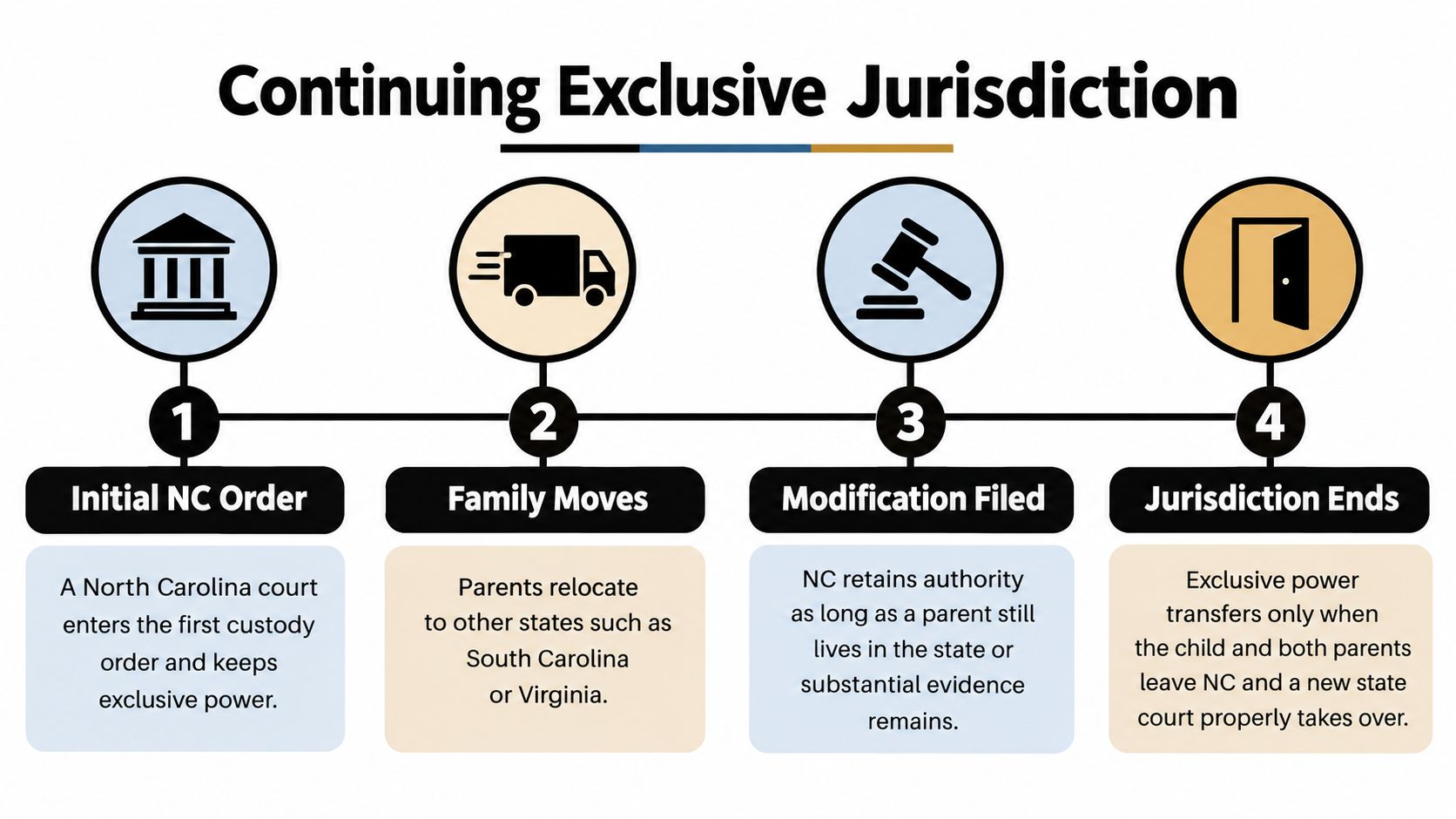
North Carolina can keep exclusive, continuing jurisdiction after the family moves. Under the statutory framework, jurisdiction can continue until the required findings show that neither the child nor the relevant parents or caretakers has a significant connection with North Carolina and substantial evidence is no longer available here, or until a court determines that everyone involved no longer resides in North Carolina. North Carolina's continuing-jurisdiction provisions set out these conditions.
Consider a family that receives a custody order in Wilmington and later moves to Atlanta. The move doesn't automatically transfer modification authority to Georgia. The court may examine whether a parent still lives in North Carolina, whether meaningful evidence remains here, and whether the statutory conditions for ending North Carolina's jurisdiction have been met.
A parent seeking a change should identify the court that entered the order before filing elsewhere. Review the language of the order, the parties' current residences, the child's ties to North Carolina, and where relevant evidence is located. Parents considering a change can also review how to modify a custody agreement while preparing questions for counsel.
The practical point is that relocation affects jurisdiction, but it doesn't answer the question by itself. A North Carolina order may continue to control until a court properly determines that exclusive jurisdiction has ended or another statutory basis applies.
Key Takeaways and Strategic Guidance for North Carolina Parents
The timing trap is straightforward. Filing before the child has completed the required home-state period can defeat North Carolina's jurisdiction over an initial custody case unless another statutory basis applies. Filing after the child qualifies may place the case in the state with the strongest connection to the child's recent life.
Keep these principles in mind:
- Confirm the filing date: Count backward from the intended filing date and document where the child lived.
- Separate short absences from relocation: A temporary trip or brief absence generally doesn't restart the home-state period.
- Watch for competing filings: If the other parent files elsewhere, respond in that case and promptly evaluate North Carolina options.
- Protect existing orders: A North Carolina custody order may retain continuing exclusive jurisdiction after a move.
- Avoid assumptions: The parent's preferred forum, the child's school alone, or a recent trip doesn't settle jurisdiction.
One common misconception is that physical presence on the day of filing is the only issue. The court examines the child's residence history, the relationship to the parent or acting parent, the statutory timing, and any competing proceedings. Another misconception is that an out-of-state filing automatically strips North Carolina of authority. It doesn't, but the parent must raise the issue properly.
Jurisdictional decisions are often time-sensitive. A consultation with a North Carolina family law attorney can help you organize the residence timeline, identify the correct statutory pathway, and decide how to respond without promising an outcome the facts may not support.
Frequently Asked Questions About NC Custody Jurisdiction
Can I stop the other parent from filing in another state?
You generally can't control where another person submits papers. You can act quickly by documenting North Carolina's home-state facts, responding to the other case, and asking a North Carolina attorney whether emergency or jurisdictional motions are appropriate.
Does the child's school determine the home state?
No. School location may provide useful evidence, but the controlling inquiry focuses on where the child lived with a parent or acting parent during the relevant period. A school enrollment decision alone doesn't decide UCCJEA jurisdiction.
What if both parents live in different states but the child lived in North Carolina for the last six months?
North Carolina may have priority as the child's home state if the statutory requirements are met. The parents' separate residences don't replace the child's residence analysis, although existing orders and competing proceedings must also be reviewed.
The Law Office of Bryan Fagan offers North Carolina-focused guidance in child custody disputes, including interstate jurisdiction, emergency filings, and custody modifications. Visit Law Office of Bryan Fagan to schedule a consultation and discuss your child's residence history, existing orders, and next legal steps.