You're looking at a North Carolina sentencing chart because you want one answer: How much time could I face? You may already know the offense class, but the chart still doesn't account for your prior convictions, the way charges are consolidated, a possible habitual felon allegation, or the result your lawyer may negotiate. Those details can change both the sentence range and whether prison is legally required.
The Reality of Structured Sentencing in North Carolina
A person charged with a felony often searches for the offense class first. Someone facing a lower-level felony may see a range that appears compatible with probation, while someone with a serious prior record may see the same charge produce a much harsher result. The chart offers a starting point, but it doesn't tell the court what facts will be proved, what plea may be available, or how several counts may be handled together.
North Carolina's Structured Sentencing Act became effective on October 1, 1994, after the General Assembly adopted it in 1993. It applies to felony and most misdemeanor offenses committed on or after that date. The reform replaced indeterminate sentencing with a grid tied to the current offense and the defendant's prior record, and it abolished discretionary parole release for nearly all crimes committed after the reform took effect. The North Carolina Sentencing and Policy Advisory Commission describes the framework and its continuing role in state sentencing policy.
Why North Carolina changed the system
Before structured sentencing, judges worked within a system that allowed broader sentencing decisions and parole played a larger role in how much time a person ultimately served. Structured sentencing moved North Carolina toward a truth-in-sentencing model, requiring the court to set minimum and maximum terms under statutory rules rather than relying on later discretionary parole decisions.
The original policy goal was practical. The state sought to reserve prison space for the most serious and chronic offenders while using community-based punishments more often for less serious conduct. That goal still matters when a lawyer argues for probation, treatment, supervision, or another lawful alternative to active imprisonment.
Practical rule: A sentencing chart can identify a legal range, but it can't evaluate the evidence, challenge prior convictions, negotiate the charge, or explain why a judge should choose one lawful disposition over another.
The system also processes a large and changing caseload. In Fiscal Year 2024, North Carolina reported 99,088 misdemeanor sentences, while felony convictions were down about 18% compared with the 2010 level cited by the Sentencing Commission summary. The same summary reports that Fiscal Year 2022 included 25,760 felony convictions sentenced under structured sentencing, with 63% involving Class H and Class I offenses. These figures come from the 2024 Sentencing Commission statistical report summary.
The important point for a client is simple: structured sentencing is formulaic, but it isn't automatic. The law narrows the available choices, yet the charge, record, facts, negotiation, and presentation of mitigation still determine where a case lands.
Navigating the North Carolina Sentencing Grid
A person charged with a felony may hear “Class H” or “Level III” and assume the outcome is already set. It is not. North Carolina's felony grid has two axes, the seriousness of the current offense and the defendant's prior record level. The court reads them together to locate the applicable sentencing cell, while the charge selected and the accuracy of the record can change that location before sentencing begins.
Step one is identifying the felony class
North Carolina places felonies into ten classes, Class A through Class I, with Class A representing the most serious category and Class I the least serious. The statutory classification affects the minimum and maximum ranges and can determine whether community or intermediate punishment is available.
The class comes from the statute defining the offense, not from the defendant's personal circumstances. Still, the charge presented for judgment may reflect the evidence and plea negotiations. Counsel should review the indictment, the elements the State must prove, the evidence supporting each element, and any lesser or related offense that may be available. Charge consolidation can also matter, because resolving several allegations through one judgment may produce a different sentencing position than separate convictions.
Step two is calculating prior record level
For felony sentencing, the court adds points assigned to proven prior convictions. The resulting levels run from Level I through Level VI:
| Prior Record Level | Point Range |
|---|---|
| Level I | 0–1 point |
| Level II | 2–5 points |
| Level III | 6–9 points |
| Level IV | 10–13 points |
| Level V | 14–17 points |
| Level VI | 18 or more points |
The point ranges appear in the North Carolina Judicial Branch citizen guide to structured sentencing. A conviction may add points, and its classification may affect how the record is treated under the applicable statute. Prior record points come from convictions, so an infraction adds nothing to that calculation. That is why the difference between an infraction and a misdemeanor in North Carolina matters when reviewing the record.
For example, a record with 0 or 1 point falls in Level I, while 2 through 5 points places the defendant in Level II. The current charge remains the same, but the grid cell changes. That difference can affect the minimum range and the punishments the court may lawfully impose.
Prior record analysis also requires checking whether each listed conviction is legally usable and whether the State has proved the record correctly. Prior record levels interact with offense-specific rules; see our explanation of North Carolina DWI sentencing levels for how a single offense class carries its own level structure.
Step three is reading the intersection
The offense class and prior record level must be read together. Looking only at “Class H felony” or “Level III” cannot predict the sentence. The cell contains the presumptive, mitigated, and aggravated minimum ranges and identifies lawful punishment options.
The grid supplies the legal framework, but it does not evaluate disputed facts, correct an overstated record, account for charge consolidation, or show how a plea to a different offense could affect the final disposition. Habitual felon treatment may also change the exposure substantially, making the charging decision and negotiations part of the sentencing analysis rather than separate concerns. A judge still has discretion within the lawful choices, and mitigation can influence which option is imposed.
Understanding Dispositions and Sentencing Ranges
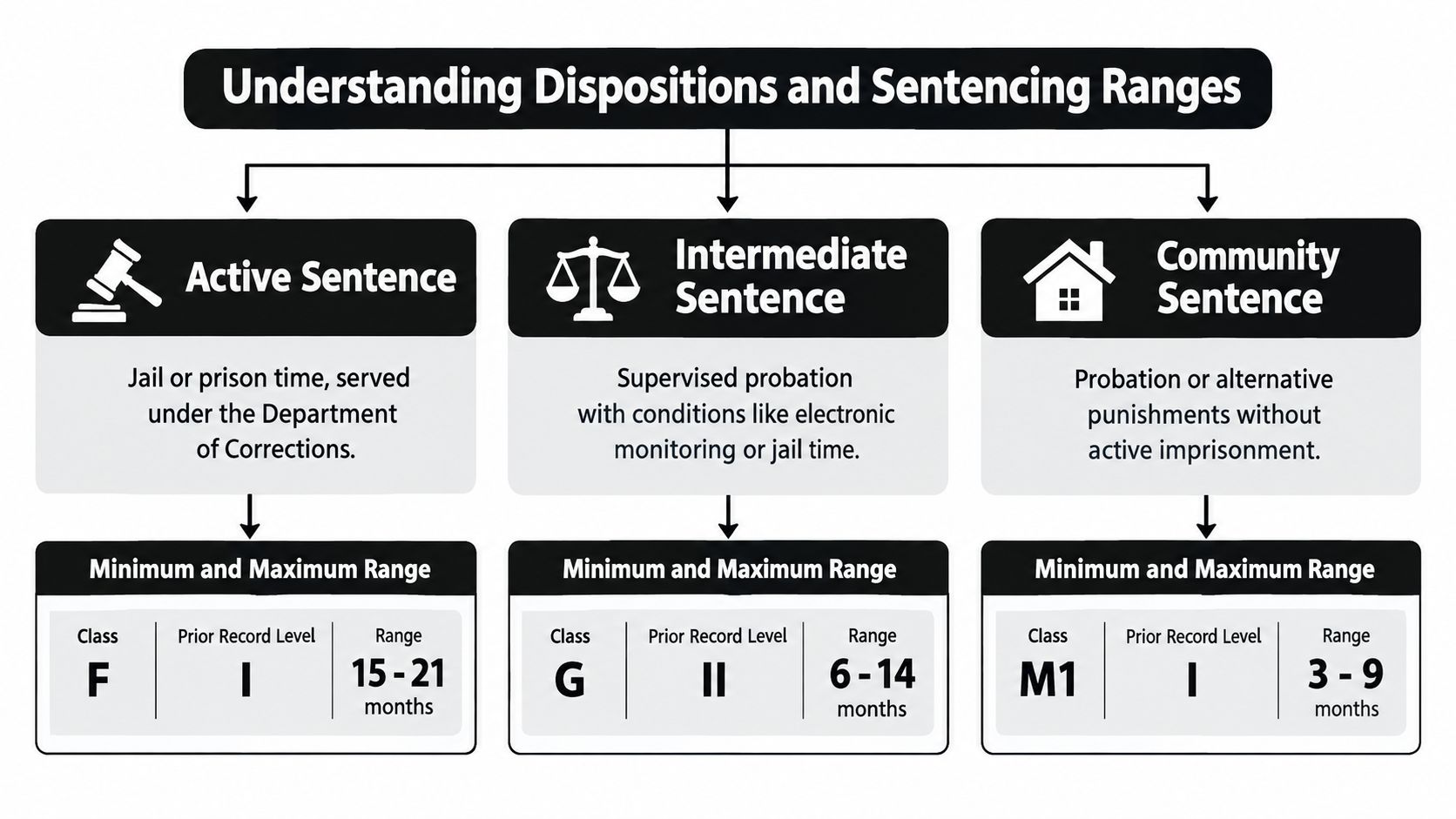
Finding the grid cell doesn't answer the most immediate client question, which is often, “Does this mean prison?” The answer depends on the disposition authorized by the cell, not on the number of months printed in a sentencing range.
The three punishment types
Active punishment means imprisonment. The person serves the active term under the authority of the Department of Adult Correction. When the applicable cell requires active punishment, a judge can't replace prison with ordinary probation because the defendant has a sympathetic personal history.
Intermediate punishment is more restrictive than basic probation. Under North Carolina law, it means supervised probation plus at least one specified restrictive condition. Examples include special probation, residential treatment, electronic monitoring, intensive probation, or a day-reporting center. The statute establishing structured sentencing defines this category and the available punishment framework in the 1993 Structured Sentencing Act.
Community punishment is generally less restrictive than intermediate punishment and doesn't include active imprisonment. The exact conditions depend on the judgment and applicable law. A court may impose supervision, treatment, community service, or other lawful requirements.
The difference is practical. A person eligible for intermediate punishment may avoid a conventional prison sentence but still face demanding supervision and restrictive conditions. Violating those conditions can create a separate legal crisis. Anyone facing that problem should understand the consequences of a probation violation in North Carolina.
Presumptive, mitigated, and aggravated ranges
Most felony cells contain three minimum-term ranges:
- Presumptive range: The ordinary statutory range used when the court does not impose a mitigated or aggravated sentence.
- Mitigated range: A lower range available when statutory mitigating circumstances are found.
- Aggravated range: A higher range available when statutory aggravating circumstances are proven and the legal requirements for using that range are satisfied.
A judge's discretion operates inside those boundaries. The court may consider the facts, the defendant's record, the harm involved, treatment needs, employment, family responsibilities, and other relevant information, but the judge must still select a lawful disposition and range.
Consider a defendant whose offense and record place the case in a cell that permits intermediate punishment. A mitigation presentation might address substance-use treatment, stable housing, employment, family support, compliance with release conditions, or other facts supported by evidence. Those facts don't guarantee probation. They can, however, give the judge a lawful reason to select a less severe option when the statute permits it.
Family-law issues can exist alongside criminal sentencing. For example, Equitable Distribution of Property in North Carolina concerns how North Carolina divides marital property under equitable distribution rather than community property. That issue is separate from the criminal grid, but a pending criminal case can create serious practical consequences for a household's stability and decision-making.
What the Grid Doesn't Show
A defendant can identify the correct offense class and still misunderstand the possible outcome. Charge consolidation, habitual felon allegations, and post-release supervision can change the consequences that the sentencing grid alone does not display.
Consolidated judgments and merged charges
When multiple offenses are consolidated for judgment, the court does not necessarily impose a separate sentence for every count. In the 2026 North Carolina Supreme Court decision reported here, the court reaffirmed that punishment for consolidated offenses must track the most serious offense in the group under the Structured Sentencing Act. The number of charges and the final judgment may therefore differ.
Consolidation can simplify the judgment without eliminating the importance of the remaining allegations. The most serious offense may control the punishment, while the facts behind other counts can still affect negotiations, sentencing arguments, restitution, or the prosecutor's position. The effect depends on the offenses involved and how the judgment is structured.
A merged judgment may reduce duplication, but it does not necessarily make a serious case minor.
Habitual felon allegations
A habitual felon allegation can change the sentencing posture of a case. The State must rely on qualifying prior felony convictions and satisfy the applicable procedural requirements. If the allegation is established, the current felony may be sentenced at a substantially higher felony class, including a Class C sentencing tier in circumstances governed by North Carolina law.
A charge that appears to involve a lower-level felony can therefore carry a different range after enhancement. Defense counsel should examine each prior conviction, including the defendant's identity, dates, offense classifications, and whether the State can prove every required element. The allegation also affects plea strategy because resolving or withdrawing the enhancement can matter as much as negotiating the current charge.
Post-release supervision
The maximum term printed in a judgment is not the same as the minimum prison term. North Carolina sentences generally include both terms, and post-release supervision may follow an active sentence depending on the offense and governing law. Anyone planning for release needs to understand supervision conditions, reporting obligations, restrictions, and the consequences of a violation. Information about probation violation consequences in North Carolina can help explain why supervision requirements deserve attention before release.
A criminal case may also affect family obligations. Alimony in North Carolina addresses how the state evaluates dependent and supporting spouse status. That family-law question is separate from the criminal grid, but incarceration can create practical problems involving household income and support.
The Strategic Impact of Plea Bargaining and Mitigation
Structured sentencing changes the negotiation, but it doesn't eliminate negotiation. In many cases, the most important sentencing decision happens before the judge selects a minimum term. It happens when the parties decide what charge, factual basis, record stipulation, and disposition will be presented.
A plea agreement may address the felony class, dismissal of additional counts, consolidation, or the State's position on punishment. A lawyer may also challenge the proposed prior record level rather than accepting the prosecutor's calculation. Moving from one class to another can place the case in a different cell, and changing the record level can do the same without changing the current charge.
What a mitigation presentation needs
Mitigation isn't a collection of apologies. It should connect verified facts to a lawful sentencing choice. Useful material may include:
- Personal history: Records showing treatment, education, employment, or other stabilizing efforts.
- Community support: Reliable testimony or documentation showing who will help the defendant comply with supervision.
- Accountability: A credible acceptance of responsibility, where appropriate, without making statements that undermine a defense.
- A concrete plan: Housing, treatment, transportation, employment, and compliance arrangements that address the court's concerns.
Suppose a person charged with a lower-level felony has a limited record, stable housing, and a documented treatment plan. Those facts won't force a judge to grant probation, but they can support an argument for community or intermediate punishment if the grid authorizes it. By contrast, a vague promise to “do better” gives the court little basis for choosing a less restrictive outcome.
A defense lawyer should also investigate whether the evidence supports the charged class at all. Negotiating a lawful reduction can be more effective than asking for mercy after the original charge has already produced a harsh grid cell. The strongest strategy depends on the evidence, the client's priorities, the risk of trial, and the consequences of each available resolution.
Common Misconceptions About North Carolina Sentencing
“The chart tells me exactly what will happen.” It doesn't. The chart identifies a legal framework, but outcomes can change based on record points, charge selection, consolidation, habitual felon allegations, aggravating or mitigating factors, and the disposition authorized by the cell.
The original evaluation of North Carolina's structured sentencing law found only limited changes in adjudication, including slightly higher dismissal rates for misdemeanors and felonies and higher infraction rates among sentenced inmates than under the prior law. The National Institute of Justice evaluation also undercuts the simplistic idea that a grid automatically produces identical outcomes in every courtroom.

“The maximum is the time I'll definitely serve.” The minimum and maximum terms serve different legal functions. The minimum establishes the earliest release point under the judgment, subject to applicable custody credit and release rules. The maximum reflects the upper boundary and can include time connected to post-release supervision. It isn't a promise that the person will serve the maximum, but it shouldn't be ignored.
“A judge can ignore the grid because my circumstances are sympathetic.” A judge may consider mitigation only within the authority provided by law. Sympathy can influence how counsel presents the case and how the court evaluates lawful options, but it can't authorize a disposition the applicable cell forbids.
“A consolidated judgment means the other charges no longer matter.” Consolidation can affect how punishment is imposed, but it doesn't automatically eliminate the factual or negotiation significance of the other counts. The most serious offense may control the consolidated punishment.
The better question isn't whether the grid is fair or unfair in the abstract. Ask which facts can still be challenged, which outcomes the cell permits, and whether the proposed plea accurately reflects the evidence and the client's long-term interests.
Frequently Asked Questions and Next Steps
Does North Carolina use the same grid for misdemeanors?
No. Felony defendants are assigned a prior record level from Level I through Level VI using points assigned to proven prior convictions. Misdemeanors use a separate three-level system based on prior convictions rather than the felony point structure. The governing framework appears in North Carolina General Statutes Chapter 15A, Article 81B.
How does custody credit affect an active sentence?
Credit for time already spent in custody may reduce the remaining time to be served, subject to the applicable rules and the way the credit is calculated. Your lawyer should obtain the custody records and compare them with the judgment rather than relying on an estimate.
What happens if I violate intermediate probation?
The court may impose consequences authorized by the judgment and North Carolina law, which can include stricter conditions or active imprisonment when legally available. The result depends on the alleged violation, notice, evidence, prior compliance, and the punishment options in the original grid cell.
What should I do after an arrest or felony charge?
Don't discuss the facts with investigators or post about the case. Preserve texts, photographs, records, and names of witnesses, and promptly provide them to counsel. Ask for a review of the charging documents, prior record calculation, possible consolidation, enhancement exposure, and every lawful disposition before entering a plea.
North Carolina residents facing structured sentencing deserve advice based on the actual indictment, evidence, record, and courtroom consequences, not a generic chart. The Law Office of Bryan Fagan evaluates felony and misdemeanor exposure, challenges sentencing calculations, develops mitigation, and negotiates with the prosecution while protecting your rights. Visit Law Office of Bryan Fagan to schedule a confidential consultation about your North Carolina case.