A grandparent in Charlotte may spend weeks calling, texting, and leaving voicemails after a painful disagreement with an adult child. A birthday gift comes back unopened. The grandparent worries that a five-year-old grandson will forget the holidays, bedtime stories, and familiar routines they once shared. The child may also feel confused, but the parents may still be married, living together, and raising him in their home.
That situation raises a difficult question under North Carolina law. Can a grandparent ask a court to order visitation when both parents remain together and jointly oppose contact? The answer usually begins with standing, meaning the legal authority to bring the claim at all. The grandparent visitation intact family rule in North Carolina often prevents the court from reaching the emotional facts or deciding whether visits would benefit the child.
When a Grandparent Gets Cut Off in North Carolina
The grandfather may believe that his close relationship with his grandson should be enough. He may have attended preschool events, provided childcare, and maintained regular contact before the family disagreement. Those facts can feel decisive, especially when the child appears to miss him.
North Carolina courts, however, begin with a different question: Is this a case the court is allowed to hear? If the child's parents are still married and living together, the child remains in their household, and no custody dispute is pending, the family will generally be treated as intact. In that posture, the parents ordinarily retain the authority to decide whether the child sees a grandparent.
Practical rule: A loving relationship may explain why visitation matters, but it doesn't automatically create the right to file a visitation lawsuit.
This can be difficult for families to understand because ordinary language treats “grandparent rights” as if grandparents have an independent entitlement to time with a grandchild. North Carolina law is narrower. Grandparent visitation is generally considered within an existing custody-related proceeding or through a specific statutory pathway, rather than through a standalone claim against parents who are raising the child together. The North Carolina grandparent rights resource can provide additional general background, but the facts and procedural posture of a particular family control.
The child's feelings don't answer the first legal question
Suppose the grandson tells a teacher that he wants to see his grandfather. Suppose the grandfather has photographs, messages, and family members who can describe the relationship. Those facts may be meaningful, but they don't necessarily overcome the threshold barrier created by an intact family.
The parents may also have legitimate reasons for limiting contact, or they may be exercising a joint parenting decision after a family dispute. A grandparent may strongly disagree with that decision. Disagreement alone usually doesn't allow the grandparent to convert the conflict into a court case.
The first step is therefore not drafting a visitation schedule. It is identifying whether the family is intact, whether custody is already being litigated, whether a prior custody order exists, and whether a statute provides a route for the grandparent to participate. Filing before answering those questions can lead to dismissal before the court hears evidence about the child's relationship with the grandparent.
What the Intact Family Rule Actually Means
The intact family rule is principally a standing rule, not a formula that tells a judge how many visits a grandparent should receive. Standing asks whether the person bringing the case has the legal authority to ask the court for relief. A merits decision asks whether the requested relief should be granted after the court considers the evidence.
The North Carolina Supreme Court established the central rule in McIntyre v. McIntyre, decided on September 8, 1995. The Court held that N.C. Gen. Stat. § 50-13.1(a) did not allow grandparents to initiate a visitation lawsuit while the child's family was intact and no custody proceeding was pending. The Court emphasized that parents have a constitutional right to care for, control, and determine associations for their children. The McIntyre decision remains the foundation for understanding this issue.
Standing comes before best interests
Many grandparents begin with the question, “Would visitation be good for my grandchild?” That is a best-interests question. Under the intact family rule, the court may never reach it.
A grandparent can have:
- A close and longstanding relationship with the child.
- A history of providing childcare or emotional support.
- Evidence that the child enjoyed regular visits.
- A sincere belief that continued contact would help the child.
Those facts may still be insufficient if the family remains intact and no qualifying custody proceeding is pending. The grandparent isn't necessarily losing on the merits. The court may be saying that the grandparent hasn't crossed the legal threshold required to have the merits considered.
This distinction also prevents confusion with other family-law calculations. For example, North Carolina Child Support Guidelines Explained addresses how child support is calculated using the Worksheet system. Child support worksheets and grandparent visitation standing involve different legal questions and shouldn't be treated as interchangeable parts of one analysis.
What counts as an intact family
In practical terms, an intact family generally means the parents are married and living together, the child remains in their household, and neither parent's custody is currently being litigated. The concept can be broader than a married two-parent household. Appellate authority has explained that an intact family may include a single parent living with the child.
That means the rule isn't limited to a particular family history. The important issues are the child's current family structure and whether custody is before the court. A grandparent shouldn't assume that the absence of a marriage, a prior family disagreement, or a parent's death automatically creates a visitation claim. Those facts require careful legal analysis rather than an automatic conclusion.
North Carolina Statutes and Case Law Behind the Rule
Several North Carolina statutes work alongside the constitutional principle recognized in McIntyre. They don't create an automatic visitation right for every grandparent. Instead, they identify circumstances in which a court may consider grandparent visitation as part of a custody matter or through another recognized statutory route.
Section 50-13.2(b1)
Under N.C. Gen. Stat. § 50-13.2(b1), a custody order may provide visitation to “any grandparent” when the court considers it appropriate. The statute also recognizes certain biological grandparents when a child has been adopted by a stepparent, along with relatives who have a substantial relationship with the child. The current statutory language appears in the North Carolina General Statutes provision on custody and visitation.
The practical point is that the statute generally operates within a custody framework. A grandparent may need to show that custody is already “in issue” or being litigated, rather than starting an unrelated visitation case against an intact family.
Section 50-13.5(j)
When custody has already been determined, N.C. Gen. Stat. § 50-13.5(j) provides a procedural mechanism for seeking custody or visitation through a motion in the existing case. The grandparent may need to show changed circumstances under § 50-13.7. The statute gives the court discretion, so it doesn't promise a particular schedule or outcome.
For example, a grandparent may have been regularly involved when an earlier custody order was entered. A later major change in the custodial arrangement or in the relationship between the child and grandparent could justify asking the existing court to consider visitation. The grandparent still must establish a legally sufficient basis for the request.
Section 50-13.7 and the two-stage analysis
Section 50-13.7 frames custody modifications around changed circumstances. That requirement is separate from the initial standing question. A grandparent may have to establish both that the court can hear the request and that circumstances have changed enough to justify revisiting an existing order.
The North Carolina Court of Appeals reaffirmed the procedural limitation in Alexander v. Alexander, a 2021 decision. Grandparents generally have statutory standing when custody is in issue or being litigated, consistent with the rule from McIntyre. North Carolina State Bar educational materials likewise summarize the framework as an ongoing custody dispute, visitation included in a custody order, and a presumption that a fit parent's visitation decision is in the child's best interest. The North Carolina third-party custody and standing discussion can help distinguish a visitation request from a separate nonparent custody claim.
The result is a sequence:
- Standing: Does a statute or existing custody posture allow the grandparent to ask for relief?
- Changed circumstances: If a prior custody order exists, has there been a legally relevant change?
- Best interests: If the court reaches the merits, would visitation serve the child's welfare?
A strong relationship matters most at the third stage. It can't always solve the first-stage problem.
Where the Rule Applies and Where It Does Not
The family's procedural posture often matters more than the grandparent's personal history with the child. The following comparison is a starting point, not a substitute for reviewing pleadings, prior orders, adoption records, and the child's current living arrangement.
| Family Posture | Intact Family Rule Applies? | Grandparent Standing Likelihood | Key NC Authority |
|---|---|---|---|
| Married parents live together with the child and no custody case is pending | Generally yes | Generally low for an independent visitation action | McIntyre v. McIntyre |
| A single parent lives with the child and no custody case is pending | It may apply | Generally low for an independent visitation action | North Carolina appellate authority applying the intact-family doctrine |
| Parents are litigating custody | Generally no in the same way | More likely to request visitation within the custody case | N.C. Gen. Stat. § 50-13.2(b1) |
| Custody has already been entered and circumstances have materially changed | The prior order controls the procedure | A motion in the existing case may be available | N.C. Gen. Stat. §§ 50-13.5(j), 50-13.7 |
| Child has been adopted by a stepparent or qualifying relative | The statutory analysis changes | A specific statutory route may exist | N.C. Gen. Stat. § 50-13.2(b1) |
| A nonparent has custody and the family relationship is already before the court | The ordinary intact-family barrier may not control the same way | Depends on the order, relationship, and statutory basis | Chapter 50 custody provisions |
Why “not intact” doesn't mean “automatic visitation”
A divorce or separation may open the procedural door, but it doesn't guarantee that the grandparent will receive visits. The court still has to apply the governing statute, consider the parents' constitutional interests, and determine whether visitation is appropriate for the child.
The same caution applies to adoption-related situations. A stepparent adoption can create a statutory pathway for a biological grandparent, but the grandparent still must satisfy the applicable requirements. The court may consider the child's relationship with the grandparent, the requested contact, and the child's welfare.
A grandparent also shouldn't confuse visitation standing with nonparent custody. A person seeking custody faces a different constitutional analysis, especially where a parent's fitness or conduct is challenged. A parent who hasn't been adjudicated unfit generally can't be displaced just because a grandparent offers a more comfortable home or has a closer relationship with the child.
Real North Carolina Scenarios That Bring the Rule to Life
Scenario one, both parents remain together
A maternal grandmother in Raleigh has helped care for her granddaughter since infancy. After an argument with the child's father, both parents stop allowing contact. They remain married, live together, and continue raising the child in their home. The grandmother files a standalone visitation claim and submits photographs showing a close relationship.
The likely obstacle is standing under McIntyre. The relationship may be genuine, but the parents' household remains intact and no custody proceeding is pending. The court may dismiss the claim without conducting a full best-interests hearing.
Take-home rule: A strong bond doesn't, by itself, authorize an independent visitation case against an intact family.
Scenario two, the parents are litigating custody
A Durham child's parents have separated. The mother has primary physical custody, and the father exercises visitation while the parents litigate custody terms. The maternal grandparents have maintained regular contact and want the court to include visitation in the custody order.
This posture is different. Because custody is already in issue, the grandparents may have a statutory route to ask the court to consider visitation under § 50-13.2(b1). They still need to present a legally sufficient request, and the court retains discretion. If a final custody order already exists, the grandparents may also need to address changed circumstances through the existing case under § 50-13.5(j) and § 50-13.7.
Likely result: The court may hear the request, but hearing it isn't the same as granting it.
Scenario three, a stepparent adoption has occurred
A child's biological parent has died, and the surviving parent's spouse later adopts the child. The biological grandparent seeks continued contact based on a substantial prior relationship. Because the child has been adopted by a stepparent, the ordinary intact-family analysis may no longer block the request in the same way.
The grandparent still needs to use the correct statutory pathway and show why visitation is appropriate. The court may consider the existing relationship and the child's welfare, but no outcome is guaranteed.
Take-home rule: A recognized statutory exception may provide access to court. It doesn't create an automatic visitation schedule.
How to File or Defend a Grandparent Visitation Case
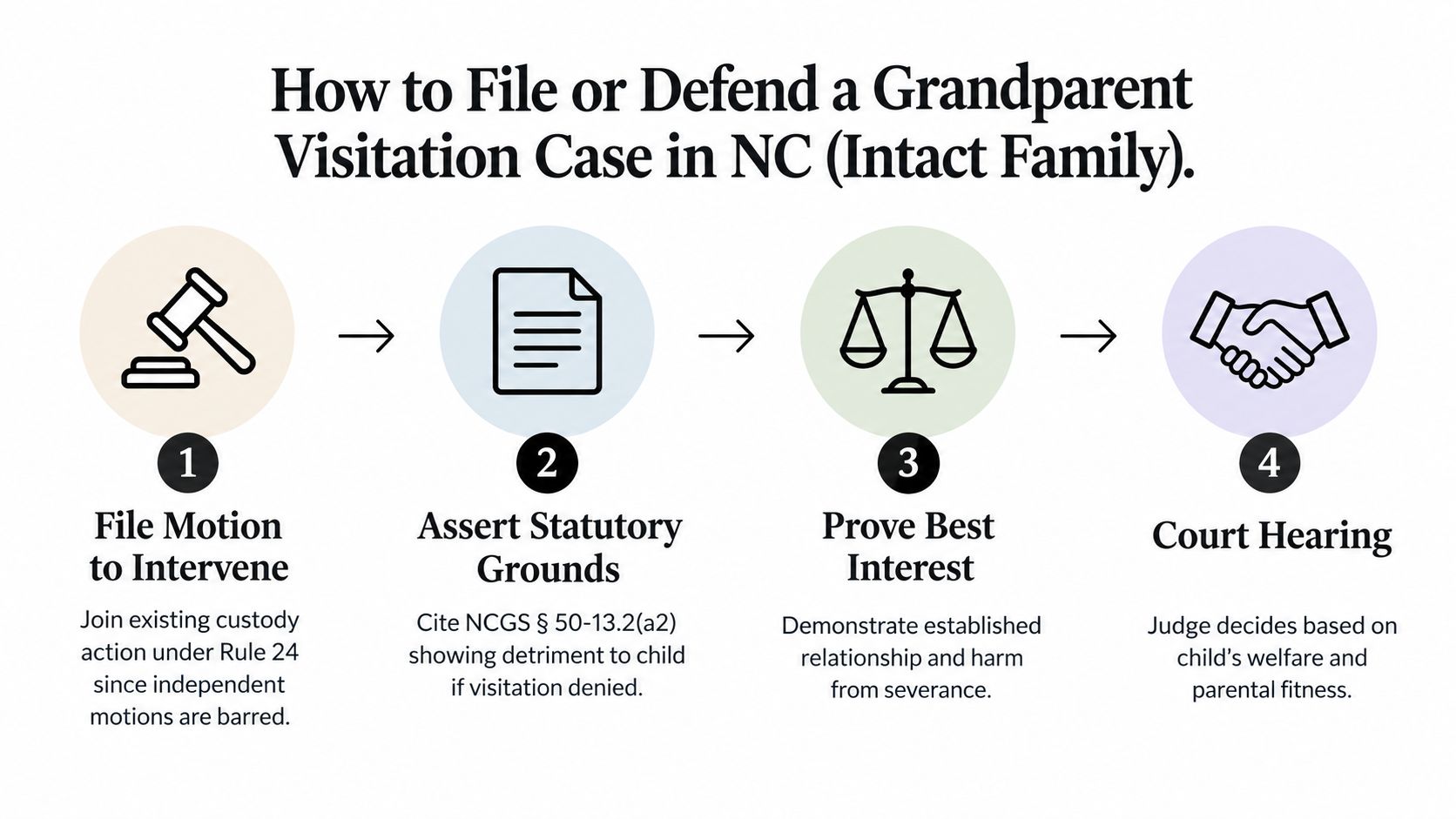
The correct filing path depends on whether a custody case is already pending, whether a prior custody order exists, and whether the family falls within a statutory exception. A grandparent generally shouldn't begin with a new, standalone visitation complaint without first examining those issues.
For a grandparent seeking visitation
A careful review usually includes:
- Locate the existing case. Identify the county, case number, current custody order, and whether custody is still being litigated.
- Choose the procedural vehicle. Counsel may determine whether intervention under Rule 24, a motion in the cause, or a specific adoption-related action is appropriate.
- Plead the standing facts. The filing should explain why the family isn't subject to the ordinary intact-family barrier or identify the statutory basis for the request.
- Address changed circumstances. If an earlier custody order exists, identify the relevant change rather than merely restating the prior relationship.
- Prepare child-focused evidence. School records, communication logs, caregiving records, and witness statements may help establish the history and effect of the relationship.
For a parent defending the case, a prompt standing objection may be important. The parent can gather records showing that the family remains intact, that no custody dispute is pending, or that the grandparent hasn't identified a valid statutory route. The defense should keep the focus on the threshold issue before the parties spend substantial time arguing about the child's best interests.
Evidence and communication matter
Both sides should preserve relevant documents. Helpful materials may include calendars, school communications, medical records, photographs, text messages, and written agreements about caregiving. Evidence should show the child's actual circumstances, not just adult accusations.
A parent who wants general information about a parent's ability to restrict another person's contact can review Can a Parent Deny Visitation in North Carolina. That question is related to, but not identical with, a grandparent's ability to obtain a court order.
The Child Custody in North Carolina resource addresses how North Carolina courts decide custody under the best-interests standard. Grandparent visitation requires an additional analysis because the grandparent must first establish a legal route for the court to consider the request.
A hearing may involve both procedural and substantive questions. The judge may first decide standing, then determine whether changed circumstances or statutory requirements are satisfied, and only then consider whether the proposed contact serves the child's welfare.
Common Misconceptions and the Debate Over Reform
A meaningful grandparent-grandchild relationship isn't enough, by itself, to guarantee visitation in North Carolina. The intact family rule protects the authority of parents who are raising a child together, even when a grandparent believes the parents are making a harmful or unfair decision.
The United States Supreme Court's decision in Troxel v. Granville is often misunderstood. It recognized the constitutional importance of a fit parent's decision-making authority. It didn't create a freestanding right for every grandparent to demand court-ordered contact.
North Carolina's framework reflects a policy tension. Grandparents can provide stability, affection, and continuity, while parents have a constitutional interest in controlling their children's associations without being drawn into litigation over every family disagreement. A North Carolina legislative committee has previously identified the intact-family limitation as a possible problem and recommended allowing some grandparents to petition, but a proposal is not the same as an enforceable change in law.
The current practical rule remains that standing must come first. Expanding access would not necessarily mean automatic visitation. It would allow a court to evaluate the child's best interests. Until the legislature changes the statute or the courts reinterpret the constitutional framework, McIntyre remains binding authority.
Frequently Asked Questions and Next Steps for North Carolina Families
Can a grandparent file independently when the parents are married and living together?
Generally, no, if the child remains in the parents' household and no custody proceeding is pending. The intact family rule usually prevents an independent visitation claim from moving forward.
What evidence shows serious harm if visitation is denied?
There isn't a universal checklist or guaranteed level of proof. Relevant evidence may include the child's established relationship with the grandparent, the grandparent's caregiving role, communications about the child's needs, and specific facts concerning the effect of ending contact. Those facts matter only if the grandparent first has a valid procedural route.
How long must a custody case be pending?
North Carolina law does not establish a universal waiting period in the verified framework described here. The important question is whether custody is in issue or being litigated, not just how much time has passed since a case was opened.
Can a grandparent recover attorney fees?
Attorney-fee questions depend on the pleadings, the statutory basis, the court's authority, and the specific facts. A grandparent shouldn't assume fees will be awarded, and a parent shouldn't assume that defending an unsuccessful claim automatically produces reimbursement.
Before filing or responding, document the family structure, identify any existing custody order, preserve communications, and consider whether negotiation can avoid further damage to the child's relationships. A consultation with a licensed North Carolina family-law attorney can help determine whether the case presents a standing issue, a custody-modification issue, or no viable visitation route.
The Law Office of Bryan Fagan offers North Carolina family-law consultations concerning grandparent visitation, custody proceedings, and related disputes involving parental rights. Review your family's procedural history and legal options with counsel by visiting Law Office of Bryan Fagan before filing or responding to a visitation motion.