An argument at a Raleigh home ends with one person in handcuffs and the other speaking with officers. By the time you're released, you may be facing a criminal charge, a no-contact condition, a 50B protective-order case, and questions about where you'll live or how you'll see your children. It's a frightening turn, especially when you believe the accusation leaves out important context.
North Carolina domestic violence defense is rarely about one courtroom or one decision. What you say to police may surface in a protective-order hearing or a custody case. A message sent to “clear things up” can create another problem. And an order may affect your home, parenting arrangements, and firearms before the criminal charge is resolved.
The right response is practical: understand what the law requires, follow every court order, preserve evidence, and get legal advice before making statements or plea decisions. The stakes are real, but an accusation alone doesn't decide the outcome. The evidence and the specific legal elements still matter.
When a Domestic Dispute Becomes a Criminal Case in North Carolina
After an arrest, you may be dealing with several separate processes at once. A criminal prosecution determines whether the state can prove an offense. A 50B domestic violence protective order, or DVPO, is a civil court matter that can impose restrictions on contact, residence, firearms, and parenting. A family-law case may also address custody, visitation, or divorce. Each proceeding has its own purpose, but information from one can affect the others.
A common mistake is treating the criminal charge as the only urgent issue. Suppose officers set a no-contact condition, then a judge issues an ex parte DVPO. Even if you think the protected person wants to talk, contacting them may violate a release condition or the order. The same contact could also become evidence in the criminal case or a later custody dispute.
Start with compliance, not persuasion. Don't contact the protected person to explain your side unless your lawyer confirms the contact is allowed. Don't assume the other person can cancel an order by inviting you to talk.
The legal question isn't whether an argument happened. The court must consider the charge and its elements, the reliability and context of the evidence, and any applicable defense. In the protective-order case, the judge considers the allegations under the law governing that proceeding. A guilty plea, a statement to police, or an alleged order violation can carry consequences beyond the criminal docket.
Early decisions matter because records and statements can travel between proceedings. Preserve communications, follow every written condition, and get advice before discussing the incident with police, the other party, or family members who may become witnesses. A coordinated strategy should account for the criminal case, any 50B proceeding, and the family-court record together.
How North Carolina Defines Domestic Violence
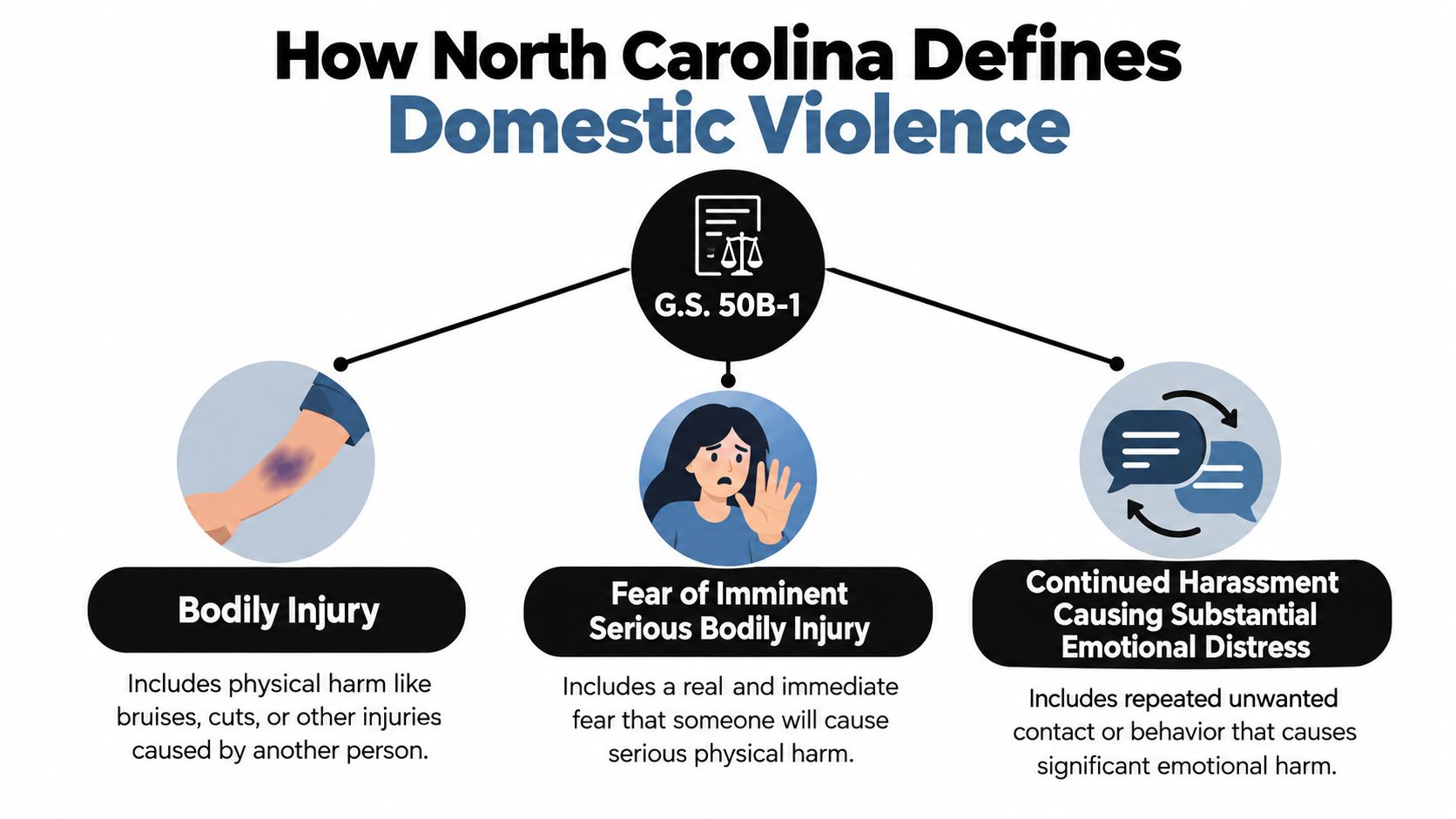
North Carolina's G.S. 50B-1 defines domestic violence through specific conduct and a qualifying relationship. A dispute doesn't become domestic violence under the statute just because it happened between people who know each other or because someone found it upsetting. The alleged conduct must fit a statutory category, and the relationship must qualify.
The statute recognizes three relevant forms of conduct:
- Intentionally causing bodily injury. The allegation must involve intentional conduct that causes bodily injury, not merely an argument or an accidental bump.
- Putting someone in fear of imminent serious bodily injury. “Imminent” means the threatened harm appears immediate, not a vague worry about something that might happen in the future.
- Continued harassment causing substantial emotional distress. Repeated unwanted conduct may qualify if it meets the legal standard and causes substantial emotional distress. A single rude message, by itself, doesn't automatically satisfy that test.
The relationship matters too
The statute applies to certain personal relationships, including current or former spouses, people who live together or lived together, people who share a child, and people who are dating or have dated. The court must connect the alleged conduct to a qualifying relationship as well as to a statutory form of domestic violence. North Carolina law also expressly excludes acts of self-defense.
That distinction can matter in a real case. If two former partners exchange insults by text, the messages may be unpleasant, but that alone doesn't establish bodily injury, fear of imminent serious bodily injury, or continued harassment causing substantial emotional distress. If the messages are repeated and part of a pattern that meets the statute, the analysis may be different. Context, chronology, and the full conversation matter.
For a plain-language overview of the separate civil order process, see this explanation of a North Carolina domestic violence protective order. Don't rely on the label used in a police report or petition. Compare the alleged acts and relationship history to the actual statutory requirements.
What to Do in the First Hours After an Arrest
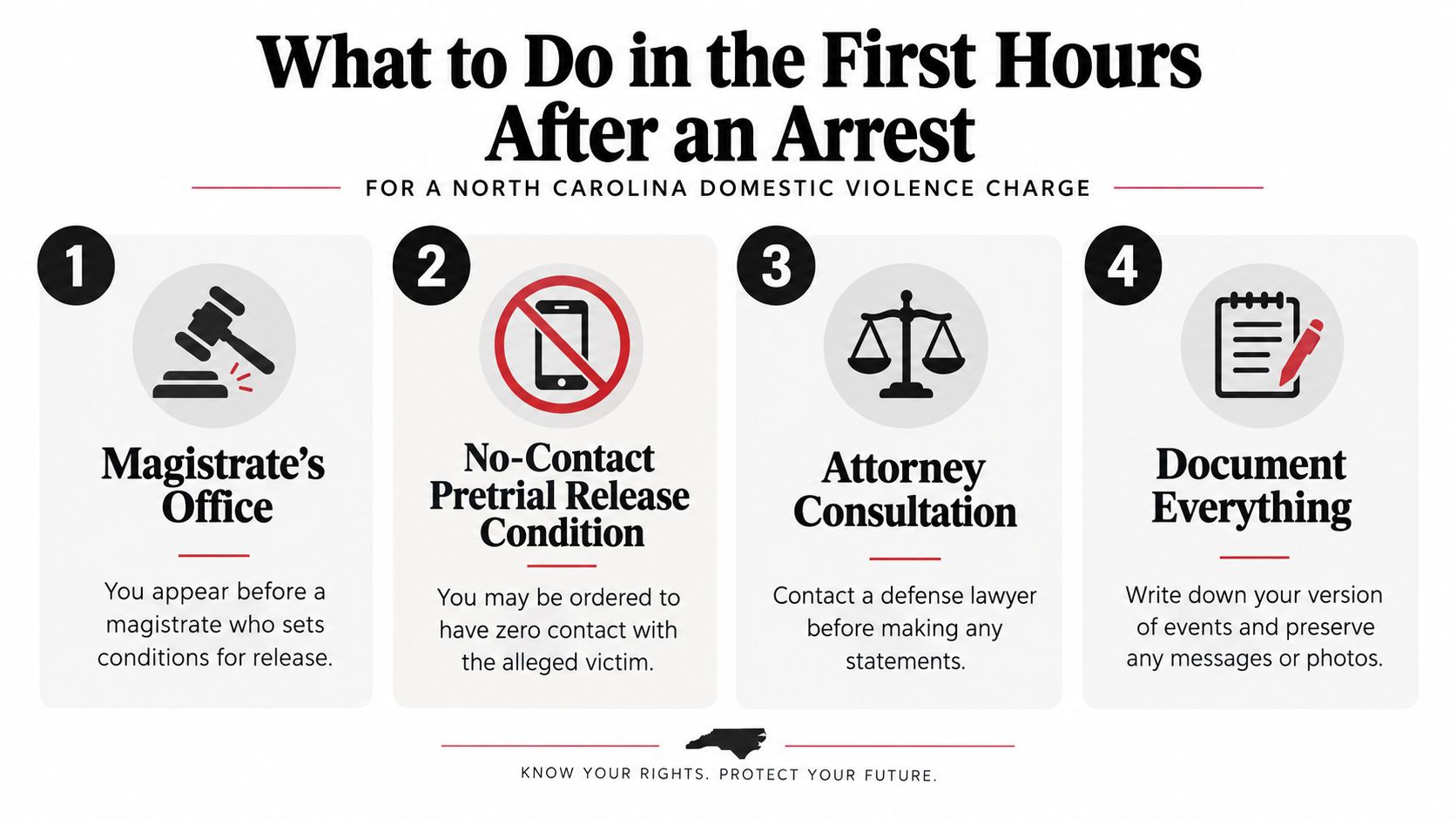
The first hours can move quickly. After arrest, you'll generally appear before a magistrate, who addresses release and conditions. The magistrate may impose a no-contact condition as part of pretrial release. You may be released on an unsecured bond, where you don't pay the full bond amount upfront, or a secured bond, which requires security under the court's terms. Read every condition and ask your lawyer to explain anything you don't understand.
Police may question you before or after arrest. Miranda warnings are generally required before custodial interrogation, but don't treat the warning as an invitation to tell your story. You can ask for a lawyer and remain silent. A short, emotional explanation can become a statement the state uses later, even if you intended to calm things down.
Keep the first-day plan simple
- Follow release conditions: Don't call, text, message through someone else, or visit the alleged victim if a no-contact condition prohibits it.
- Get legal advice before an interview: Tell officers you want a lawyer and don't answer questions about the incident without counsel.
- Preserve records: Save messages, photos, call logs, and other evidence without deleting or editing anything.
- Write a private chronology: Record what you remember while it's fresh, including names of witnesses and where relevant evidence may be stored. Share it with your lawyer, not online.
Consider someone arrested after an argument who sends a text from a friend's phone saying, “I just want to explain.” If a no-contact condition is in place, that well-meant message may become the focus of a separate allegation or a later hearing. Don't use another person, a new account, or social media to get around a restriction.
Your first district court date will be scheduled through the court process. Keep the paperwork, track the date, and make sure your lawyer receives the release conditions and charging documents. If you're also considering divorce, North Carolina has a six-month residency rule for filing, described in this overview of North Carolina divorce residency requirements. That filing rule doesn't change the need to obey criminal release conditions or a protective order.
Common Defenses in North Carolina Domestic Violence Cases
A defense should fit the evidence, not just the client's preferred account. In North Carolina, a lawyer may examine self-defense, defense of another person, a false allegation, mistaken identity, or insufficient evidence. Several issues can arise together, but each needs support in the record.
Compare the possible defense theories
- Self-defense: North Carolina's statute excludes acts of self-defense. The evidence should show what threat the defendant faced and what happened in response. For example, if a spouse grabbed the defendant first and the defendant used force to stop the attack, the sequence, injuries, recordings, and witness accounts may matter. Self-defense isn't established by saying the other person started the argument.
- Defense of another: A person may act to protect someone else from harm. The key questions include what danger appeared to be happening and whether the response was connected to that danger. A neighbor's account or a recording may help establish what the defendant saw.
- False allegation: A claim may be disputed because of mistaken recollection, conflict, or an inaccurate account. A custody dispute can provide context for examining timing and motive, but it doesn't prove an allegation was fabricated. Look for messages, prior statements, and records that independently support or contradict the accusation.
- Mistaken identity: When witnesses didn't clearly see who acted, the state must still prove the defendant's identity. For instance, if several people were present and an object was thrown during a chaotic argument, lighting, distance, video, and inconsistent descriptions may matter.
- Insufficient evidence: A case may turn on whether the available evidence proves each required element. If the allegation rests on one statement without supporting physical evidence, recordings, or reliable corroboration, the defense can test the statement's consistency and detail. Lack of corroboration doesn't automatically end a case, but it can be important to the court's assessment.
Don't build a defense around a label. A lawyer needs the full timeline, not just the most favorable screenshot or the part of the story that makes you look best.
Credibility is often central. Preserve both favorable and unfavorable records, and tell your lawyer about facts that may complicate your account. Selective disclosure can leave counsel unprepared for evidence the state already has.
How Criminal, Family, and Protective Order Cases Connect
The criminal docket, a 50B DVPO proceeding, and family court are separate matters, but a decision in one can affect the others. Statements to officers, messages, recordings, and testimony may become relevant in more than one proceeding. A guilty plea can also become part of the record considered in a later parenting dispute, even if the children weren't present during the alleged incident.
For example, imagine a Wake County father who pleads guilty to a misdemeanor after discussing only the immediate criminal consequences. In a later custody-modification hearing, the other parent may point to the plea as evidence relevant to parenting and safety. That doesn't automatically decide custody, but it can shape the arguments and the court's review. Before accepting a plea, discuss both the criminal consequences and the potential family-court record with counsel.
An alleged violation of a protective order can create additional criminal exposure under G.S. 50B-4.1. A prohibited text or an appearance at a protected person's workplace may be scrutinized under the exact terms of the signed order. Don't assume the protected person can waive the restriction by agreeing to meet. Only the court can modify or dissolve its order.
The practical crossover looks like this:
| Action in One Case | Criminal Case Effect | 50B Protective Order Effect | Custody/Divorce Effect |
|---|---|---|---|
| Giving a statement to police | May be used as evidence in the prosecution | May be relevant to the allegations or response | May be raised in a parenting dispute |
| Pleading guilty | Creates a criminal case outcome | May affect how related allegations are argued | May be considered as part of the family-court record |
| Contacting someone despite a restriction | May lead to a separate charge | May be treated as an alleged violation | May raise concerns about judgment or compliance |
| Preserving complete messages | Can help test chronology and context | Can support or challenge the petition | Can clarify communication relevant to parenting |
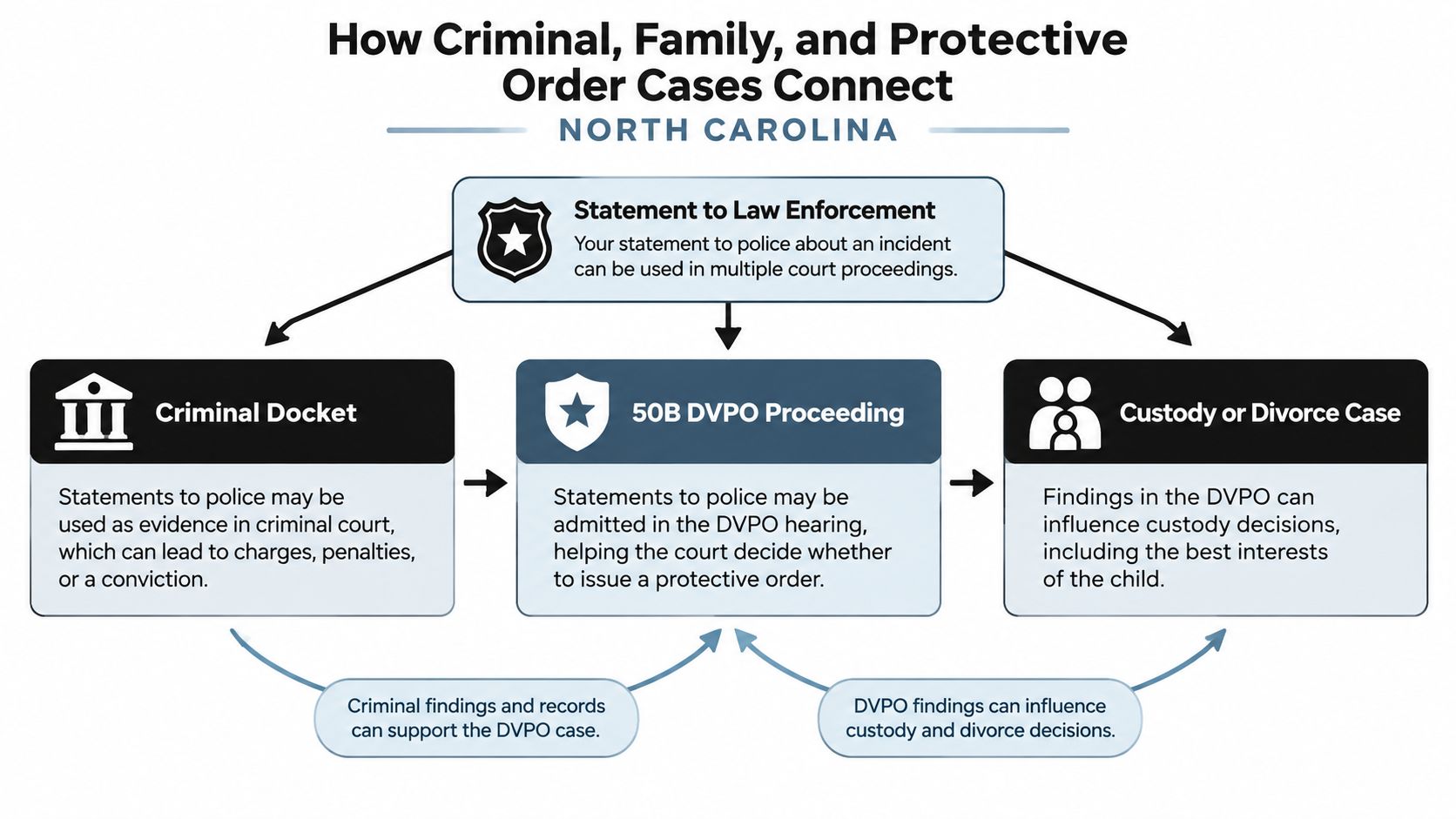
If a custody case is active, coordinate legal advice rather than treating each court file as unrelated. North Carolina's child custody laws provide the family-law context, but your criminal defense lawyer should understand how statements and proposed agreements may affect the broader record.
Evidence Preservation and the North Carolina Hearing Deadline
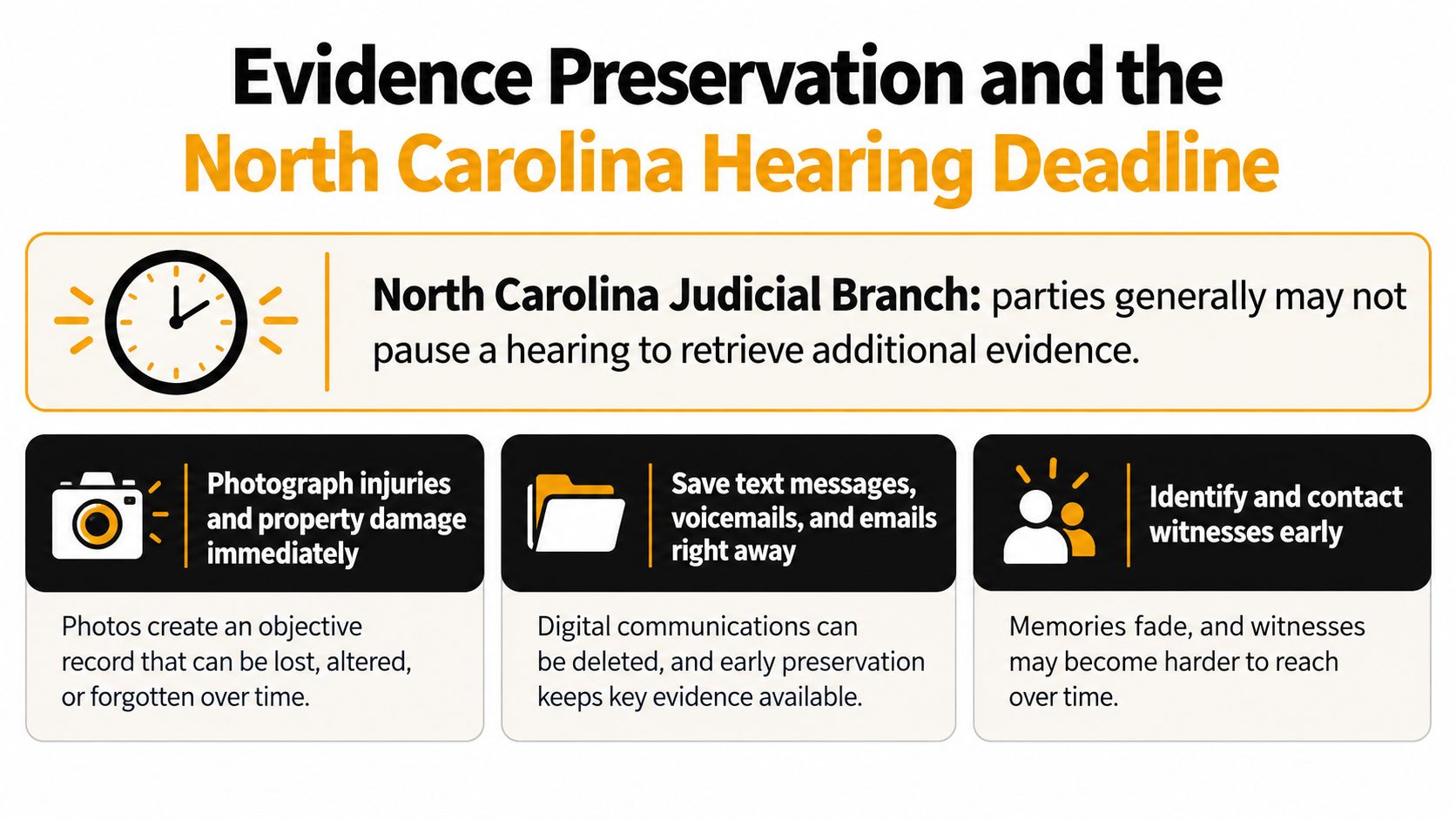
A North Carolina DVPO hearing can arrive quickly. If a judge issues an ex parte order, the court generally must hold a hearing within 10 days of issuance or within 7 days of service, whichever is later. The North Carolina Judicial Branch says parties may not pause the hearing to retrieve additional evidence or witnesses. North Carolina courts' guidance on domestic violence protection orders makes early preparation essential.
Preserve the full record
Start with the evidence most likely to disappear or lose context:
- Text messages and email: Save complete threads, not selected screenshots. An isolated message can look threatening when the preceding conversation explains what it referred to.
- Call logs and voicemail: Preserve timestamps and original audio. Don't rely only on a handwritten summary of what someone said.
- Video and photographs: Save doorbell, dashcam, or other relevant recordings promptly. A recording may show who approached whom, or when an event occurred.
- Witness information: Write down names and contact details for people with firsthand knowledge. A witness who is identified too late may not be ready for the hearing.
- Medical, work, and property records: Preserve records that may clarify injuries, timelines, location, or damage. Keep original files when possible.
Create a chronological folder and give your lawyer access to the original material. Don't crop, edit, delete, or circulate evidence on social media. If a recording appears to show the other person acting first, preserve the whole recording, not just a short clip. A complete record lets counsel address context and authenticity rather than fighting over a fragment.
Move quickly, but don't pressure witnesses to adopt your account. Ask them to preserve what they saw or heard and provide their own recollection. The court needs firsthand evidence, not a rehearsed version of events.
Firearm Surrender, Plea Choices, and Possible Outcomes
A protective order may restrict firearms, and mishandling surrender can create a separate problem. Read the signed order and follow its exact instructions. Don't hide, transfer, or move a firearm to avoid a restriction, and don't assume that a relative's offer to store it makes the arrangement lawful. Ask counsel how to document compliance, especially if a firearm is jointly owned, inherited, stored at work, or subject to unclear instructions.
North Carolina House Bill 206 provides for surrender of firearms, ammunition, and permits to the sheriff within 24 hours of service in specified circumstances. The bill's provisions include implementation dates of December 1, 2025, and additional application beginning February 1, 2026. Check the current law and the language of your order with a North Carolina lawyer before acting. A written receipt can help document what was surrendered and when. This practical guide to firearm surrender under a 50B order in North Carolina addresses the issue from the perspective of compliance and defense.
Plea or trial
A plea agreement may resolve the case without a trial, but it means admitting to the offense or otherwise accepting a specified disposition. That decision may affect the criminal record and later family-court arguments. Trial preserves the state's obligation to prove its case, but it also carries uncertainty and requires a careful assessment of evidence, defenses, and sentencing exposure. Ask counsel to explain the proposed terms and collateral consequences before deciding.
Misdemeanor and felony cases have different classifications and sentencing consequences under North Carolina law. The exact exposure depends on the charge, the person's record, and the facts. Don't assume a first offense will be dismissed or that a plea will disappear later. Some convictions may qualify for expungement under North Carolina law, while eligibility depends on the specific offense and history. A lawyer can also review whether post-conviction remedies are available in your circumstances.
Frequently Asked Questions About Domestic Violence Defense in NC
Can a 50B order be dismissed if the alleged victim doesn't want it?
The protected person's preference doesn't automatically end a court order. A valid order remains enforceable unless the court changes or dissolves it. Don't rely on a private agreement or invitation to resume contact. Follow the order and ask a lawyer about the proper court process.
What happens if both people claim self-defense?
The judge or jury must assess the evidence, including who used force, what threat each person faced, and how the incident unfolded. Preserve recordings, photographs, messages, and witness information. Your account should be assessed alongside the full timeline, not in isolation.
How does a first-offense misdemeanor differ from a felony at sentencing?
A misdemeanor and a felony are different offense classifications and can carry different sentencing consequences. The charge, criminal history, and case facts matter, so don't rely on a general prediction. Ask your lawyer to explain the specific exposure and how a plea could affect related proceedings.
Can a deferred prosecution be expunged?
Possibly, but completion of a deferred prosecution doesn't automatically mean a record will be expunged. Eligibility depends on the disposition, offense, and applicable North Carolina law. Have counsel review the final court record and explain any available process.
Choose a North Carolina defense lawyer who handles domestic violence cases, understands local district-court procedures, communicates clearly under stress, and can coordinate with family-law counsel when custody or divorce is involved. Your lawyer should review the criminal file, the exact 50B order, and any family-court papers before advising you about statements, contact, evidence, or a plea.
If you're facing a charge or protective-order hearing in North Carolina, get advice before making a statement, contacting the other party, or agreeing to a plea. The Law Office of Bryan Fagan offers representation in criminal defense and related family-law matters, with consultation available to discuss your situation and legal options. Visit Law Office of Bryan Fagan to schedule a consultation.