You may be sitting at home after a traffic stop, looking at a citation and wondering how a first DWI could affect your license, job, family, and future. You may not have caused a crash, hurt anyone, or ever faced criminal charges before. Even so, North Carolina treats a first impaired-driving case as a serious legal matter with two separate tracks: the criminal case in court and the administrative consequences handled through the DMV.
Those tracks can move differently. The court decides whether you're convicted and, if so, which sentencing level applies. The DMV can impose license consequences connected to the arrest, testing, or conviction. A short criminal sentence doesn't necessarily prevent a substantial interruption to your ability to drive.
This guide explains DWI first offense NC law in plain English. It covers the definition of impaired driving, the five sentencing levels, license revocation, the case timeline, potential defenses, and practical steps you can take now. North Carolina law is fact-specific, so general information can help you understand the process, but it can't replace advice about your individual stop and evidence.
What a First DWI Means in North Carolina Right Now
A first DWI arrest often begins with an ordinary evening. You leave a restaurant, drive home, and notice blue lights behind you. The officer asks where you've been, whether you've been drinking, and whether you'll perform field sobriety tests. Before you've had a chance to understand what's happening, you may be arrested and taken for chemical testing.
A first conviction is generally handled as a misdemeanor under North Carolina's structured DWI sentencing system. The sentence isn't based only on the fact that this is your first offense. Instead, the judge considers aggravating and mitigating factors and places the case into one of five punishment levels, with Level Five being the least severe and Level One carrying the greatest ordinary exposure. The statutory framework appears in North Carolina General Statutes § 20-179.
The practical impact can be significant even where there's no crash or prior record. A first conviction carries a mandatory one-year driver's license revocation, and the least serious sentencing level still involves a minimum active punishment that can be satisfied through jail, community service, or a combination authorized by the court. State materials also describe alcohol education or substance-abuse-related conditions in many first-offense cases. You can review the state's public guidance in the North Carolina DWI alcohol and the law materials.
The immediate question isn't only, “Will I go to jail?” It's also, “What happens to my license while the case is pending, and what evidence will shape the sentencing level?”
The answer depends on details such as the reason for the stop, the officer's observations, field sobriety testing, chemical analysis, driving history, accident facts, and whether any statutory aggravating factors apply. A first DWI is serious, but an arrest is not the same thing as a conviction. The next steps should focus on preserving evidence and understanding both tracks before making decisions in court or with the DMV.
How North Carolina Defines DWI for a First Offense
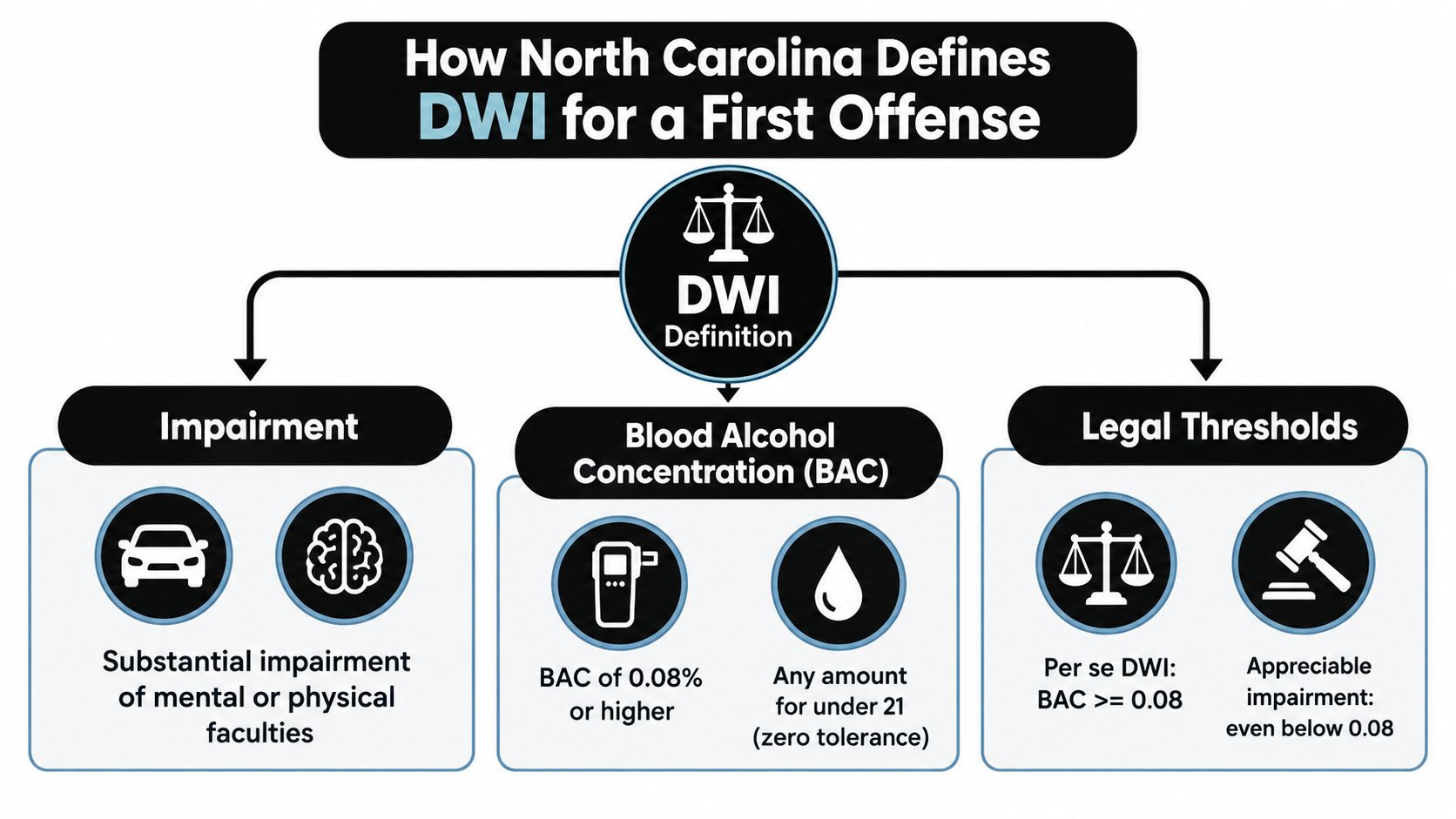
North Carolina uses the term driving while impaired, or DWI. The state can pursue a DWI based on impairment by alcohol, drugs, or another impairing substance. A person may also face a charge based on a chemical analysis showing a blood alcohol concentration at or above the legal threshold. The key point is that the case can involve either the driver's impairment, the chemical result, or both.
Impairment and chemical analysis
In plain language, impairment means the state contends that alcohol or another substance reduced your mental or physical ability to operate a vehicle safely. The prosecution may rely on driving behavior, speech, coordination, odor, divided-attention performance, field sobriety tests, officer observations, and chemical testing.
A chemical analysis can involve breath or blood evidence. Refusing a test doesn't make the criminal case disappear. It can create a separate DMV issue, and the circumstances surrounding the request, administration, and result may become important to the defense.
Why a low result doesn't automatically end the case
Many people assume that a result below the per se alcohol threshold means there can't be a DWI charge. That isn't necessarily correct. North Carolina can allege appreciable impairment even when the chemical result is below the per se threshold, depending on the total evidence.
Think of the distinction this way. A per se theory focuses on the chemical number. An impairment theory focuses on whether the state can prove that your faculties were noticeably affected while you were driving. A defense lawyer must examine both theories rather than treating the chemical result as the entire case.
For parents who are also dealing with a separate family-law issue, the calculation method is different. The North Carolina Child Support Guidelines Explained describes how child support is calculated using the Worksheet system, but that process doesn't determine whether a DWI occurred or what criminal sentencing level applies.
The facts from the stop matter. A routine drive after dinner may produce a very different evidentiary record from a case involving erratic driving, an accident, a high alcohol concentration, or a revoked license. That factual record becomes central when the court evaluates punishment.
Criminal Penalties and License Consequences You Face
A first DWI can place you on two tracks at once. The criminal court decides the sentencing level, jail exposure, fine, and conditions. The DMV addresses your driving privilege separately. A low criminal level does not prevent a serious license consequence.
North Carolina uses five ordinary DWI punishment levels. The level depends on aggravating and mitigating factors, not only on whether you have a prior DWI. The North Carolina DWI sentencing levels guide summarizes how those levels work.
| Sentencing Level | Jail Range | Maximum Fine | Typical Trigger |
|---|---|---|---|
| Level Five | 24 hours to 60 days | $200 | Few or no aggravating circumstances, with mitigating facts potentially supporting the lowest level |
| Level Four | Up to 120 days | $500 | A more serious factual profile than Level Five |
| Level Three | Up to 6 months | $1,000 | Greater aggravation or fewer mitigating circumstances |
| Level Two | Up to 12 months | $2,000 | Significant aggravating circumstances |
| Level One | Up to 24 months | $4,000 | The most serious ordinary first-offense sentencing profile |
These ranges and maximum fines are described in North Carolina's DWI sentencing materials, including the UNC School of Government sentencing handbook excerpt. At Level Five, the court may authorize 24 hours in jail or 24 hours of community service as the minimum punishment. The court controls that decision, and every first offense does not receive the same sentence.
The separate license track
A first conviction carries a mandatory one-year driver's license revocation, as reflected in North Carolina driver guidance and the state's DWI materials. This revocation is separate from the criminal sentence. A judge may impose a short jail term, suspend some punishment, or require conditions, while your driving privilege remains revoked.
The DMV may also impose an administrative suspension after a chemical-test refusal. For a first refusal, that suspension can last one year, and it proceeds separately from the criminal case, as explained in this North Carolina DWI sentencing explanation. Waiting for the court case to finish before addressing the license can create avoidable problems.
Factors that can increase exposure
Aggravating factors include an alcohol concentration of 0.15 or more, especially reckless driving, a reportable accident caused by negligent driving, driving while license-revoked, and speeding 30 miles per hour or more over the limit. These facts can move a case away from Level Five even when no prior DWI exists. The surrounding evidence matters because the court evaluates the full factual record when selecting a punishment level.
From Traffic Stop to Resolution Timeline in North Carolina
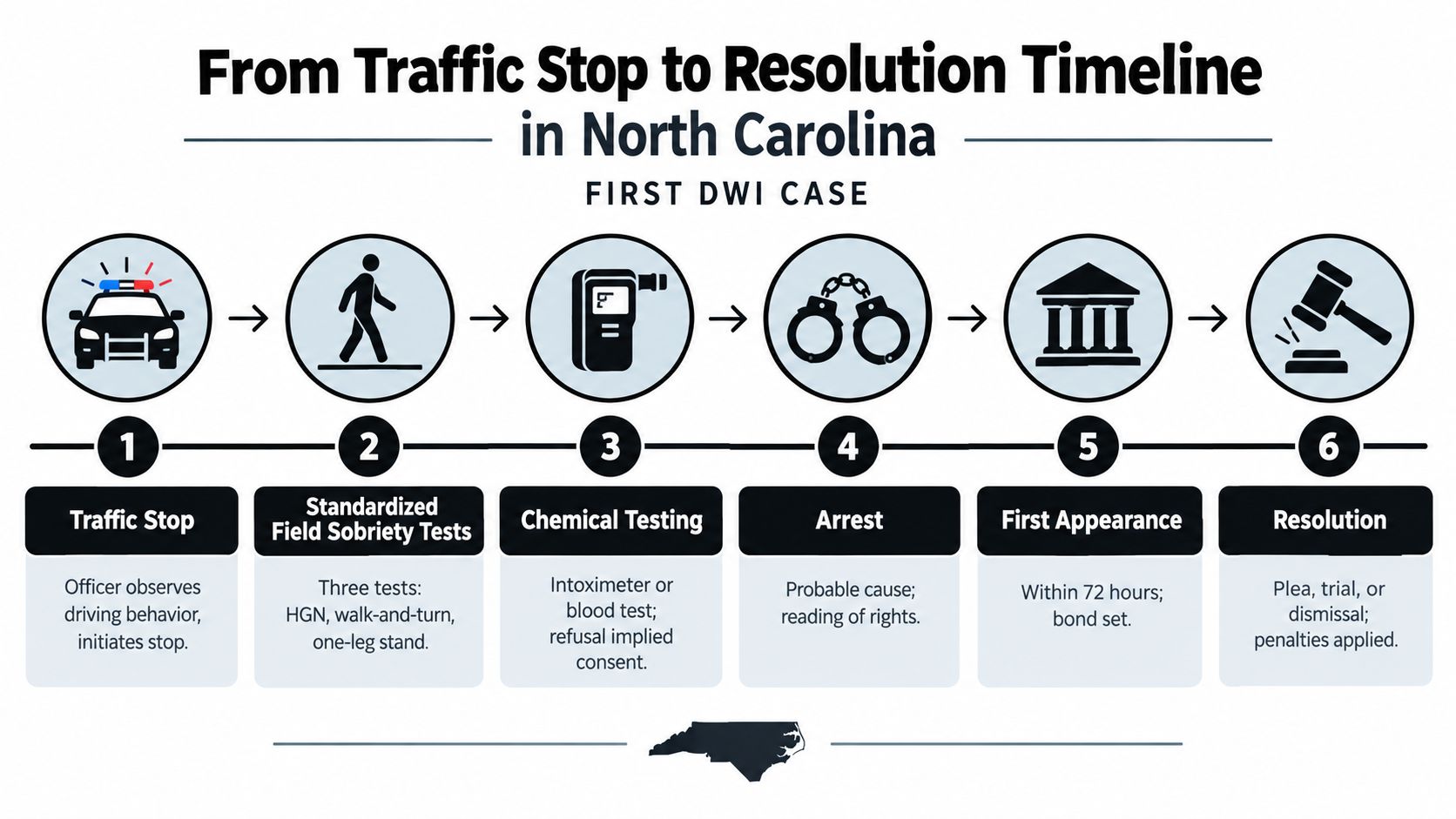
A DWI case develops through several events, and the criminal and DMV tracks may not move at the same pace. Understanding the sequence helps you identify decisions that shouldn't be postponed.
At the roadside
The process typically begins with the officer's observations and the traffic stop. The officer may ask questions, request field sobriety tests, and investigate whether there's probable cause for an arrest. Your words, driving pattern, physical presentation, and performance on tests may later appear in reports or testimony.
After arrest, you may be taken for chemical testing. The test could involve an approved breath instrument or a blood draw, depending on the circumstances. A refusal can create independent DMV consequences, so the paperwork provided at the stop deserves careful review.
After arrest and before court
You may be taken before a magistrate or another judicial official for the initial process involving release conditions and court scheduling. The criminal charge then proceeds through court dates, where the state and defense review the evidence and address motions, negotiations, or trial preparation.
The DMV side may involve revocation or suspension notices and questions about whether you qualify for a limited driving privilege. Eligibility depends on the specific revocation, your record, compliance with statutory requirements, and the court documents involved. Don't assume that a limited privilege is automatic or that it permits unrestricted driving.
Resolution
A case may resolve through a negotiated plea, dismissal, or trial. If there's a conviction, the judge determines the applicable sentencing level and conditions. The DMV consequences may still apply independently, so a lawyer evaluating your case should track both the criminal court calendar and every license-related deadline.
Here is a video resource that offers another visual explanation of the process:
Bring every citation, revocation notice, test paperwork, and court document to counsel. Small differences in dates, test type, and notice language can affect what needs attention first.
Defenses Mitigating Factors and Common Misconceptions
If you are facing a first DWI, the word “first” may feel reassuring until you see the possible license and sentencing consequences. The charge is not automatically minor, and it is not automatically unwinnable. The outcome depends on the evidence, the facts surrounding the stop, and the circumstances the court may consider.
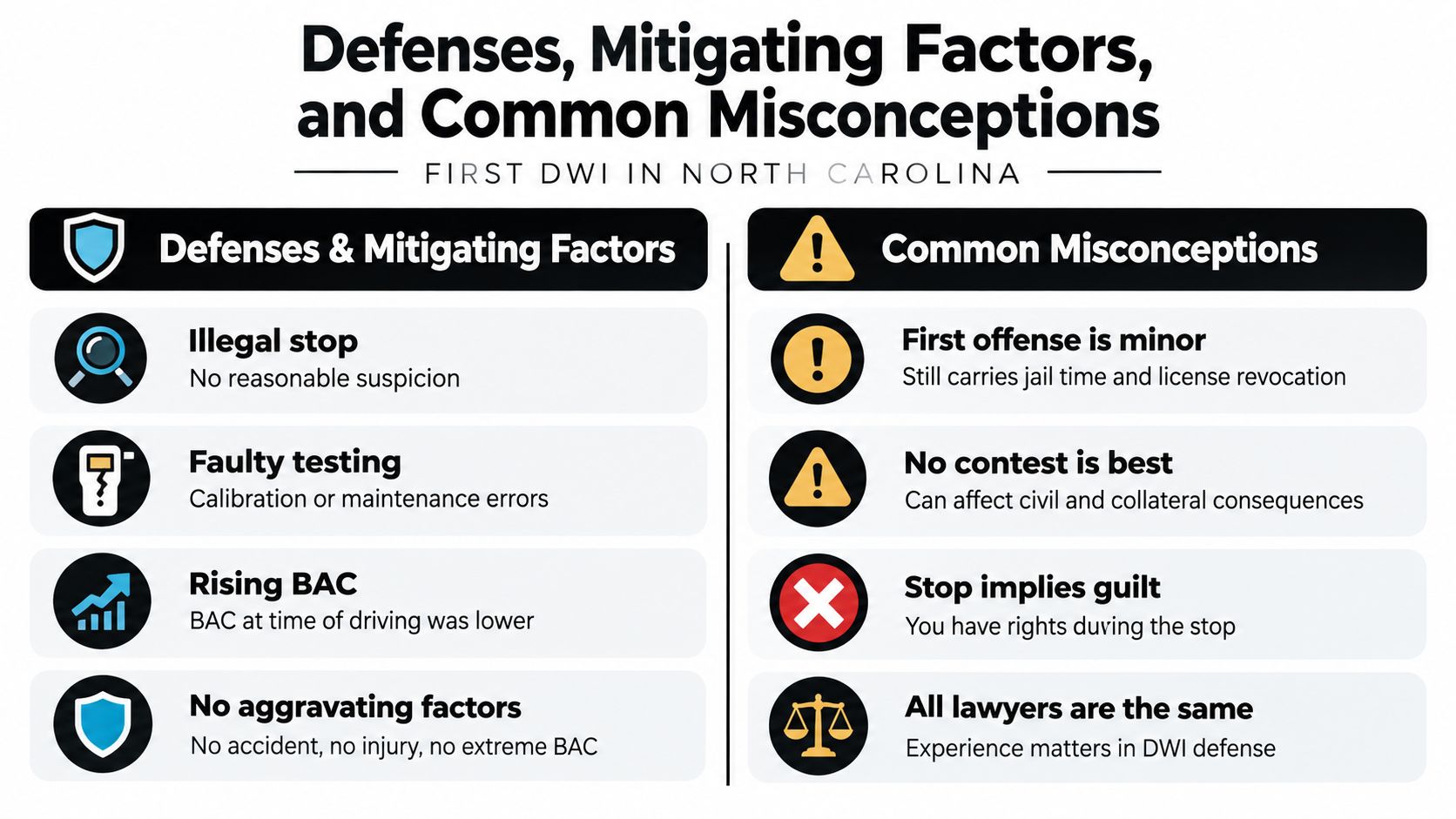
What a defense review examines
A defense review often begins with the traffic stop. Counsel may ask whether the officer had a lawful reason to stop the vehicle and compare that explanation with dash-camera footage, body-camera video, dispatch records, witness accounts, and the officer's reports.
Testing requires its own careful review. Relevant questions may involve administration procedures, observation periods, instrument records, blood-draw handling, and whether the available evidence supports the state's interpretation. A rising-BAC argument may apply in some cases if the alcohol concentration increased after driving, but timing and proof determine whether that argument fits the evidence.
Field sobriety testing can raise separate questions about instructions, conditions, balance, medical issues, and how the officer recorded the results. For more background, see refusing a field sobriety test. The discussion cannot determine your case, but it can help you identify issues to raise with counsel.
Aggravating and grossly aggravating factors
North Carolina sentencing considers aggravating, grossly aggravating, and mitigating circumstances. Grossly aggravating factors can increase sentencing exposure. Examples include a prior impaired-driving conviction within seven years, driving while license-revoked for an impaired-driving revocation, causing serious injury while impaired, or transporting a child or other protected passenger.
A first DWI may therefore involve two parallel tracks. The criminal court determines sentencing consequences, while the DMV handles administrative license consequences. A Level 5 case can still affect your ability to drive, even when the criminal sentencing level appears less severe.
A first DWI label describes your record. It doesn't describe every fact the prosecutor or judge will consider.
Mitigating evidence may include a clean record, responsible conduct after arrest, completion of an assessment, and facts that weaken the state's aggravating allegations. These facts do not guarantee a particular sentencing level or result. They give the court a fuller picture and help counsel assess available sentencing and negotiation options.
Immediate Steps to Protect Your Rights After an Arrest
The first days after an arrest are a poor time to rely on memory alone. Write down what happened while the details remain fresh, and preserve documents before they disappear into a folder or phone.
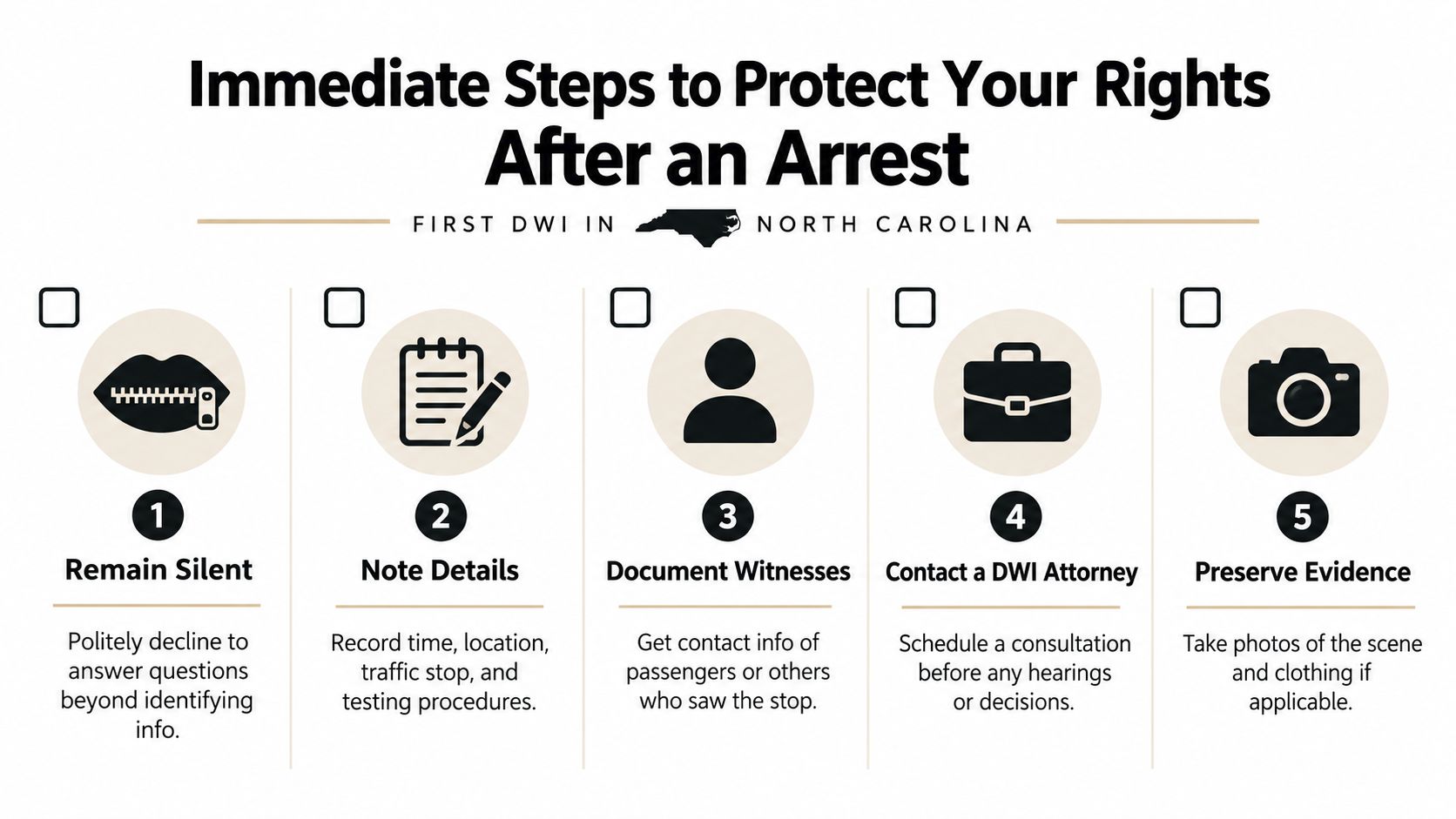
Build a reliable record
Use a private note to record the approximate route, time, location, traffic conditions, reason given for the stop, questions asked, tests requested, chemical-testing process, and names of potential witnesses. Save photographs of the vehicle, roadway, lighting, weather, and any relevant physical condition or clothing. Don't alter, delete, or embellish anything.
- Keep every document: Save the citation, release paperwork, revocation notice, testing forms, and court notices together.
- Identify witnesses: Record contact information for passengers and people who observed the stop, arrest, or events shortly beforehand.
- Preserve recordings: Look for dash-camera, doorbell-camera, business-camera, or phone footage before recording systems overwrite it.
- Avoid public discussion: Don't post explanations, jokes, accusations, or case details on social media. Don't message people involved in a way that could be misunderstood later.
- Use caution with law enforcement: You generally must address identification and lawful instructions, but you can politely request counsel before answering investigative questions.
Address the license promptly
Read the DMV paperwork carefully and identify the effective date, type of revocation or suspension, and any stated requirements. A limited driving privilege, when available, may come with specific conditions and permitted purposes. Driving outside those conditions can create additional legal trouble.
The North Carolina DWI license revocation and limited driving privilege resource can help you frame questions for an attorney, but your eligibility must be assessed from your own record and paperwork.
Prepare for a consultation
Bring your documents, a written timeline, witness information, insurance details, and any video or photographs. Ask counsel to explain the criminal exposure, DMV track, testing evidence, court dates, and decisions that require immediate action. If you're considering an assessment or treatment, discuss timing with your lawyer before assuming that completing a program will produce a particular legal result.
North Carolina DWI First Offense FAQs and Next Steps With Our Team
Can a first DWI affect employment?
It can. A charge or conviction may create questions for employers, especially where driving, licensing, safety, or background checks matter. The effect depends on the job, the employer, the case result, and whether the license remains available for work-related travel.
Can a DWI affect insurance?
A conviction may affect insurance eligibility or premiums, but the precise result depends on the insurer and your circumstances. Don't assume that a dismissal, reduction, or conviction will have the same effect. Ask about the insurance consequences as part of a broader case review.
Can a first DWI be expunged?
Eligibility for expunction depends on the final disposition, the applicable North Carolina law, and your record. A first arrest doesn't automatically mean the case can be erased, and a conviction doesn't automatically make expunction impossible. A lawyer should review the docket and disposition rather than offering a conclusion based only on the charge name.
Can I travel while the case is pending?
Travel may be possible, but release conditions, court dates, probation terms, passport issues, employment obligations, and pending DMV requirements can matter. Confirm the rules before making plans, and never miss a required court appearance.
North Carolina residents facing a first DWI need advice based on the actual stop, testing, paperwork, driving history, and license status. A consultation can help you separate urgent DMV decisions from longer-term criminal defense strategy, without promising an outcome that no lawyer can guarantee.
The Law Office of Bryan Fagan provides North Carolina-focused criminal defense representation, including guidance on DWI charges, court proceedings, sentencing exposure, and license-related consequences. Visit Law Office of Bryan Fagan to schedule a consultation and discuss the facts of your first DWI with a legal team serving individuals and families throughout North Carolina.