You have a custody order, but the conflict hasn't ended. One parent says the exchange must happen at the usual location. The other says a holiday event changes the plan. A school activity creates another disagreement, and a question about bedtime or transportation turns into a string of angry messages. Before long, a dispute that should take a few minutes to resolve becomes another trip to court.
North Carolina parenting coordination is designed for this kind of ongoing conflict. It can provide a structured way to address limited, day-to-day custody disputes, but it doesn't give a coordinator the same power as a judge. Understanding that boundary is essential before you request an appointment, agree to one, or challenge a decision.
Why Some NC Custody Cases Need a Parenting Coordinator
A parenting coordinator becomes relevant when a custody order exists but the parents still can't carry it out without repeated conflict. Consider two parents whose order sets out parenting time, holiday arrangements, and transportation responsibilities. Every exchange becomes an argument. Each school event leads to a disagreement about attendance. The parents return to court repeatedly because they can't resolve practical questions on their own.
That pattern can exhaust everyone, especially the child. Parents may spend their energy documenting messages, preparing motions, and anticipating the next dispute instead of helping the child move between two homes with as much stability as possible.
A court tool for continuing conflict
A parenting coordinator isn't couples therapy, and the role isn't designed to repair the former relationship. The coordinator is a neutral professional operating under authority defined by a court order. Within that defined authority, the coordinator can help clarify or enforce portions of the custody arrangement and resolve certain disputes that don't justify a new judicial decision about the family's entire custody structure.
The arrangement may be useful when parents disagree about matters such as:
- Exchanges: Where a child should be transferred when the order's language creates uncertainty.
- Holidays: How an unclear holiday provision applies to a particular event.
- Transportation: Which parent handles transportation when the order doesn't clearly address a change.
- Daily routines: How to apply provisions involving bedtime, discipline, diet, child care, or activities.
The important point is that coordination doesn't replace the custody order. It helps apply the order within the limits set by the judge.
Practical rule: A coordinator is closer to a referee for defined parenting disputes than to a new judge for the entire custody case.
This article focuses on the questions parents usually need answered before taking the next step: who can serve, how appointment works in North Carolina, what the coordinator can decide, who pays, how long the appointment lasts, and how a parent may ask the court to review an appointment or decision. The central question is always the same: Is the issue one the coordinator may handle, or is it reserved for the judge?
What a Parenting Coordinator Is Under North Carolina Law
North Carolina created its parenting coordinator system by statute in 2005, when the General Assembly enacted Session Law 2005-228 and authorized courts to appoint a parenting coordinator in child custody cases. The statutory framework appears in North Carolina's custody provisions, including North Carolina's parenting coordinator statute.
Appointment can occur at any time after a custody order has been entered. That timing matters. Parenting coordination is generally connected to implementing or clarifying an existing custody order, not to deciding custody from the beginning.
Consent changes the appointment analysis
If both parents agree to a parenting coordinator, the court can consider that agreement in deciding whether to appoint one. If the parents don't consent, the court must make specific findings that:
- The case is high-conflict.
- Appointment is in the child's best interests.
- The parties are able to pay for the coordinator.
Those findings protect against treating parenting coordination as an automatic step in every custody case. A parent who objects should understand that disagreement alone doesn't answer the legal question. The court must evaluate the statutory requirements and the circumstances of the family.
A simple analogy helps. The judge writes the rules for the game and decides matters reserved to the court. The parenting coordinator may act like a referee for certain disputes that arise during play, but the referee can't rewrite the rules or change the structure of the game.
What the role is not
A parenting coordinator doesn't represent either parent. The coordinator isn't a substitute for your family law attorney, and the coordinator doesn't provide individual legal advice to either side. The coordinator also isn't a mediator whose only function is to help parents reach a voluntary agreement.
Under the statute, a coordinator may have authority to issue written decisions within the scope of the appointment. That authority makes the role different from ordinary informal communication support. Parents should read the appointment order carefully because the order defines what the coordinator may address.
For a broader overview of how a North Carolina custody case proceeds, including mandatory custody mediation, parents can review The North Carolina Custody Process and Mediation. The process for resolving a custody case and the later use of a parenting coordinator are related, but they aren't the same proceeding.
The North Carolina custody law overview may also help explain the larger custody framework. A coordinator operates inside that framework, not outside it.
Who Qualifies and How North Carolina Courts Select One
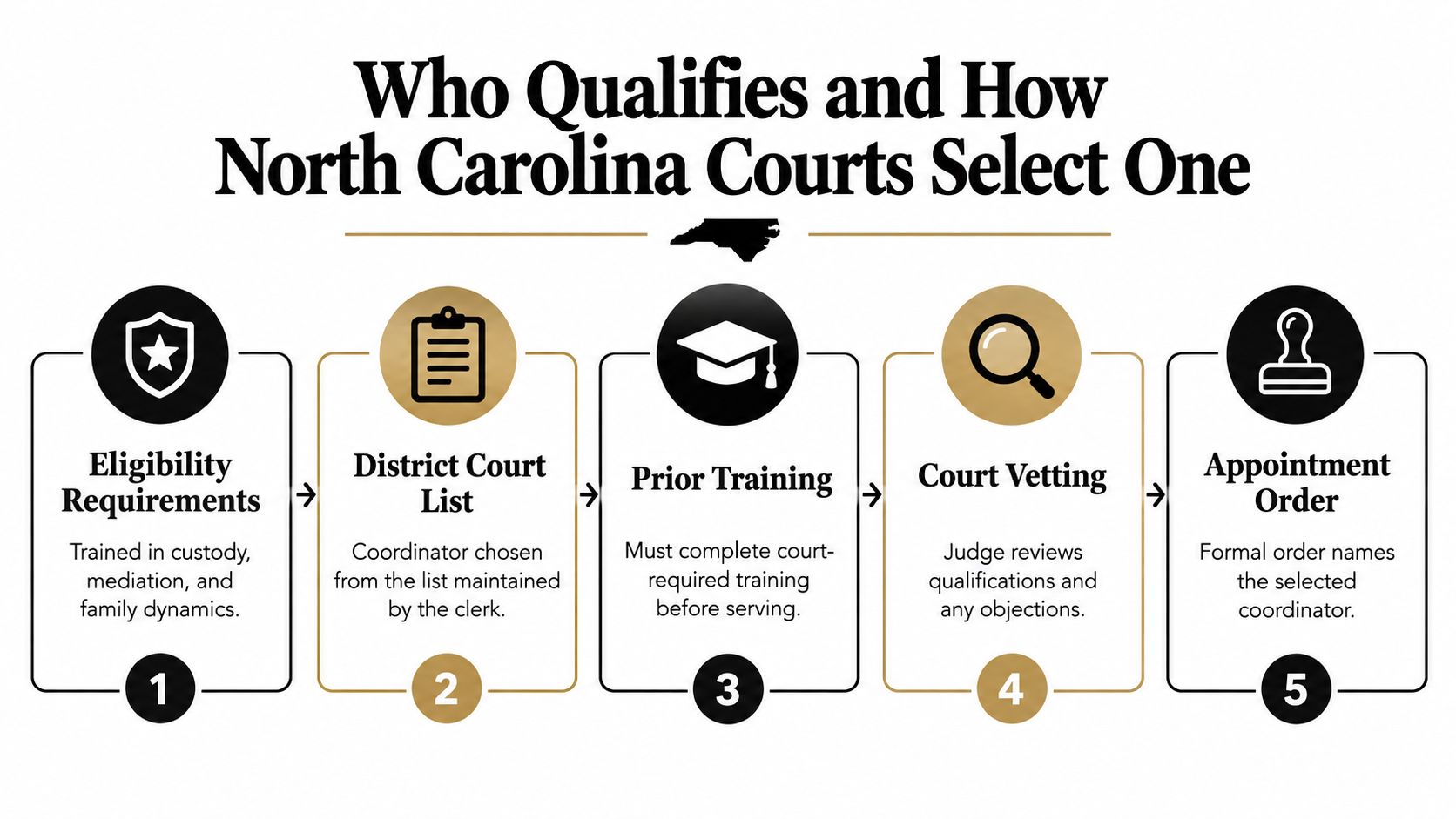
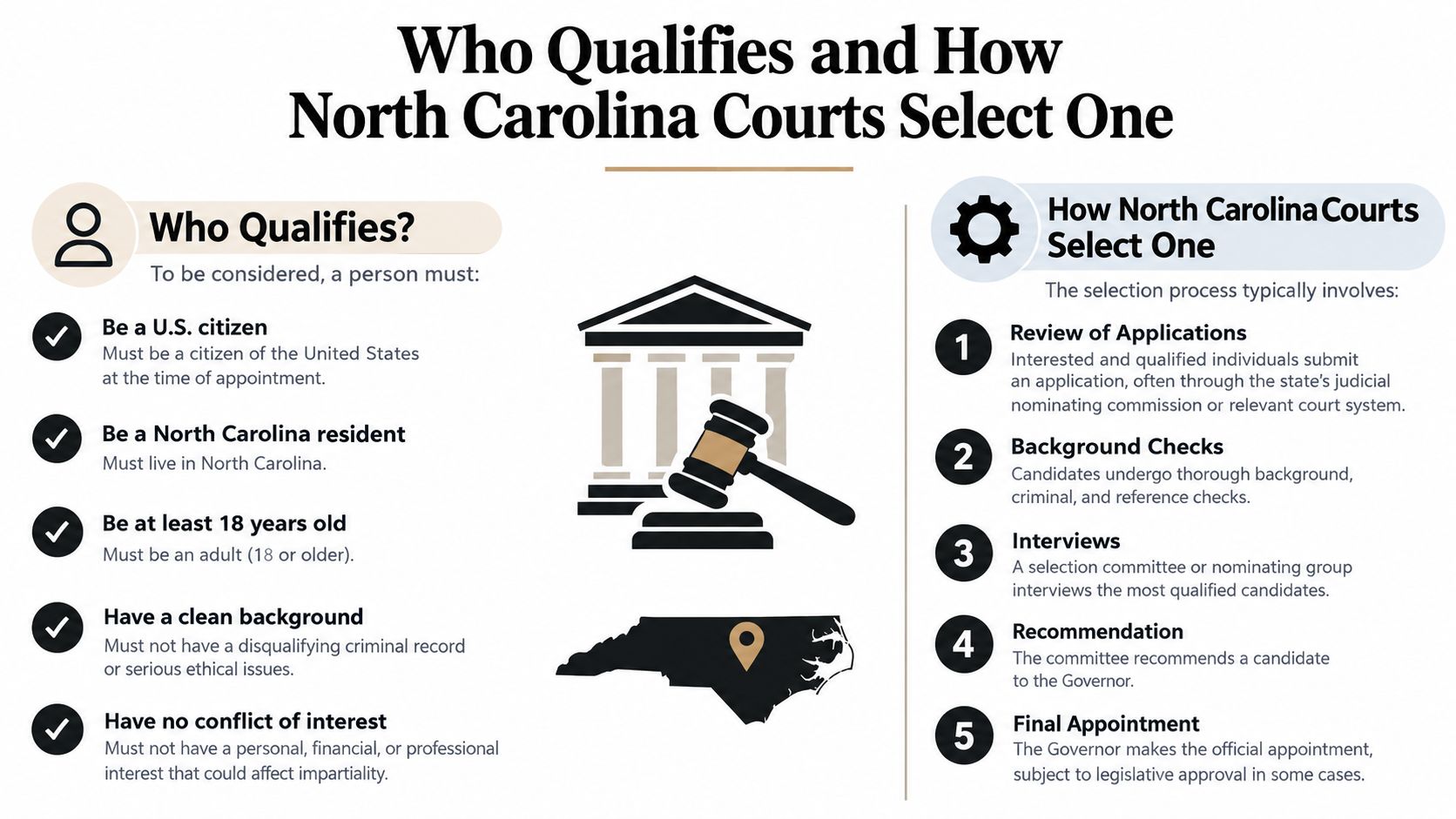
North Carolina doesn't treat parenting coordination as an informal service that anyone may provide. The law creates a formal selection system. The coordinator must come from a district-court-maintained list, and the court, attorneys, or parties must contact the proposed coordinator before appointment to confirm that the person is willing and available to serve.
That preliminary contact matters for practical reasons. A proposed coordinator may not be available, may not be able to accept the appointment, or may not be appropriate for the particular family. Parents should avoid assuming that the first name mentioned in a courtroom or email is automatically the final selection.
Qualifications are part of the process
State university materials referenced in the statutory framework explain that coordinators must have:
- Related experience: At least five years of related post-degree experience.
- Professional license: A current North Carolina license in the person's area of practice.
- Specialized training: Twenty-four hours covering child development, high-conflict family dynamics, the effects of divorce, problem-solving, mediation, and legal issues.
These requirements are described in the North Carolina parenting coordinator qualification provisions. They give parents a concrete basis for evaluating a proposed coordinator instead of treating selection as a purely personal preference.
What parents can do before appointment
A parent and attorney can ask practical questions before agreeing to a person or objecting to a selection:
- List status: Is the person on the district court's maintained list?
- Professional background: Does the person's licensed practice fit the family's needs?
- Conflict concerns: Does the person have any relationship with either parent, a lawyer, or a witness?
- Availability: Has the person confirmed willingness and availability to serve?
- Order language: Does the proposed appointment order clearly describe the coordinator's authority?
Parents should distinguish between a legitimate concern and a general dislike of the process. An objection based on qualifications, availability, a conflict, or the limits of the proposed order is more useful than stating, “I don't want this person.”
A custody evaluation is also different from parenting coordination. Parents who need to understand that distinction can review the North Carolina custody evaluation process. An evaluation addresses a different type of court-related inquiry, while coordination concerns the implementation and clarification of custody arrangements within statutory limits.
The appointment process remains court-centered. The court selects from the applicable list, confirms that the proposed coordinator is willing and available, and enters an order defining the authority. A parent who participates in selection discussions should remember that the coordinator is not the parent's advocate. Each parent needs independent advice about whether the appointment is appropriate.
Requesting Appointment and What the Order Must Say
A request for parenting coordination usually begins with a motion or another formal request presented to the court. The request should identify the existing custody order, describe the continuing disputes, and explain why a coordinator would address those disputes within the child's best interests. If the parents agree, their agreement can be presented for the court's consideration. If one parent objects, the requesting parent must be prepared for the court to examine the statutory findings required for a non-consensual appointment.
The appointment can happen after a custody order has been entered. That means a parent doesn't necessarily need to wait for a new custody trial just because the existing order has become difficult to implement. The parent still must show why the appointment is appropriate under the facts and the statute.
The appointment conference and hearing
The court, lawyers, or parties must contact the proposed coordinator to confirm willingness and availability before appointment. The court may also require an appointment conference as part of the process. A self-represented parent should expect to explain the conflict pattern, identify the relevant provisions of the custody order, and respond to questions about the proposed coordinator and the cost of the appointment.
Bring the current custody order, any proposed appointment order, and organized examples of the disputes. Avoid presenting every angry message without context. A shorter, dated explanation of recurring problems may help the judge understand whether the issue is truly a high-conflict implementation problem or a disagreement that requires a different remedy.
The order is the boundary
The appointment order should define the coordinator's authority with precision. Counsel commonly address provisions such as:
- Scope: Which types of disputes may be presented to the coordinator.
- Term: When the appointment begins and what event or date ends it.
- Fees: How the financial responsibility is allocated.
- Communications: How parents submit issues and exchange information.
- Decisions: How written decisions are delivered to parents and attorneys.
- Court review: How a parent may seek judicial review when a decision is outside the coordinator's authority or not in the child's best interests.
A vague order can create new disputes because each parent may interpret the coordinator's role differently. A carefully drafted order gives the coordinator a workable assignment and gives both parents a clearer standard for deciding whether an issue belongs in coordination or in court.
A parent who is representing themselves should read every sentence of the proposed order before the hearing. If the language allows the coordinator to address “all parenting issues” without meaningful limits, ask what that phrase includes and whether it conflicts with the court's exclusive authority over fundamental custody, visitation, and support.
What a Parenting Coordinator Can and Cannot Decide
This is the most important distinction in the parenting coordinator process. The coordinator may address matters that help enforce or clarify the custody order, including disputes not specifically covered by the order and terms that are ambiguous or conflicting. The coordinator's authority is limited to the scope established by statute and the appointing order.
The permitted subjects can include transitions, holidays, transportation, child care, bedtime, diet, discipline, extracurricular activities, and similar day-to-day matters. For example, if the order is unclear about transportation for an extracurricular event, that may be the type of practical dispute a coordinator can address.
The authority line in practice
The court retains exclusive power over core custody, visitation, and support. A coordinator therefore can't use a routine exchange dispute as a reason to transfer primary custody, create a substantially different visitation arrangement, or decide a major child support issue.
| Parenting Coordinator May Decide | Reserved for the Court |
|---|---|
| Clarifying how an existing holiday provision applies | Changing legal or physical custody |
| Addressing transportation tied to the custody order | Restructuring fundamental visitation rights |
| Resolving a defined exchange or transition dispute | Making a fundamental custody determination |
| Applying order language to bedtime, diet, or discipline issues | Deciding child support obligations |
| Addressing child care or extracurricular activity disputes within the order's scope | Entering a major custody or support modification |
| Resolving ambiguous or conflicting terms within statutory authority | Rewriting the custody arrangement as a whole |
A disagreement about a coordinator's decision isn't automatically proof that the coordinator exceeded authority. Suppose a coordinator decides which parent will handle transportation for a school activity because the order contains conflicting transportation language. A parent may dislike that decision, but dislike alone may not justify setting it aside.
The analysis changes if the coordinator orders a permanent change to the custody schedule or makes a support ruling. Those matters may exceed the coordinator's authority because they belong to the court.
Written decisions and enforceability
A decision within the coordinator's scope must be written and provided to the parties and their attorneys. The decision is enforceable as a court order unless a court later finds that it isn't in the child's best interests or that it exceeds the coordinator's authority.
That structure gives the process legal force while preserving judicial oversight. It also means a parent should not ignore a written decision just because the parent disagrees with it. The proper response may be a request for court review, not unilateral refusal to comply.
Costs Duration and Enforcement of Coordinator Decisions
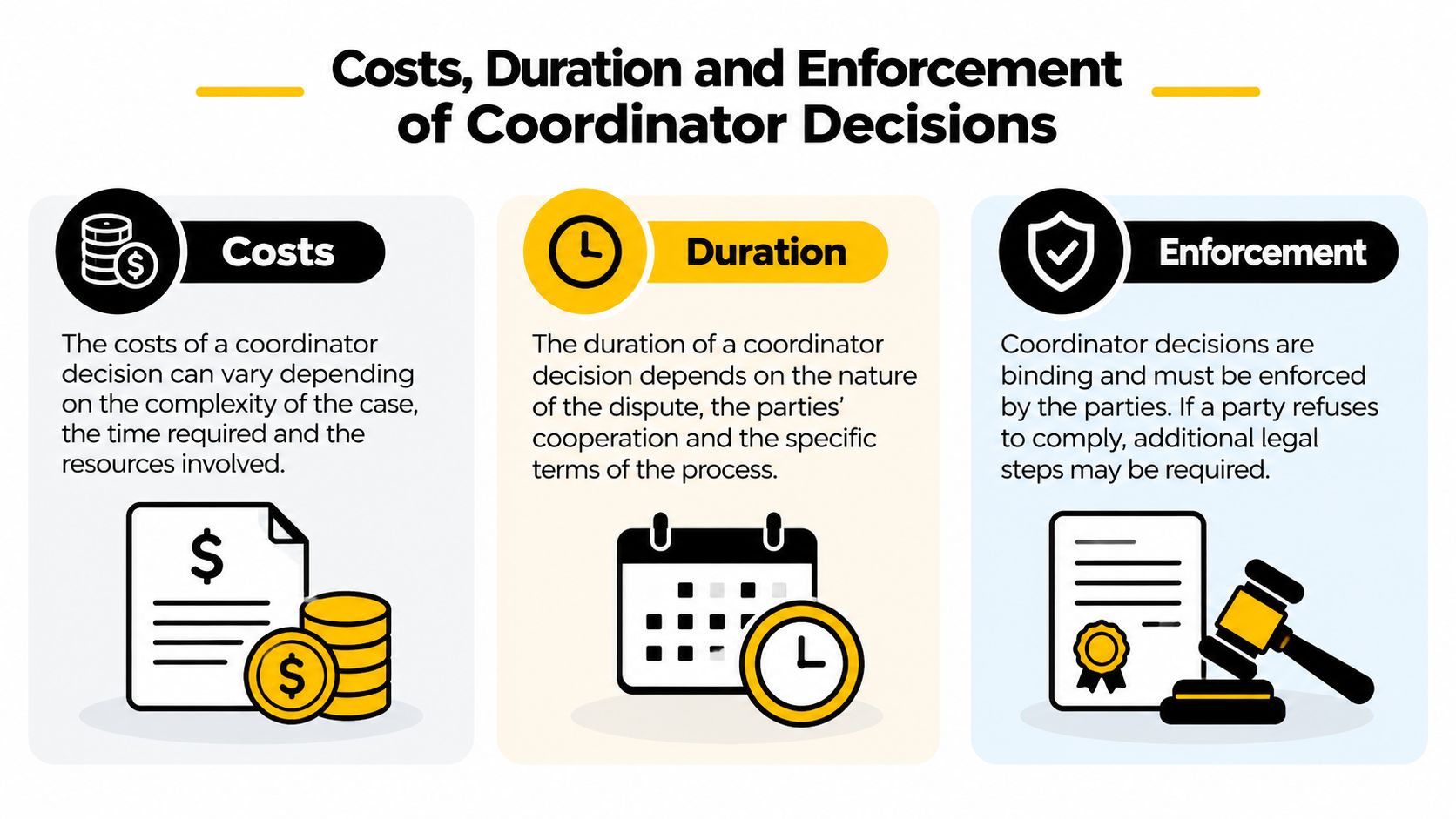
Cost is a central concern, particularly in a case where the parents are already spending money on litigation. A parenting coordinator is a paid professional, not a free court service. In a non-consensual appointment, the court must find that the parties can pay for the coordinator before making the appointment, as reflected in the North Carolina statutory parenting coordination framework.
The appointment order should address how the cost is divided between the parents. The court may set the allocation, and parents can ask their attorneys to address payment responsibility directly in the proposed order. The ability-to-pay finding doesn't mean coordination is financially comfortable. It means the court must consider whether the parties can bear the cost before ordering a non-consensual appointment.
Duration depends on the order
North Carolina's framework doesn't create one universal appointment length for every family. The appointing order defines the appointment's terms, including its scope and duration. Parents should look for a clear start point, an end point or review mechanism, and a process for asking the court to change the arrangement if circumstances change.
A defined appointment can prevent uncertainty. If the order says the coordinator may serve only for a specified period or until a stated review, the parties know when they can evaluate whether coordination is still necessary. If the order is open-ended, a parent may need to return to court to seek modification or termination.
What enforcement looks like
When the coordinator issues a written decision within the authorized scope, the decision is enforceable as a court order unless a court later sets it aside on the statutory grounds. A parent who ignores it may create a new enforcement problem instead of resolving the original dispute.
If the other parent refuses to follow the written decision, collect the decision, the delivery record, the relevant custody-order language, and evidence of noncompliance. An attorney can evaluate whether to seek enforcement in court. Information about enforcing an existing custody arrangement is available through North Carolina custody order enforcement guidance.
Parents can also make the appointment more productive by keeping communications focused on the child, submitting only issues within the order's scope, and following the coordinator's communication procedures. A coordinator can't eliminate every disagreement. Clear submissions and compliance with written decisions can help prevent a limited dispute from expanding into a broader legal conflict.
Challenging or Modifying an Appointment
A parent may object before the court appoints a coordinator. The objection should address the legal and factual basis for refusing the appointment, not just the frustration of being asked to work with a neutral professional.
Potential issues include whether the case is genuinely high-conflict, whether appointment serves the child's best interests, and whether the parties can pay for the coordinator. A parent may also raise concerns about whether the proposed person came from the district-court-maintained list, whether the person is willing and available, or whether a conflict affects neutrality.
Challenging the scope or a decision
After appointment, a parent may ask the court to modify the appointing order if the scope is unclear, too broad, or no longer fits the family's circumstances. The request should identify the specific language creating the problem and propose a narrower alternative.
The statute says the coordinator may only address compliance with the custody order, disputes not specifically covered, or ambiguous or conflicting terms, and the court retains exclusive power over fundamental custody, visitation, and support. That limitation is stated in North Carolina General Statute Section 50-92.
Consider a parent who believes a coordinator overstepped by deciding that the child must permanently spend school weeks with one parent. If the decision changes fundamental custody rather than clarifying an existing provision, the parent may have a legal basis to seek review. By contrast, a parent who merely dislikes a transportation decision that falls within the order's scope may have a disagreement, but not necessarily grounds to overturn it.
A court may set aside a coordinator's decision if the decision isn't in the child's best interests or exceeds the coordinator's authority. A parent should continue following the decision unless and until the court provides different direction, unless an attorney advises otherwise based on an urgent legal or safety issue.
Frequently Asked Questions About Parenting Coordinators in NC
Can I be forced to use a parenting coordinator if I never agreed to one?
Potentially, yes. North Carolina law allows a non-consensual appointment when the court makes specific findings that the case is high-conflict, appointment is in the child's best interests, and the parties can pay for the coordinator. A parent who objects can present evidence and legal arguments at the appointment stage, including arguments about the level of conflict, ability to pay, selection, and the proposed scope.
Can a parenting coordinator change my custody schedule?
A coordinator can address limited scheduling questions when doing so enforces or clarifies the existing custody order. The coordinator can't exercise the court's exclusive power over core custody or visitation by creating a substantially different custody arrangement. If a decision appears to change the basic structure of custody, have an attorney compare the decision with the appointing order and seek court review when appropriate.
Who pays the parenting coordinator in North Carolina?
The court must find that the parties can pay before ordering a non-consensual appointment. The appointment order should address how the cost is allocated between the parents, so payment responsibility isn't left unclear. Because the coordinator is a paid professional, parents should consider the financial terms before agreeing to an appointment and should raise ability-to-pay concerns if they oppose one.
Can I fire or replace the parenting coordinator if I disagree with them?
Disagreement with a decision doesn't automatically establish grounds to remove or replace the coordinator. A parent may raise specific concerns about authority, qualifications, selection, availability, conflicts, the scope of the order, or whether the process is still appropriate, and may ask the court for relief. The court, not one parent acting alone, controls the appointment and any modification of the appointing order.
High-conflict custody cases are exhausting, particularly when every exchange or school event creates another dispute. Deciding whether to request, accept, or challenge parenting coordination is a strategic choice based on the existing custody order, the history of conflict, the child's needs, the proposed coordinator, and the financial terms.
A consultation with a North Carolina family law attorney can include reviewing the current custody order, evaluating whether the case may meet the high-conflict standard, identifying potential coordinators on the district list, and drafting or contesting an appointment motion. The Law Office of Bryan Fagan serves families across North Carolina and can discuss the legal options that may apply to your circumstances without guaranteeing a particular result.
The Law Office of Bryan Fagan can review your custody order, explain the limits of a proposed parenting coordinator appointment, and help prepare or challenge the related court papers. Schedule a consultation to discuss your North Carolina custody situation, the authority line at issue, and a practical path forward.